In 2017 I visited my mate Paul in Rhodes. I wrote a short post about how disappointed I was to find that there had been no guns at Navarone Bay. It’s been my most visited post, but I don’t really know why. I can only think that when someone remembers the film The Guns of Navarone and Googles it, my post comes up. Here’s the link if you’d like to join the crowd.
On the other hand, if you’d like to read something more informative and edifying, check out my books here.
Some people plan their life trajectory. For me, serendipity has often trumped planning. How else did I find myself unexpectedly signing up to an Arabic degree more than fifty years ago? Recently I began to ask myself how half a century of knowing Arabic has shaped the way I think and feel. How different has it made me from the person I might have been if I’d never taken this path?
It was 1971, and I’d applied for a languages degree at the Polytechnic of Central London (now the University of Westminster). The Russian interview went well; I could only offer a GCE ‘O’ Level, but Russian wasn’t widely studied in the secondary education system at that time. I had a GCE ‘A’ Level in French, but they were two a penny in the UK. Sorry, the French lecturer sniffed, your grammar’s not good enough; try the Arabic room down the corridor, they start from scratch.
The Head of Arabic sat in an empty classroom staring out over the roofs of Bloomsbury: I was signed up in minutes for a journey that would shape the rest of my life. For most of my adult years, Arabic and Arab culture have been embedded in my mind, helping to shape my world view, my scholarship, my values. In signing up on that day in 1971, I joined an exclusive club of English speakers who know something about the world of the Arabs from the inside, rather than through the smeared lens of ignorance, prejudice and habituated racism. I find it impossible to imagine a me who didn’t wander into that classroom in 1971.
I’d had a messy flirtation with Arabic in 1969. After leaving school at sixteen, I stumbled into a civil engineering traineeship which ended with me failing my maths exams three years in a row. Freshly unemployed, I headed for Gibraltar and picked up a job driving a grocery van with a crew of Moroccans. I spoke schoolboy French with them, but I was fascinated by their throaty Arabic. I bought a copy of Teach Yourself Arabic and slogged through the chapters for a couple of weeks, but there was no connection between what the book said and what my Moroccan buddies said. Much later I learned that the Moroccan Arabic dialect is pretty well incomprehensible to anyone but Moroccans, and that the high-flown language of Teach Yourself Arabic isn’t used by van drivers.
Arabic installed itself in my mind quite differently from the way that French or Russian did. I learned French at school between the ages of 11 and 15. As soon as I arrive in France or New Caledonia, I open my mouth and bad French pours out based on prepubscent rote learning.
I studied Russian alongside Arabic from age 20 to 25, but while Arabic dazzled me, learning Russian was like pouring grey sand into a holey bucket. It seemed to need ten times more effort to find places in my head where it would stick. Cyrillic script looked like a row of Soviet era radiators, unlike the dramatic flourish of Arabic. Beyond the teaching staff you never met a Russian in the Polytechnic cafeteria. Poor, unattractive Russian was trapped inside cheap Soviet textbooks. But in 70’s London you met with a whole stream of Arabs – Lebanese communists, Yemeni poets, Libyans on Gaddafi’s big oil scholarships. You went to parties with Arabs in their expensive flats on the Edgware Road. Russian didn’t stand a chance.
And unlike Russian, Arabic words entered my brain dressed up in their own colourful costumes, where they had a jolly time mixing with new friends – words like Al-Urwah Al-Wuthqa, ‘The Firmest Bond’, the title of a short-lived Egyptian revolutionary journal that was key in initiating the Arab revival of the late nineteenth century. My teacher mistranslated it as ‘the reliable handle’ and I have used it for decades to describe useful household items like spanners (Wow, I bought a real Urwah Wuthqa at the hardware store today). A Libyan taught me a filthy poem in high-flown Classical Arabic that I can still reel off. I knew a Tunisian girl called Buthaina, and learned that her name is a slang word for pussy cat. I have a habit of commenting on Arab names when I watch TV. That guy’s name means ‘glory of the religion’, I might mutter. Then I remember the Arabic saying al-asmaa’ laa tu’allal, ‘names are not to be explained’, told to me by a man whose name meant ‘war sparrow’.
Thus Arabic poured into me, along with a jumble of memories, associations, emotions, stories, relationships, people, and images.
The aesthetic of the east was part of the attraction of Arabic: In my mind, the Arab World belonged to the exotic and sensual Orient – alongside India, joss sticks, flowing robes and sitar music – that coloured my generation in the late sixties. If I’d been offered a course in Hindi or Bengali that day at the Poly, I’d probably have taken it. It would be eight years until Edward Said would challenge the West to examine the underbelly of its relationship with the East and to frame a postcolonial conception of East-West relations. Not even the Beatles were spared postcolonial scrutiny; was their appropriation of Indian culture imperialistic, just dressed in psychedelic garb? I unconsciously modelled this worn-out worldview: I was doing the Arabs a favour by learning their language. In 1973, I was proud when an Egyptian journalist gave me a book of his inscribed in Arabic ‘to the orientalist Stuart Campbell’. I groan at my naivete now.
The inner workings of an immature psyche aside, it was the sheer alien complexity of Arabic that got me hooked, from the sweeping right-to-left script, the mad plug-in word-building system, and the pharynx-bending phonetics. Our Egyptian lecturers utilised a traditional classroom method of slog, repetition and memorisation with minimal use of English. The core materials were a kind of cultural studies curriculum strongly infused with the long-forgotten creed of Arab Socialism, handwritten and printed on a Roneo machine. The early texts had two sentences per page in big handwriting, the fourth year ones were on a par with newspaper Arabic. Our job was to memorise it all – hundreds of word roots, jagged morphological patterns, unpredictable plurals, alien sentence constructions, unexpected semantic frameworks, none of it remotely like the European languages we had learned at school. It was pure slog, every spare moment with nose in notebook memorising, self-testing, silently chanting like an acolyte in an occult sect.
I quickly cracked the Arabic dictionary code: You don’t look words up alphabetically by the first letter; you search the word for its three-consonant root and look up the root, under which the whole word family is listed. I’m on my second Hans WehrArabic-English Dictionary, the first of which ended up stuck together with gaffer tape until it disintegrated after twenty years of look-ups. The Arabic dictionary is as much a learning tool as a reference tool; it’s impossible to look up a word without mentally evoking – and reinforcing – the grammatical rules needed to search for it. I didn’t realise how the Hans Wehr had become almost an extension of my psyche until I opened it last year and found that my eyesight had deteriorated so badly that I couldn’t read the tiny text; I was so distraught that I brought forward my cataract surgery.
Writing Arabic entailed less mental rewiring than I expected. I dimly recall copying loops and lines from right to left, but I must have learned so quickly that few traces remain. I have a completely unscientific intuition that there is something more ‘natural’ about writing in Arabic. Writing in English entails a contradictory ergonomics: Maintaining a horizontal progress using an up and down sawtooth motion. Arabic entails a horizontal sweep interrupted with loops and ticks. It feels fluid, liquid, relaxed to write – as you might expect from a script that was traditionally written with a reed pen rather than chiselled into stone.
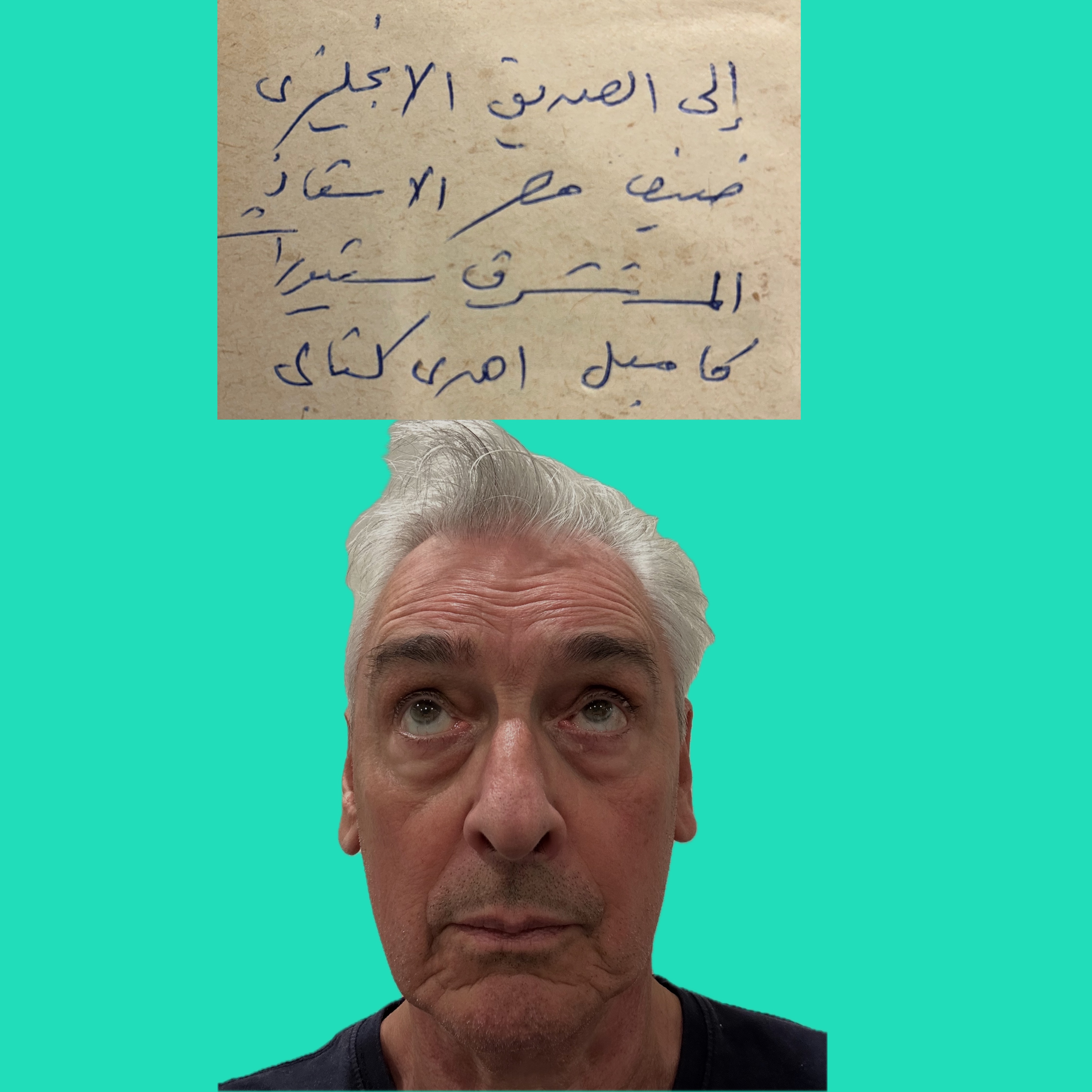
There are delicious stylistic features such as kashida, a kind of kerning that emphasises the horizontal sweep of Arabic: A word can be stretched across the page as in Figure 1, where both words contain a kashida, indicated by the curved sweeps.
Fig 1.
The elegance and ease of writing Arabic is, however, contradicted by the difficulty of reading aloud: Arabic script mostly omits short vowels, leaving it up to the reader to work out the pronunciation. The exceptions include the Qur’an and some language learning materials, where short vowels are indicated. But as you steadily absorb word patterns and grammatical rules, the opacity of vowelless script clears. Nevertheless, reading errors abound even for native speakers, and purists delight in spotting mistakes. A Lebanese friend who used to read the evening news on a Sydney Arabic radio station always received corrections from indignant listeners the next morning.
The challenge of reading aloud leads to the broader topic of learning to speak Arabic. For me there were two salient issues: The phonetics of Arabic and the dialect problem. Foreigners often describe Arabic as ‘throaty’. The phonetics component of the Polytechnic’s mandatory linguistics strand explained in scientific terms what ‘throaty’ meant. In no time I revelled in being able to produce pharyngeal fricatives and uvular stops. There was an immense satisfaction in performing these phonetic tricks, especially executing tongue twisters, or more accurately throat twisters.
But even with authentic pronunciation, gaining fluency was a challenge. The speaking part of our course focussed on reading aloud, and our model was the oratorical style of our male teachers. Amazingly, it is only at my keyboard today that I realise that no woman ever spoke to us in Arabic at the Poly. I based my speaking style on the Egyptian chaps so that I sounded like those newsreaders with moustaches who pump out the party line on TV in dictatorships.
I had anticipated the dialect issue. In fact, some months before our class went off to study in Cairo, I led a delegation of students to request that the Poly offer some teaching of Egyptian dialect before we departed. We were assured that we would ‘pick it up’, but the staff were uncomfortable with the idea that a low status dialect might have grammatical rules.
After two years at the Poly, we were sent off to Egypt with vague instructions to report to a certain Professor at Cairo University (in contrast to modern study abroad programs that entail detailed risk analysis and in-country fixers). My wife and I arrived at her Armenian grandmother’s boarding house in central Cairo to find that the lady had gone shopping. The gentleman boarders were amused and intrigued at meeting an Englishman who knew Arabic. They called in a student who lived in the block; he would take us out to look for Madame. Here, I quote from my memoir Cairo Rations:
We went from shop to shop while the student practised his English on us. I was expecting him to be interested and flattered … that a British student had gone to the trouble of studying his language and his culture. Instead, he questioned me brusquely about why I was in Egypt, eventually becoming quite sarcastic and tossing in terms like ‘imperialist’ and ‘invader’.
Madame was eventually found. She didn’t speak English, so I barked at her in my Egyptian lecturer fashion but immediately sensed a horrible dissonance. This weird alpha male persona wasn’t me! And Madame spoke back in Egyptian dialect, not newsreader Arabic!
My dialect fluency peaked in 1974 due to the demands of living in a country at war – queuing for ration cards, being chased in the street as a suspected Israeli spy, being detained and questioned by police.
This incident with the angry student was an epiphany, a signal that there was a fatal crack in my thinking and that of my generation. When Edward Said blew the lid off Orientalism five years later, I’d already gained a deep understanding of anti-Arab racism in its many forms, both subtle and explicit. But Said’s writings helped me recognise that in 1973 I had stood at the confluence of two intellectual streams – the old Orientalism that infantilised the Arabs, and the postcolonial era that exposed the West’s racist condescension. In later years I did research on anti-Arab attitudes in the Australian press, and wrote the Siranoush Trilogy of espionage novels that challenged the ‘bad Arab’ trope that infests popular literature and film.
While studying Arabic helped form my worldview, it also opened unexpected doors to academic research – serendipity again. A relative gave me an archaic-looking illustrated manuscript in Arabic script: “I got this in Saudi Arabia. You might find it interesting.” It was actually in Persian, replete with Arabic loanwords, but I noticed an anomaly in the spelling of some of the nouns. By chance, I was doing some work on Indonesian at the time and was surprised to find the same Persian spelling anomaly in the borrowed Arabic words in Indonesian and Malay. According to indigenous scholars, the Arabs who brought Islam to the Malay world sailed straight from Arabia. Then how did the Arabic words acquire Persian spellings? Over the next few years, I developed and published an account showing that Arabic words entered the Malay world in three historical layers, one of which was Persianised. This work was a major historiographic advance that is unchallenged to this day.
Today, the impact of Arabic on my life is evident from my curriculum vitae: A career in teaching and researching Arabic linguistics and Arabic translation; senior university roles; a string of PhD students, most of Arab background; books and refereed journals. But how has Arabic contributed to my worldview? How am I different from a Stuart Campbell who might never have taken those few steps down the corridor?
I’m fairly sure that the political and social consciousness of my alter ego would have aligned with the real me: The Cold War, Vietnam and the Palestine conflict shaped the foundational thinking of many of my generation. But the extra element conferred by Arabic is an enhanced insight into the Arab world. It’s the ability to look behind the English language news media about the Middle East because you can read the Arabic press; it’s the ability to bypass the slipshod and stereotyped characterisation of the Arabs because you’ve known and worked with so many of them; it’s the ability to watch a TV interview with an Arab politician or a Syrian refugee or a Dubai Bling star, and decode the signals that the translation won’t give you: What does the accent tell you about the speaker’s origins and class? How is the level of language formality shaping the message? What does the person’s name tell you about their background? How do they address the other speakers and why do they use this or that form? How often is God evoked, and what does that tell you about the speaker’s emotional state? What does that place name mean, and what glories and tragedies are infused in it? What does that graffiti mean?
I was always intrigued in Cairo by the way that people in the street addressed me. My favourite was bash muhandis, ‘chief engineer’. For me, this evokes a whole set of questions – what sort of person would address me thus, why is there a Turkish element in the expression? And how I would address the person back?
That’s the kind of thing that sticks in your head after you wander into a room and sign for a fifty year stretch.
###
If you want to read more of my writing check here to find out about my short stories and novels.
This short story was written for my Free Shorts project, which culminated in a twelve-story collection , which is itself entitled The Afternoon of the Jackal. In 2025, I’m releasing one of the stories each month free on my website. Happy reading, and please leave a comment to let me know if you enjoy my work.
***
“Those jeans look bloomin’ ridiculous,” Dad said. This from an overweight middle-aged man in a Santa hat and a yellow T-shirt with PROUDLY MADE IN THE UK on it. Okay, so maybe that extra rip around the butt was a bit too revealing. I offered to carry the wine when we got out of the Kluger, and let the two-bottle cooler hang over the gash in the denim. Mum went ahead bearing the bowl of home-made tabbouleh she brought every year, great-granny’s special Armenian recipe of course.
“And don’t curl that lip, Missy,” Mum said without even looking back to see my expression. Sure, I’d made a slight fuss about going to Uncle Gary’s Boxing Day barbecue. I mean, I’m sixteen next month, I’ve got a life of my own, things to do, stuff Mum and Dad wouldn’t have a clue about. And it’s so far, way up on the Northern Beaches on the other side of Sydney.
We go to our uncle’s place every Boxing Day. He’s actually called Garo, but Dad is genetically incapable of pronouncing foreign names, so he relabelled Mum and her brother years ago. Mum’s really called Serpouhi, which isn’t exactly hard to say, but Dad can only manage Sophie.
Anyway, every December 26, me and my cousins have to sit around the patio table in the heat drinking soft drinks while the adults get jolly and bang on about mortgages and TV programs and real estate prices and cholesterol and Jimmy Barnes. I’d planned to go to a party with my friends, but Dad said Uncle Gary would be hurt if I didn’t come this year, especially since his partner Derek had passed away last January.
So I did come after all, which was why I didn’t appreciate Mum’s comment because I was definitely not curling my lip. What changed my mind was the news that Uncle Gary had got married to a guy from Scotland.
Yes, married.
My cousin Ruby phoned me the week before and told me about it and how the husband was young and hot. But Uncle Gary’s old and fat, I said. Yeah, weird, Ruby said, but can we just say he’s got a larger build, you know, not f-a-t. Ruby’s studying psych at uni, and she’s always banging on about triggering words as if I’ve never heard of it.
I asked Mum and Dad about Uncle Gary over breakfast, and they said oh didn’t we mention it? No, I said with maximum offended dignity. Anyway, I said, curiosity winning over dignity, what do you guys think about it? Then they went all ‘each to his own,’ and ‘it’s not for us to judge’ but I knew they were busting to see the new crush.
Uncle Gary and Derek had been a family fixture since before I was born, and the story behind the Boxing Day barbecue (also a fixture since before I was born) was that since Mum’s brother was a bachelor and didn’t have any kids to spend the day with, we were ‘good company’ for him. Mum said ‘bachelor’ as if it was a box with a ghastly secret inside, like when people say ‘cancer’ and you have the horrors imagining tumours on their eyeballs or wherever. I remember Dad talking to a friend about Uncle Gary and them both sniggering when the friend asked if he was a confirmed bachelor. As the years went on, it gradually dawned on us kids that Gary and Derek were more than bachelors, but woe betide anyone who mentioned the ‘gay’ word to Mum. One year, my cousin Jackson – he would have been eight – asked out loud if Uncle Gary was a poof, and everyone suddenly found something loud to say: More of that lamb? Pass the Cab Sav. Goodness, it’s thirty-two degrees, usually rains over Christmas.
So this Boxing Day barbecue doubled up as the regular gathering plus the Scottish husband’s debut, not that anyone actually said that he’d be presented to the family; we just all knew. The honeymoon, we heard, had been in Goa, which was doubly weird since Uncle Gary and Derek used to drive to Noosa for their holidays, although Derek travelled overseas a lot for his work.
As we walked up the path to the front door, Mum was all fake brightness and Dad had huge armpit sweat stains. It struck me that the garden looked a bit tatty. Uncle Gary’s place was nestled in a subtropical suntrap on a cliff overlooking the beach. Derek used to keep the lush plants immaculately pruned, but now there were fat spiders hanging on webs between the yellowing leaves and gone-to-seed blooms.
The rest of the clan were there – about fifteen now that we three had arrived. I spotted Ruby chugging a beer on the back patio. She waved and nodded at the beer bottle; she’d sneak one out for me later. A stranger was turning kebabs on the barbecue – it must be a caterer, although Uncle Gary usually did the cooking himself on Boxing Day. When the guy turned and waved, I realised it was my uncle, not in his usual billowing kaftan, but shorts and a T-shirt. He must have lost thirty kilos.
Everyone seemed to be busy setting the table and avoiding looking at Uncle Gary or the back garden. So where was the Scottish hottie? Uncle Gary gave me a skinny hug while I did a recce over his shoulder – no sign.
“You’ve grown, let me see you, so beautiful.”
I did a cute pose. “And you, Uncle Gary, you’ve …”
“Shrunk,” he said, and we both laughed.
“That lamb smells good,” I said.
“I’ve done some of those English pork sausages for your dad.” We laughed again.
Ruby popped out from behind a gazebo. She flipped the tops off two beers and beckoned me onto the terrace leading to the pool on the next level.
“Look.”
We sat under the palms to watch the man sunning himself prone by the pool.
“That’s Romeo,” Ruby whispered.
“Is that his name, Romeo?”
“No, you dill. He’s Edward. Romeo’s like in Shakespeare.”
“Right, so Uncle Gary’s Juliet?”
“Shut up. He can hear us.”
The man was in perfect shape – muscular but not pumped, smooth golden skin, close, wiry black hair. He wore tiny red bathing shorts – hardly more than a G-string.
“Oh my God. What a waste.” Ruby swigged on the beer. I’d drunk half of mine too fast and was feeling slightly woozy on an empty stomach.
“Fuck, yeah,” I said, and then felt a bit stupid because Ruby had a thing about not using the f-word casually: It’s a weapon. Use it sparingly. Make it fucking count.
Uncle Gary’s Chinese lunch gong rang – another annual fixture.
Romeo stirred, turned on his back. He was brutally handsome, in his late twenties maybe.
“Don’t stare,” I whispered.
“I’m appraising.”
He looked at us both with a glassy expression and slipped into the pool, swimming rapid laps, smoothly and effortlessly like a dolphin.
We ran up the steps to the long table on the vine-covered terrace. A sea breeze took the edge off the noon heat. Mum was freshening up the tabbouleh, which was looking limp after an hour and a half on the back seat of the car.
An empty chair highlighted the new husband’s absence.
“Will I fetch Edward from the pool?” Mum asked. “I expect he’s hungry.”
Uncle Gary looked up from serving the kebabs. “He’ll be up in a minute. Just getting dressed I should say.” Ruby frowned at me. I shrugged my shoulders.
But Romeo didn’t come. The atmosphere was fragile. Mum kept looking towards the pool area. Dad attacked his British sausages and launched into a long story about the warranty on his new mower.
Gone was the jocular banter of past years. Uncle Gary used to be an architect and Derek had been a professional violinist, and they would entertain us with a ping-pong of affectionate digs and well-rehearsed anecdotes throughout the meal, with Dad trying to outdo them with lead balloon rejoinders that were so bad you wouldn’t waste breath groaning at them. The couple had been complete opposites: Derek small and dapper in crisply pressed whites and tinted glasses, Uncle Gary portly and dishevelled. They used to play really cool old school music over the outdoor sound system – jazz, I suppose. But this year it was just the clink of cutlery mixed up with people saying jeez and wow at Dad’s mower warranty story.
On the way home last year, Mum, a bit relaxed after too much prosecco, had said to Dad, “Do you think they, you know, do it?” Dad laughed: “I doubt if Gary can locate the wherewithal.” I just pretended I hadn’t heard. It’s so embarrassing when they talk about that kind of stuff. What I did know was that Derek and Uncle Gary loved each other, not like Mum and Dad, who just seem to put up with each other.
Dad’s story ended at last, and everyone stared at their plates while Mum tried to drag information out of her brother.
“Where did you and Edward meet?”
“Oh, it would have been online as far as I remember.”
Dad put on his ‘how interesting, tell us more’ face, but Mum jumped in with, “And Goa for the honeymoon? It sounds so exotic.”
“A bit more spicey than Noosa,” Dad chipped in and winked at Mum. I hate winking. It’s so gauche. Mum says Dad can’t help it because he’s English, and nobody on her side of the family ever winked because in the Armenian community they have better manners.
Uncle Gary mumbled something about having a good travel agent.
“Oh, absolutely, a good travel agent’s an absolute essential,” Mum forged on, swerving into another conversational lane. “And what does Edward do?”
“Do?”
“For a living, you know?”
“He’s looking around for an opportunity, maybe taking a course or something.”
“But did he have a job before?”
“Oh yes, definitely.”
“What job was that, darling?”
I cringed. Mum saying ‘darling’ means the thumbscrews are coming out.
“He was a dancer.”
“Did you say dancer?” Mum asked, omitting ‘not a doctor or a pharmacist?’
“Yes, a dancer?”
“What kind of dancer, Garo?”
“On cruise ships.”
Mum froze while she processed this bit of information that had no known geolocation in her world view. That’s a big difference between her generation and mine – cognitive flexibility, adaptability to new ideas.
As Mum opened her mouth, Dad jumped in. “Come on Sophie, that’s enough of the third degree. Give poor old Gary a minute to eat his lunch.”
Ruby got us back on track by telling the younger kids to sing a Christmas song, and the adults munched in gratitude. When the brats finished the first song, Ruby started them on another and the atmosphere relaxed because the adults didn’t have to talk. Then it was time for dessert and more fussing with dishes and spoons to cover up the unmentionable absence.
“Oh, here he is at last,” Uncle Gary said with a chuckle I’d never heard before, a bit like when a cute puppy jumps onto the couch. Edward appeared under the entrance to the gazebo, shiny with lotion and almost naked. Dad, who was nearest to him, jerked out of his chair, toppling it into a display of potted orchids. He scrabbled in the pots, righted them, straightened himself up, and thrust his hand out with a booming “How d’you do, Edward”. Mum’s jaw hung open. Ruby peeped at me and smirked. The kids looked up from their ice cream.
Edward ignored Dad, who looked around at us in bafflement, retrieved his chair and topped up his wineglass.
The near-naked man sat down in the empty seat, filled a bowl with pav and ice cream, and hunched over it, slurping with a fist-gripped spoon.
“Haha,” Uncle Gary said, “My diamond in the rough,” at which Mum spluttered something through her ice cream that might have had the word ‘manners’ in it.
Ruby stood up and told the little kids it was swim time and the last one in the pool was a squashed banana. She led the giggling herd out of the gazebo leaving me, Mum, Dad, Uncle Gary, and Edward behind, as well as two sets of uncles and aunts who, sensing trouble, said they were desperate for a ciggie.
With the smokers puffing away in the driveway, Edward scraped his bowl clean and burped. My phone vibrated. I peeped down. Ruby: Keep me posted.
“Well, this is a bit different,” Dad said. We all looked at Uncle Gary.
“I need to explain one or two things,” he said. “Edward, sweetheart, come over here.”
Dad made a choking noise and blew his nose.
Romeo slipped into the seat vacated by one of the smokers. He held Uncle Gary’s hand.
“You see,” my uncle went on, “Things aren’t always what they seem. I know you’re thinking about those lovely Boxing Day parties, and how Derek and I were so smart and funny and happy.”
“You were smart and funny and happy. Weren’t they?” Mum said, looking at me and Dad for agreement. I shrugged. Dad frowned.
“It was all an act.”
Romeo produced some words that sounded like “Ball make widna fract,” and Uncle Gary said, “Yes, sweet boy”.
Dad spluttered, “How was it an act?”
“I hated him. I detested Derek.”
Dad chewed a fingernail. I looked at the baba ghanoush.
“No,” Mum spluttered like a goldfish flipped out of its bowl.
Dad squared his shoulders but Uncle Gary waved his hand before he could say any more.
“Derek was cruel and controlling. He treated me like a slave. Worse than a slave.”
My parents goggled at him, making vague lip movements as if words were trying to come out but hadn’t made their minds up what they should sound like.
“But why didn’t you …”
“Why didn’t I leave, Sophie? He was clever. He made me believe my inadequacies were my fault and that without him I’d be useless and lonely. He used to bring his sleek friends here and flaunt them at me. He was always taunting me for being fat, and the more he did it, the more I ate. I was so ashamed. The kaftan was his idea. The sack of shame, he called it.”
“Well, I’ll be buggered,” Dad muttered, never lost for the wrong word. “Are you sure about all this, Gary?”
Mum waved me down to the pool, evidently fearing I was in acute moral peril. I ignored her. Another text from Ruby: He’s straight. Has to be. Just wants a spouse visa. What’s going on?
I texted under the table: It’s getting weird here.
Ruby replied: Be there in a sec.
Edward now had his arm around my uncle’s shoulder. His glassy expression had turned to deep concern and sorrow. He said something in an accent like chunks of words mixed up with garden pebbles.
Dad stood up and crossed his arms. “Sorry Gary. This isn’t making sense. You’re telling us the bloke you lived with for decades, the bloke you made a big sobbing speech about at the funeral … I mean, we knew him, he was like … y’know, someone we … “
“… liked, trusted,” Mum chipped in.
“… respected,” Dad added.
I stood up and crossed my arms. “It’s called coercive control, Dad. These people can be very manipulative.” This from the girl domestic violence expert who, half an hour ago, was emoting over Derek and Gary’s love and devotion. I’m a fast learner, you have to be in this world, and anyway we’re doing a project on domestic violence in social studies at school right now. Judging from Dad’s angry glare, I should have shut up, but I was saved by Ruby, who glided into the gazebo wearing – but only just – the tiniest bikini in Sydney.
“Edward, we didn’t get introduced properly.” She knelt next to the new hubby with face tilted to receive a social kiss, which was rewarded with the icy stare. Edward muttered more pebbly Scottish words and went back to consoling my uncle. Ruby stood up, stared around at us all completely affronted; nobody ignores Ruby. We looked back, bewildered.
“Well,” Mum said, looking at her watch.
***
On the way home in the Kluger, I put on my headphones and pretended to listen to music while Mum and Dad thrashed out a story to fit the evidence: Maybe Derek hadn’t been quite the angel they thought he was, but Gary was probably exaggerating, after all grief did strange things. Yes, they remembered that Derek could be a bit sarcastic, but then Gary gave as good as he got, well not always, there was that time he walked out on the Boxing Day lunch and didn’t come back, and Derek sniggered that he was having his period. And the kaftan and the weight, who’s to know what goes on in other people’s relationships? And especially homosexuals – after all, it can’t be the same as a woman and a man, can it? (Mum looked back to check I had the headphones on.) As for Edward, he was odd but seemed sincere, although you couldn’t understand a word he said. Takes all sorts to make a world, and it’s a fact that some Scottish people can be surly, but time would tell. If he’d got Gary to lose thirty kilos, he was worth his weight in gold for that alone. Dad thought he’d probably located his wherewithal at last, but it was so weird that a handsome chap like Edward can go off and play with the other team. Still, look at poor Ruby and the deadheads she finds on her apps, like that artsy fartsy one she’s living with, all Ned Kelly beard and quinoa and almond lattes. Mind you, it wasn’t exactly fun this year. Maybe now that Gary has Edward, they’ll go away next Boxing Day and we can do something different.
When we got home I went to my room. Ruby called.
“Did you see the look on his face when I bent over?”
“What look?” I asked.
“Male gaze on steroids. When I dropped my bag. The hungry jackal look. I tell you, he’s a fake. The evidence is in.” She made a growling noise.
“Evidence? What evidence?”
“It was an experiment, to see how he’d react. You saw his face.”
“Yeah, I suppose,” I said. An experiment? A girl dropping her bag in front of a guy?
Ruby went on, all fired up. “Maybe someone should tell Uncle Gary. He deserves to know, doesn’t he?”
I wasn’t quite sure about this, even though Ruby’s knows a lot of psych. I also felt slightly uncomfortable about the way she bent over when she pretended to drop her bag. I mean there are times when it’s OK to be a bit over the top, but the way she did it was just embarrassing with Mum and Dad and Uncle Gary all there. And then twisting around and looking straight at Edward.
Ruby’s embarrassing performance wouldn’t shake itself from my thoughts. I lay awake that night replaying in my mind what I’d seen as we were leaving: Edward hanging back while we farewelled Uncle Gary. Dad giving Uncle Gary a giant handshake, Mum hugging her brother. Dad launching in Edward’s direction with an outstretched hand and changing his mind and retreating at the last moment. The more I replayed it, the clearer it became. They all stood around for half a minute saying, “Well, then,” and “That was lovely,” until Mum said to Dad, “Hit the road, Jack.” We all laughed, and that’s when Ruby did her thing. I remember looking towards Edward at that moment; he frowned at Ruby bent double, looked up at me and gave me a really nice wink. I felt this connection, like he was an older brother.
The bit about Ruby’s experiment was bugging me too. I mean, you might do something like that as a sort of test, but calling it an experiment seemed over the top. So I did a search and came up with Single Subject Experiments in psychology, which had nothing to do with what Ruby did, and I came to the conclusion that just because she’s doing psych at uni, she’s actually a bullshitter.
###
If you enjoyed this story, you can find details of my books here.


 Stuart Campbell author