These twelve stories, set mostly in Australia and Britain, lead the reader through irony, black comedy and the weirdly unexpected towards truths at the very heart of humanity.
You may know me as an author of novels like The Siranoush Trilogy and An Englishman’s Guide to Infidelity . With this new book, I’ve now turned to the short story genre: A defeated man stows away on a cruise ship. A woman prefers to be a bird than a human. A nineteenth century scholar discovers a deadly Nirvana. A wife decides to redesign her brain damaged husband. A school reunion revives an unlikely friendship.
The story behind the stories
In 2023, I challenged myself to unbung the writer’s block that struck me during COVID: I would learn to write short stories. I spent much of 2023 reading short story authors in order to crack the code. As I drafted stories, I emailed one a month to a group of about thirty readers and friends during 2024. I called this the Free Shorts project. I used reader feedback to fine-tune the twelve stories, which are now published as this collection. Along the way, three of the stories were recognised in writing competitions in Australia and the UK.
I hope you enjoy these stories, which you can find in ebook and paperback on Amazon here.
And don’t forget to check out my other books here. Happy reading!
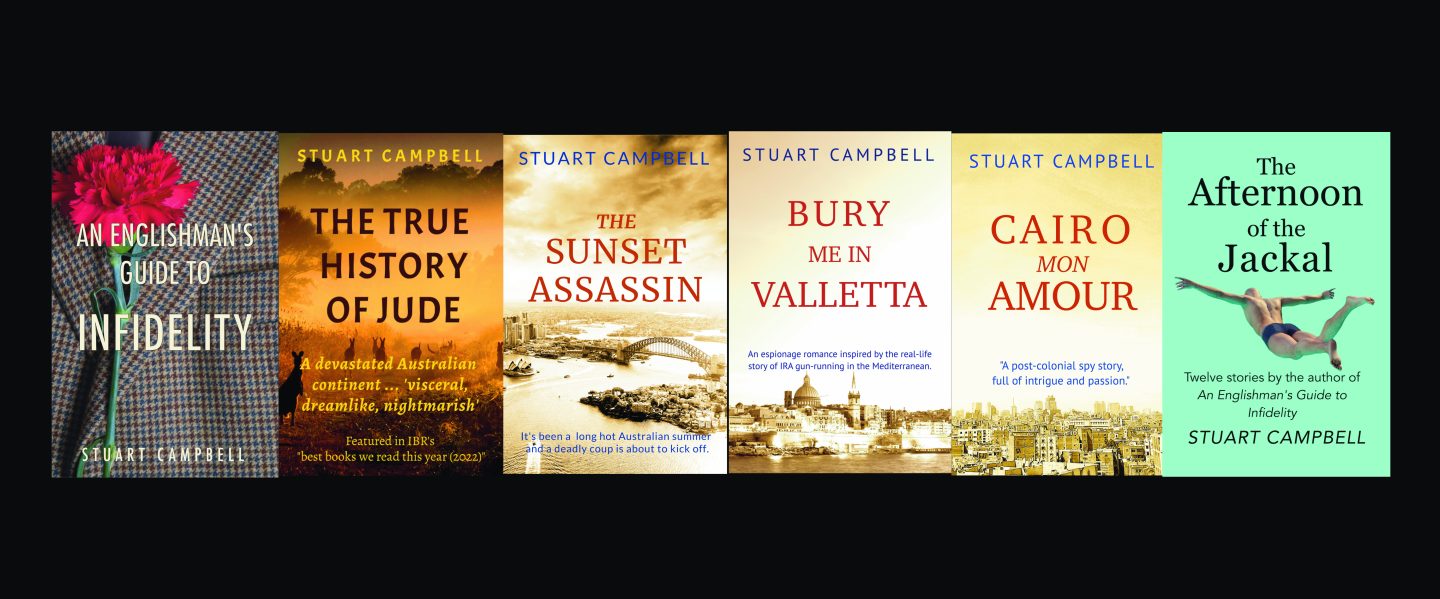
You may know me as the author of novels like Cairo Mon Amour, Bury me in Valletta, The Sunset Assassin, An Englishman’s Guide to Infidelity, and The True History of Jude.
For the last year I’ve been writing short stories. I’m working hard to master the form, but I’m especially interested to hear your views on what works and what doesn’t – and to use this feedback to make improvements to my stories.
The short story scene thrives on competitions run by libraries, municipal councils, bookshops and other bodies that support writers. I’ve been submitting stories in in recent times and I have my fingers crossed!
I’d gladly post samples of my stories free on my website but for one thing: Most competitions won’t accept stories that have been published – and that usually includes publication on a blog or website.
That’s why I’m offering free email access to one of my stories each month for a year starting in January 2024. You can see the list of stories below.
At the end of the year I’ll publish an anthology of the stories on Amazon, Kobo and Apple, hopefully with one or two competition plaudits under my belt.
Look out for my January story announcement later in the year. All you’ll need to do is email me at stuartcampbellauthor@gmail.com to request the January story. Even better, email me today and I’ll put you on my list.
I’m sure you hate spam as much as I do, so I won’t put your email into a mailout program without your consent.
A year of stories:
January 2024
Your Own Luck: A man with a past stows away on a cruise ship to Brisbane.
February 2024
An Afternoon under the Paperbark: A hidden observer witnesses a family drama on a hot afternoon in Sydney.
March 2024
The Unmasking of Mr French: A new neighbour in a luxury apartment block is not what he seems.
April 2024
Ninety-nine Names for Rain: A nineteenth century scholar discovers a deadly Shangri-La.
May 2024
The Afternoon of the Jackal: Uncle Christopher’s Boxing Day BBQ doesn’t go to plan.
June 2024
Birdbrain: A lonely woman prefers to be a bird.
July 2024
Thanks Dad: The Vice Chancellor of a university struggles with Imposter Syndrome.
August 2024
Belfast: When an Australian searches for his roots in Belfast, things get complicated.
September 2024
Fireworks: A man loses his memory in an accident, so his wife tries to redesign him.
October 2024
Lawrence of Arabia’s Box: An update on the fate of the lost manuscript of The Seven Pillars of Wisdom.
November 2024
Happy Days: History is rewritten at a school reunion.
December 2024
Balti Lamb: A dinner date at a Heathrow Airport restaurant goes pear-shaped.
“Are your family Lebanese?” I asked the young glazier working in my house. “Yeah, I’m second generation,” he said.
I told him I’d been in Beirut in 1973.
“Ah, the good old days,” he replied.
In the Epilogue to Rebirth, Lebanese-Australian journalist Antoun Issa notes the yearning among many Lebanese for a Lebanon ‘untainted by war’. My glazier had clearly inherited this yearning from his parents.
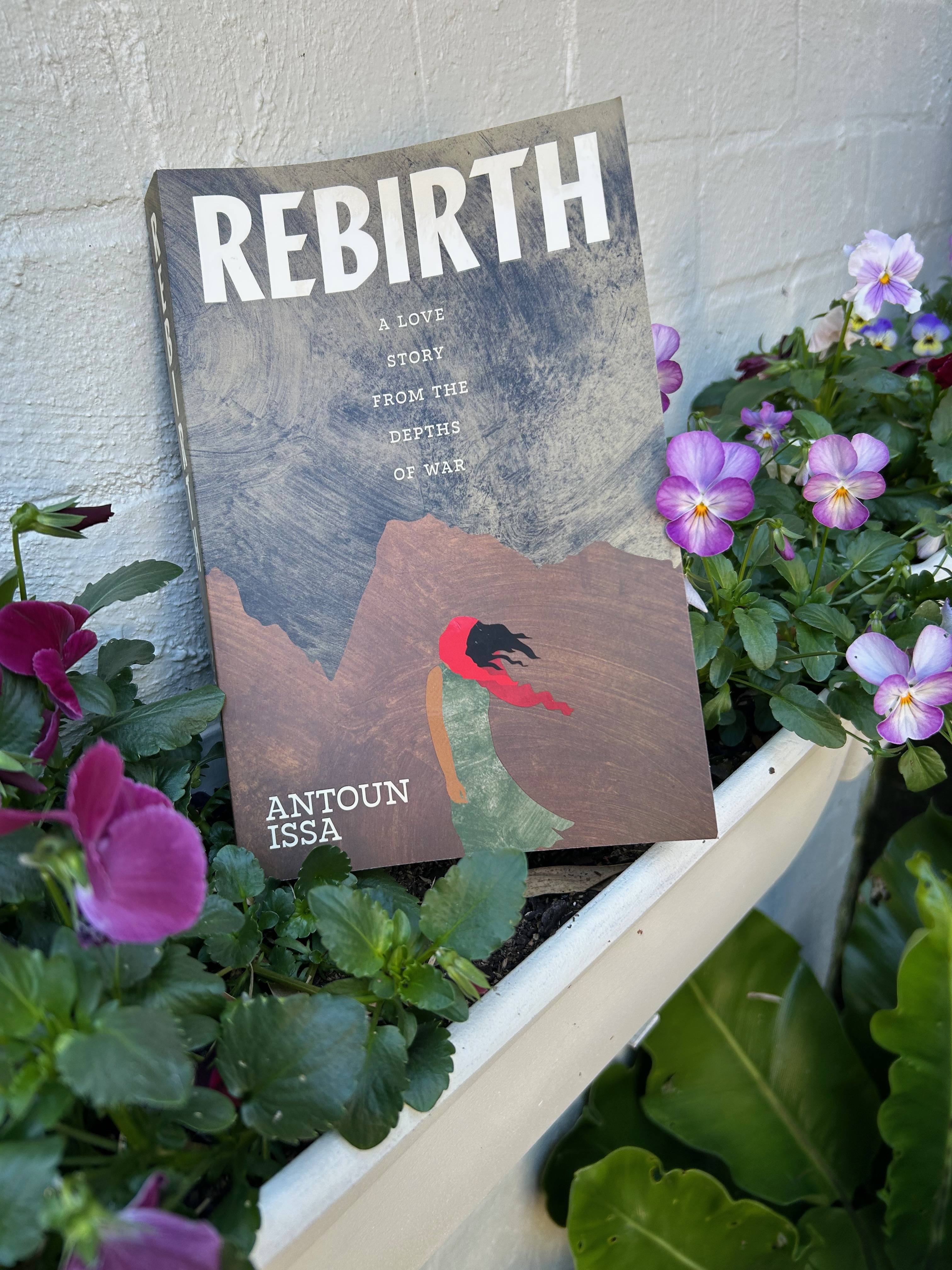
Rebirth tells the story of a poor Beirut family torn apart by the 1975 civil war, who eventually migrate to the inhospitable northern suburbs of Melbourne. The story is told through Antoun Issa’s mother’s eyes in a remarkable feat of fictionalised biography. Laila’s family live in dire poverty in Jisr El Bacha, a Maronite Christian suburb squeezed up against two Palestinian refugee camps. Her father Fares struggles to provide for the family, but Laila has to leave school at fourteen to work as a tailor. As the civil war erupts, Fares insists that the family remain isolated from politics, but the vicious conflict between the PLO and the Phalangists shatters their home, their family and their friendships.
In the late seventies I taught many adult migrant Lebanese in Sydney who’d fled the aftermath of the civil war. With Egypt as my own point of reference for the Arab World, I was intrigued by these people with their curious Arabic dialects, French given names, and fiercely protective attitude to their culture. I met students from Christian villages whose families had spoken Aramaic a few generations past, others from Sunni towns. I met refined intellectuals, poets, preachers, schoolteachers. Cognisant of their confessional government system and clan loyalties, I trod carefully. They formed a cultural kaleidoscope whose colours I could barely distinguish. The students never spoke of the war. I never asked.
Antoun Issa’s Rebirth lays bare the reality of the shootings, the betrayals, the checkpoints, the revenge, the hunger. The emotional impact is supercharged through the family’s fierce instinct to maintain their values despite the vileness of their circumstances. Food – or the lack of it – is a central concern as Laila’s mother makes scraps into meals during the long siege as shells and bullets fly around their house. In the latter part of the book Laila is astonished by the huge quantities of food served in Australia; when in Jisr El Bacha a few pine nuts were a treat, here they were piled on in pointless abundance.
Rebirth gave me a clue about the lives of those students in the faraway seventies, and I thank Antoun Issa for filling this gap.
The author does a skilful job of creating a voice for Laila – rich in noble sentiment, heavily larded with metaphor, and drenched in pathos. I found this approach entirely appropriate for a story that conveys the tragic history of a family, a culture and a country. There is the deft hand of the journalist in this work, especially in Antoun Issa’s handling of politics in a text driven by voices that claim to be apolitical; when necessary, he discreetly stands back from the action to seamlessly explain a point about who is slaughtering who and why.
I was interested to observe how he peppers the dialogue with Arabic to convey the foreignness of the setting and characters (a special interest of mine). In much the same fashion as Michael Mohammed Ahmad’s The Tribe, we see find untranslated easy to guess words like finjen ‘cup’; others like tfaddal, untranslated but clearly a welcoming utterance from the context; and expressions with translations such as Leik ya hala – welcome! Overall the foreignisms do their job of exoticising the setting without clogging the text.
Alf shukr (a thousand thank yous) to Antoun Issa for this deeply affecting and intellectually satisfying novel.
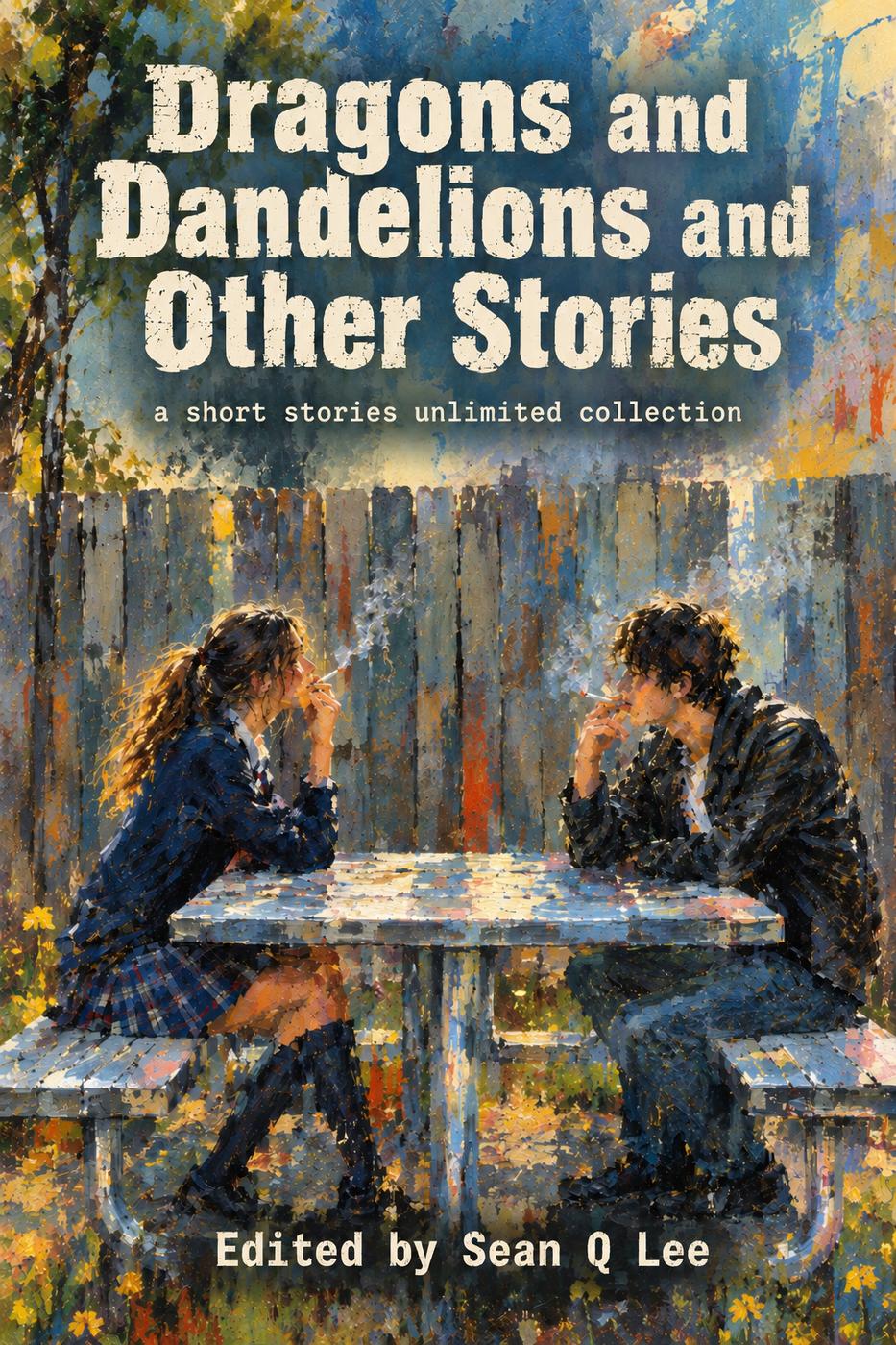
I was delighted to see my story Note Perfect published in the anthology Dragons and Dandelions and Other Stories, edited by Sean Lee of Short Stories Unlimited. Note Perfect was commended in SSU’s open theme short story competition 2026.
My story is about an ageing detective called to a double suicide in a shabby English suburb some time in the late fifties or early sixties. Despite the gloomy setting, I did rescue the mood with an uplifting moment in the final paragraph.
I wrote the story after immersing myself in the short stories of Doris Lessing. I didn’t intend to imitate or emulate her style, but to nudge my own authorial voice in her direction. It’s a craft technique I use frequently; I have a story in my files whose flavour owes a lot to Thomas Mann’s Death in Venice, and Maupassant recently gave me a hand with another piece.
I pass on my thanks to my buddies at the No Boundaries writing group in Sydney, whose feedback on my stories has been greatly appreciated in 2025 and 2026. And of course, thanks to Doris Lessing.
Somehow I missed the 1955 movie Our Best Days (Ayamna Al Helwa). Catching up with it this week I was catapulted back to my days studying Arabic at Cairo University. It’s a gentle charmer of a movie – an orphan girl moves into a flat and is wooed by three friends who compete for her love until the grim hand of fate intrudes. In between the romance scenes between Omar Sharif and superstar Faten Hamama, dreamboat singer Abdel Halim Hafez croons songs that have qalbi (my heart) in almost every line. It was a massive hit in Egypt.
I saw other Egyptian movies in the open-air Rio cinema in Bab El Luq, where we ate cold fried aubergine sandwiches packed by my wife’s granny. We snacked on chickpeas wrapped in recycled exam papers and drank flat local cola. When the Yom Kippur War broke out in 1973, the Rio started showing Russian war movies, I guess in sympathy with the massive Soviet arms airlift. Not the best days.
Those days in Cairo later provided the setting for my debut novel Cairo Mon Amour, which came out under a traditional publishing contract in 2017. I parted amicably from agent and publisher a few years later, and independently published a new edition in 2022, which has sold steadily (if modestly) with barely any promotion. A recent very modest uptick in sales got me wondering why people keep buying this book.
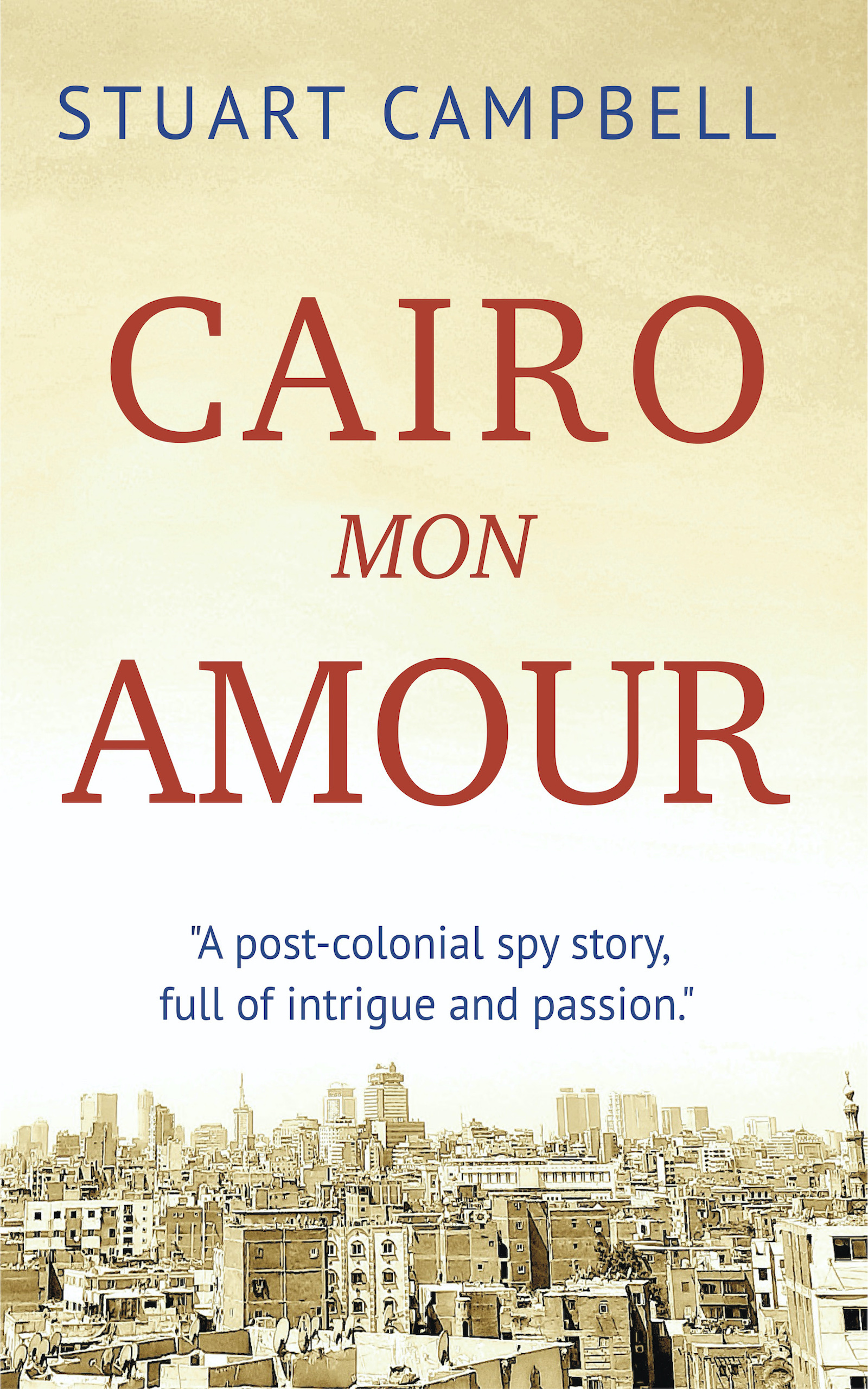
Alain Resnais should take some of the credit: I adapted the title from his 1959 movie masterpiece Hiroshima Mon Amour. It’s an apt title: Cairo Mon Amour is a romance embedded in an espionage tale in which the key characters are forced into exile from the city they love. In the book cover I tried to convey the wistfulness of a city remembered, using the faded sepia cityscape to suggest an old postcard, a forgotten love letter to the Cairo of Our Best Days.
I wonder too whether the cover quote ‘post-colonial spy story’ holds some allure. It’s taken from a thoughtful review, and I think the phrase sets off a train of associations that are evocative but not especially clear. The reviewer was spot on: At the time of writing I was immersed in postcolonial literature, influenced especially by the writings of Edward Said. Indeed the book was a reaction to espionage fiction tropes about Bad Arabs; I had been researching Arabophobia and wanted to write a story from the other side of the fence.
Of all my books, Cairo Mon Amour is the most solidly researched; you can tell I’m an ex-academic from the reference list at the end. In essence I used President Sadat’s secret deception campaign against Israel as the core plot element, following the events leading to the Yom Kippur War day by day. I blended the painstaking research with my own experience of the Cairo streets as war broke out.
It’s also a book about the frailty of the male psyche, conveyed through two protagonists. One, a translator and private detective of Armenian and Coptic heritage, is ‘closed in on himself’ as a defence against a world of betrayal and chicanery; he is brought into the daylight by a notorious actress with a price on her head. The other is a British sleeper agent who slips into depression waiting for a spy swap after being kidnapped from Cairo to Moscow; his pregnant girlfriend keeps a level head amid the privations of Soviet life. The women are the real heroes.
My Egyptian actress was inspired in part by Faten Hamama, whose steadfast and generous character is the real hero of Our Best Days. Director Helmy Halim resists a predictable melodramatic ending, instead opting for a wistful and fatalistic closing scene that resonates so strongly with what I tried to achieve in my own story.
It was really gratifying to be longlisted for the second year in a row in the 2026 Furphy Literary Award. My short story Leylandii is set in the Blue Mountains west of Sydney, a setting guaranteed to evoke the world of spirits. It’s a story narrated by a teenage boy who tries to unravel the strange events surrounding his widowed neighbour. The title Leylandii refers to those aggressive fir trees that are planted to provide privacy. My late mother had a palisade of these trees around her garden in England, and the idea for the story was prompted by my fancy that as the trees grew taller, my Mum got smaller.
The second success this year was in the Short Stories Unlimited Open Short Competition 2026, another Australian comp. I was awarded Highly Commended in a SSU competition a few years back, and this year I was delighted to receive a Commended for my story Note Perfect. I wrote this piece as an attempt to emulate the style of Doris Lessing, whose work I admire greatly. Note Perfect is a gloomy piece about the suicide of a struggling couple in postwar London. My key aim was to recreate the atmosphere of the time when Britain was throwing off the burden of the war years. The story is framed by an old detective for whom the case is just routine until it sparks a long-forgotten memory.
Not all my stories are about death! Have a look at my published anthology The Afternoon of the Jackal, which includes some quite cheerful stories!
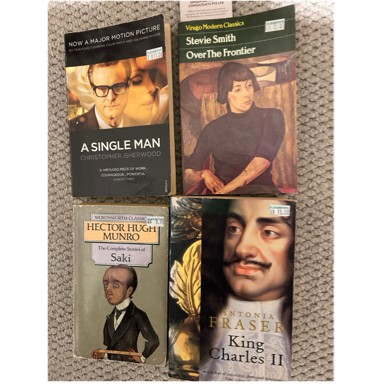
Once every few months I head for Elizabeth’s Bookshop in Newtown, a daggy-chic inner Sydney suburb where hard-up students rub along with social housing tenants and real estate investors. Elizabeth’s isn’t just a second-hand book paradise, it’s my antidote to the enshittification of culture; because when I buy old books I am completely immune to marketing, reviews, and algorithms. I cruise the shelves on autopilot, selecting books according to some mysterious internal instinct. Here are some of my latest haul:
Stevie Smith, Over the Border
Antonia Fraser, KingCharles II
Christopher Isherwood, A Single Man
Hector Hugh Munro, The Complete Stories of Saki
In the case of Stevie Smith, I know her poetry but not her novels. Antonia Fraser is super famous but I’ve never read her – and I have a soft spot for Charles II. I’ve been an Isherwood fan for decades, but I’ve never read A Single Man. And as for Saki, he’s so famous that I felt embarrassed that I didn’t have a clue who he was. More on my haul in a moment.
I read voraciously as a child in England. My mum signed me up for the public library: I can still feel the comfort of fat hardbacks wrapped in soft polythene dust covers. My dad had a little collection of highbrow books I read as a teenager. I remember stories by Somerset Maugham and the E.V. Rieu translations of The Iliad and The Odyssey. On reflection, it was escapism that drew me to books. I wanted to be anywhere but the dreary suburbs where we lived.
But I also became hooked on words. The first book I bought with my own money was Kit and the Mystery Man by Mollie Chappell, in which someone found themself in imminent jeopardy. I was desperate to know what it meant, and when I found out I shoehorned it into my school compositions. I’ve recently been chewing over Stevie Smith’s description of a freshly tidied garden as like a child with a washed face and a clean pinafore. I’m hooked on beautifully arranged words.
And I think it is escapism that has driven a lifetime of eclectic reading: Escaping into other times and places; escaping into a writer’s consciousness; escaping into other spiritualities; nowadays escaping from algorithms and grim headlines. When I began to write fiction seriously fifteen years ago, I carried back fragments of those other worlds and minds, using them to shape the new worlds and minds I created in my own novels and stories. Thus a perfect circular feedback mechanism developed: Reading and writing became two sides of a coin, input and output fused.
So here’s my take on the four books I mentioned:
Stevie Smith, Over the Border
Those new to Stevie Smith may at least know the title of her 1957 poem Not Waving but Drowning, which you can listen to here. She’s known principally as a poet but wrote three novels. Over the Border, set in 1936, follows Smith’s peculiar alter ego Pompey Casmilus as she mopes after a romance breakup in London and somehow finds herself in the midst of an opaque espionage adventure in WWI Germany. Pompey’s narration meanders through style shifts, syntactic recursions, and odd frenchified vocabulary. I read it very slowly, stopping from time to time to gaze at a paragraph and wonder where it was going. What to make of this for example?
Why now certainly this Pompey is becoming very sad-case and dippy, for see now I am crying …
Over the Border somehow reminds me of a weird buffet restaurant in Japan where I filled all the bento box compartments with unrecognisable foods, then grazed around it discovering that many of the items were Yōshoku – adaptations of western food, e.g. cold mashed potato topped with pink fish mousse, oddly spiced bolognese sauce. With Over the Border, you graze among the sentences savouring tasty tidpits and ending up feeling quite sated without knowing quite why.
Antonia Fraser, KingCharles II
This book is – like those massive fridges you can buy these days – a big unit. It’s huge, it’s detailed, it’s a magnificent work of scholarship, but written with such a deft hand that after 670 pages you don’t realise a fortnight has gone by. Notably, Charles II emerges from the pages as a great guy you’d love to have a goblet of Sack with.
Christopher Isherwood, A Single Man
I’ve probably read Isherwood’s Mr Norris Changes Trains a dozen times, and even used it as a device to bring two lovers together in my novel An Englishman’s Guide to Infidelity. How on earth did I miss A Single Man? It was worth the wait: Isherwood embeds us deep in the mind of bereaved British professor George Falconer as he spends his last day on earth in a US university. The writing is silky and sly, infused with suppressed irony and black humour. It’s 1962, and Falconer’s students are gauche and gawky; the barrier between him and them is like those invisible and impenetrable force fields in sci-fi movies. Delighted with the book, I streamed the movie. Twenty minutes in (in defiance of the critics) I was wondering why I bothered. There’s no denying that Colin Firth acts well (he did get an Oscar) but I felt that (a) all the principal characters were hopelessly miscast, and (b) the internal monologue of the novel seemed to have been replaced by gay sex scenes laid on with a sweaty shovel. Sure, Falconer’s gay but he is so much more.
Hector Hugh Munro, The Complete Stories of Saki
This is a one-off. Hundreds of quirky stories by an English toff with British India connections crammed into 700 pages of microscopic text. Under the pen name Saki (from the Arabic saaqii water bearer), Munro created a world of Edwardian house parties peopled by blowhard dowagers and crusty retired colonels. His most famous protagonist is Clovis Sangrail, a posh young fellow who pokes fun at Edwardian manners through pranks and veiled slights. Clovis, who is sometimes described as epicene (what a delicious word), is devilishly witty and mature well beyond his years (he seems to be about seventeen). Some of the stories are hilarious, some fall flat, most are very short. Poor Saki’s life was complicated, as was his background. Contemporary portraits show a man bearing a burden. He enlisted at the age of 43 and was killed by a sniper in France in 1916. He is best enjoyed in small bites; I estimate I’ll have got through The Complete Stories of Saki in about five years.
In July 2025, my friend and fellow linguist Professor Basil Hatim set up his soapbox on LinkedIn. He promised that he would be “sharing … thoughts, opinions, and maybe even a few rants on the issues that get me thinking.” Ten months on, we are blessed with an impressive suite of more than thirty essays ranging from the first, which calls for a new text-linguistics approach to translating the Holy Qurān, to a recent one on the text-linguistics concept of informativity. This particular essay is built around the notion of divine provision, incidentally bringing into play a Blind Snake and a Devoted Cat.
Along the way we have seen the development of the concept of rhetorical intelligence, a desperately needed glossary of rhetorical and text-linguistic terms, and the launch of the ship nūn: a joyful graphic rendering of the Arabic letter ن (n) metaphorically carrying us along our journey of intellectual discovery. Colleagues have contributed comments and sometimes essay of their own in response. Prof Hatim has humbly taken these on board, issuing clarifications and explanations. For example, I had some misgivings about the early definition of rhetorical competence; a much more elaborated version soon appeared (which I’m sure was already in the pipeline).
The ship nūn is a good reminder that many of Prof Hatim’s essays are all built on the notion that the Holy Qurān (and the Arabic it was revealed in) provides unique examples of the workings of rhetorical and text-linguistic devices. The Arabic letter nūn for example isn’t marshalled as transport because it looks like a boat; rather, Prof Hatim extracts layers of signification for nūn from the Holy Qurān itself: It is linked to ‘the act of recording destinies and truths’ and ‘the act of creation, bringing words/worlds into being’. nūn is the first letter of Surah 68, which is concerned with oath and inscription.
As I watched the ship nūn sail through 2025 into 2026, I reflected on why my friend’s work left such a positive impression on me. On the surface, the writing – in Prof Hatim’s stately English prose – is joyful, reverent, crisp, and deeply insightful. What struck me more deeply through was its creative character and its liberation from academic convention*. I was struck by the parallel with my own post-retirement journey from Professor of Linguistics to a writer of fiction, the joy of being my own literary boss, along with the discovery that my literary creativity in later life has been a powerful impetus to self-discovery and, as Jung would have put it, individuation. More of Jung later.
In Prof Hatim’s work I have seen that same joy in creating not just new work but a new kind of work. In my view these essays represent a unique genre of writing located at the intersection of linguistics, theology and a third point that lies somewhere between oratory and dialectic. Let me go back to the Blind Snake and the Devoted Cat to illustrate my point.
Prof Hatim’s recent essay Informativity: A Frequently Misunderstood Concept is structured roughly as follows:
1. Informativity is defined with reference to Beaugrande and Dressler’s seminal text.
2. We are told that Sacred Hadith on divine provision (al-arzāq) will be used to exemplify informativity.
3. We learn that a discussion on divine provision by the Sheikh Abdal-Hamid Kishk employs a fable on the Blind Snake and a Devoted Cat. A translation of the fable is provided.
4. A beautifully written section follows, in which Prof Hatim argues that God deploys his ‘unseen agents’ (e.g. the snake and the cat) to make visible the ‘divine signature’. The entire fable challenges ‘reductive paradigms’ like Darwinism. The cat ‘is nothing more than a soldier of God’.
5. We return to the Sacred Hadith referred to by Kishk and its ‘moral force’ and its value in illustrating informativity.
6. The definition of informativity is mentioned again, along with the comment that the conditional consequence (jawāb ash-sharț) will be the focus of the argument.
7. The Hadith is provided in English translation with the final sentence suppressed.
8. The final sentence is revealed. While the text has guided us towards an expected conclusion – that God will disapprove if we do not meet his demands (loosely interpreted), the actual conclusion ‘overturns this expectation with disarming grace’ by revealing God as merciful.
9. The essay concludes with a reminder that ‘God’s dealings with his servants exceed the logic by which we deal with one another’.
This essay breaks all the genre rules of academic writing, and in this rupture lies its magic, its force and its call to action.
My actions were: To check the definition of informativity; to look up Robert de Beaugrande’s unusual (to say the least) biography; to check some Arabic terms in my battered Hans Wehr dictionary; to look up Sheikh Kishk; to look up and read a commentary on Surah 68. Then, in the early hours of the morning to lose sleep thinking about the fable and the parallels with Jung’s archetypes; to think about a story I might write; to think about a story I wrote about a man condemned to solitary confinement who is visited in his dreams by a green bird and an eyeless girl; to spend fifteen minutes on the cross-trainer in the gym listening to a podcast on Jungian analysis and thinking how this might influence how I might write a response to Prof Hatim’s essay.
A final word about informativity: I recently read George Saunders’ A Swim in a Pond in the Rain where the renowned author analyses short stories by four Russian authors and (to my mind) demonstrates that writing fiction is all about informativity, ‘the strategic orchestration of expectation and its deliberate violation’, as Prof Hatim puts it in this essay. For a writer of fiction, informativity is seen in such things as subverting a stale metaphor, the use of bathos, and betting how long you can string out the reveal. How we writers strive to achieve the ‘minimal linguistic shift that yields maximal ethical insight’!
I thought I’d celebrate the tenth anniversary of the passing of Raymond Saucisson by reposting this tribute from 2015:
Raymond Saucisson, the noted gourmand and long-time editor of Charcuterie Monthly, passed away unexpectedly yesterday. His close friend Stuart Campbell said that Saucisson’s death comes just a week after the publication of the anthology With Gusto!, for which the charcuterie supremo wrote an introduction. “I’m devastated,” said Campbell. “He was always at the cutting edge, as an editor and as a small goods expert; he was a man who took on life one huge slice at a time”. Saucisson was born into poverty in Marseilles in 1945. He learned the art of sausage making from his mother, who sold her wares in the alleyways off Le Canebière. As a child Saucisson listened to the stories of the sailors who haunted the area, and in 1960 took a job as a ship’s cook. After ten years at sea he jumped ship at London, eventually obtaining residence papers and gaining employment as a bus conductor with London Transport. Stuart Campbell remarks on the formidable standard of his English, considering he had virtually no formal education. “During his fifteen years on the buses he read voraciously: Georgette Heyer, The Times, Charles Dickens, The Beano, Thomas Hardy. He consumed everything that was left behind on a bus seat. The 142 to Watford Junction was his university, he once told me.” In 1985 he was offered the editorship of Charcuterie Monthly. In a recent article he reflected on the magazine’s success: “A piece of writing is like a sausage. It has form, content, texture. And in the same fashion, what turns a quotidian article into an exceptional article is that inexpressible je ne sais quoi, the literary counterpart of a bead of glistening pork fat or a perfect balance of herbs.” With his trademark cravat, four-day stubble and haughty stare, Raymond Saucisson will be missed around the French markets that have become de rigueur among Sunday bruncheurs (a neologism of his own invention) from Aylesbury to Auckland. Raymond Saucisson is survived by his wife Solange, an author of vegan cookbooks. “While our dietary tastes differed, we complemented one other perfectly like ham and peas. If he was my bubble, I was his squeak,” she said yesterday.
***
You can find books by Raymond Saucisson’s alter ego Stuart Campbell here.
I grit my teeth and pressed the button, brushing aside my ethical misgivings about depriving a voice actor of a fee. I’d accepted an invitation from my publishing platform to turn one of my novels into an audiobook using their AI voice program. The truth is that my fiction ‘business’ runs at a loss, and I had no plans to invest in a voice actor; I was motivated more by curiosity, especially since the company wasn’t charging me a cent.
Their audiobook building process is dead simple: They put your ebook version up on screen. You choose your voices from a selection of American and British examples (I chose three – one for each character) and hit the narration button.
My baby began to speak! The narration was startlingly realistic; I was in awe of the technical virtuosity of the AI engine under the hood – and I still am despite my later reservations.
My job as author was to tune the engine as it hummed along – principally by repairing pronunciation errors. The toolkit is pretty simple: You respell the incorrect word to achieve the right pronunciation, e.g. respelling row as roe to block it rhyming with how. But a good handful of errors were resistant to my efforts, despite some ingenious tactics based on my expertise in phonetics.
The audio conversion runs in real time, but it took me several hours to stop and fix errors. While the voices in the audio version sounded sort of authentic, something was slightly off. All the major phonetic elements were well executed: Properly pronounced vowels and consonants, word stresses on the right syllables, sentence stresses mostly correct, longer segments like phrases, clauses and sentences overlaid with intonation contours to signal when they began and ended.
So what was slightly off? I think the problem lay in the way that the AI engine tackles intonation, a speech mechanism that conveys all kinds of meanings. You can test the magic of intonation by reading aloud “I love you” in ten different ways: You might find yourself conveying passion, regret, sadness, anger, desperation, or even sarcasm – each rendition depending on the context. And it’s likely that the intonation pattern you use is motivated by clues that go back over several sentences or even paragraphs. But while the AI gizmo uses intonation patterns that sound human in isolation, they don’t seem to reflect emotional cues beyond the current sentence. I didn’t see evidence that it ‘remembers’ elements of the text that would motivate subtle intonation patterns.
Don’t get me wrong: We’ve come an unbelievably long way since the first Dalek croaked EXTERMINATE, EXTERMINATE. There are vast numbers of applications for AI voicing where authentic human affect is irrelevant. But my novel sounded emotionally insincere and – dare I say it? – robotic, despite the dazzling technical feat behind its production.
Midway through writing this piece, I jumped onto the audiobook catalogue to listen to the free sample of the book. This time it wasn’t so dazzling. The rendition had an odd, jumpy singsong quality that I attribute mostly to intonation problems. And one sentence slipped disastrously from fruity Midsomer Murders British into a variety of American.
The customers evidently didn’t like it. The ebook has racked up about 2000 sales over the years, was an online bestseller for a day in 2016, and has a ranking of 3.6 stars and 73 genuine reviews. I still get a dribble of ebook sales without doing any serious promotion.
When a slick email arrived congratulating me on my ‘literary achievements’, some pleasure centre in my brain briefly glowed. Reading on, I found the standard list of offerings: Enhanced SEO, exposure on Goodreads, engagement with influencers, etc. I’m sure most fiction authors endure a similar blizzard of unsolicited offers to help sell books; in fact I suspect that more money is made in the author support business than the author business.
When a second email arrived the next day, I took a good look at both communications: They both referenced a number of my titles, threw in key plot motifs, mentioned main characters, and wrapped up the whole piece with lavish praise. ‘Wow’, I (momentarily) thought, ‘someone’s put some effort into writing this’.
The someone was apparently an opaque email address and bland name – no other details. The actual someone was clearly a Generative AI setup that has scraped my book blurbs off the internet and tipped them into a copywriting blender. A similar non-human email arrived two days later, this time from a company with a website and the street address of a seedy premises on the fringes of a major US city that looked as if it might double up as a swingers club.
These emails could have been the reason the term ‘bottom feeding’ was coined: Fiction writing is so poorly remunerated that – from the author’s point of view – the writing industry barely deserves the term ‘industry’ at all. It staggers me that somebody can find a business niche that depends on scraping thousands and thousands of book blurbs in the hope of hitting authors willing to cough up good money for services that in my experience yield a negative ROI.
My other Generative AI encounter arose from a professional postgraduate course I recently enrolled in – fourteen years after I retired as a Pro Vice Chancellor and forty years since I was last a uni student. I was intrigued to learn that the university’s obligatory unit on academic integrity was much preoccupied with the hazards of dealing with AI in academic writing
So far, so good. Except that my second study unit entailed (a) researching a topic using a Generative AI tool, (b) researching it with my human brain, and (c) comparing the results. A quick check showed that this assessment item fulfilled a graduate attribute on understanding AI.
My human brain research wiped the floor with the GenAI version, and I managed to gleefully use the term ‘stochastic parrot’ (properly referenced) in the closing paragraph of the paper.
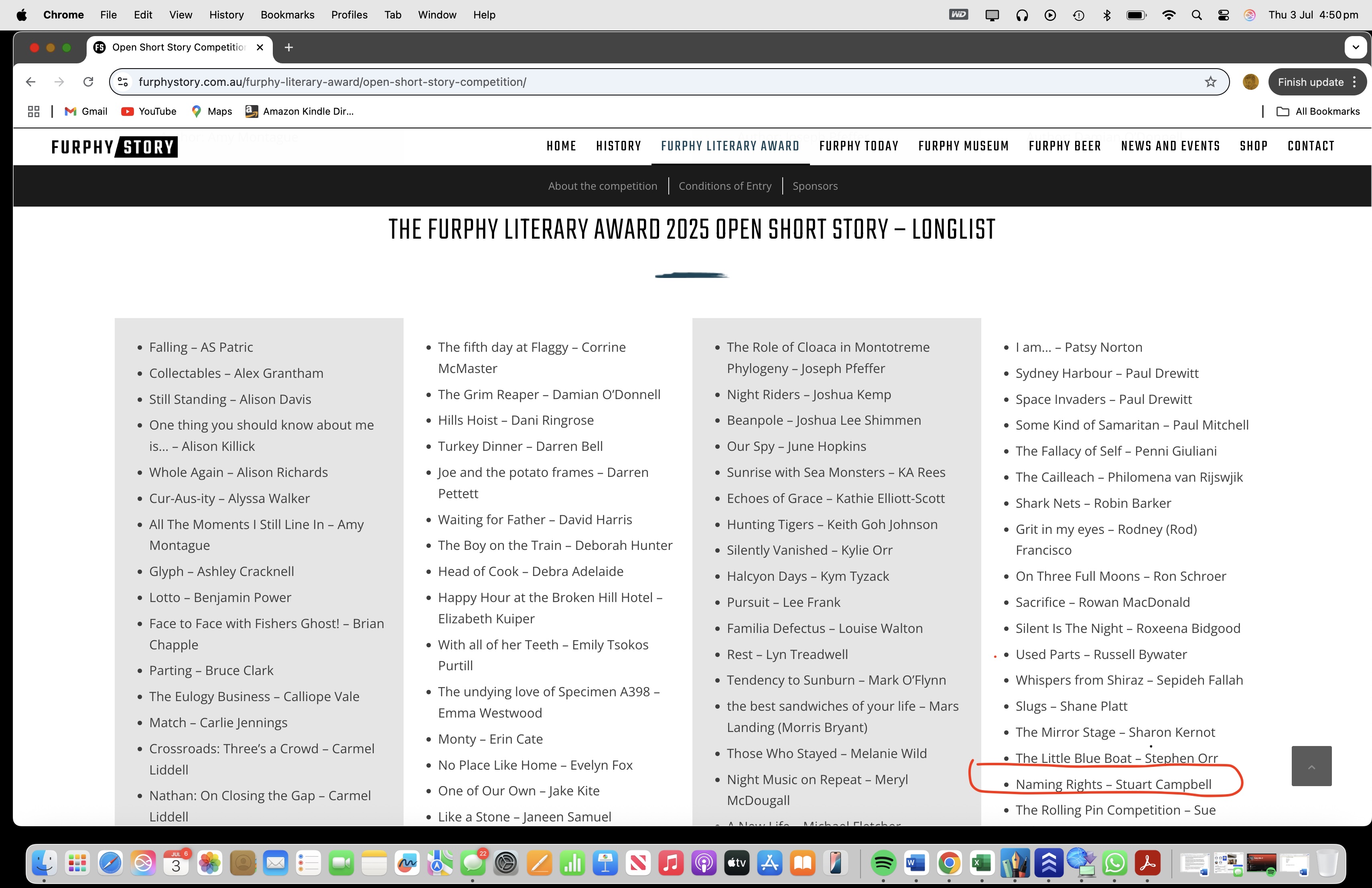
It’s a huge thrill for my short story Naming Rights to be longlisted for the Furphy Open Short Story Award, and a further confirmation that I seem to have made the transition from novels to short stories.
Thanks to my many readers and supporters! I’ll make Naming Rights available soon.