Author Ann Massey – deft touch, deep concerns

ann
Ann Massey

I came across Australian indie author Ann Massey last year when I picked up her novel The White Amah. Looking at her diverse output, I’m tempted to ask ‘what’s her angle?’ And where does her latest novel The Little Dog Laughed fit into her body of work? In fact, Ann Massey is a conviction novelist, producing work that barracks for the powerless. If this sounds like the work of a humourless ideologue, it isn’t.

Her latest work The Little Dog Cover of The Little Dog LaughedLaughed is a sparkling time-travel fantasy that showcases her wit, her deep knowledge of Britain in Roman times, and for good measure her love of dogs. And woven into the whole nutty tale is a deeper theme about the travails of people caring for sick or disabled relatives. I never realised what hilarity could be found in a  mobility scooter!

Here’s Ann Massey answering a few searching questions I put to her:

Q – The Little Dog Laughed is impossible to place in a genre. Is this a help or a hindrance in finding readers?
A – I’ve been a square-peg all my life and this is reflected in my writing. I know smart marketeers stick to one genre and write series, but I can’t change who I am. I like hopping all over the place, and writing in many very different genres. The reader I’d like to attract is someone like me who reads everything by authors on my shortlist of favourites, and impatiently wishes they would increase their productivity.

Q – Like me, you’re a Pom who has spent the larger part of your life in Australia. Do you think that having a foot in each culture has influenced your writing?

A – I was born in Bolton and grew up in the tough environment of a council estate in post-war Britain. Both my parents left school at fourteen but I was I was fortunate enough to win a scholarship to a Grammar school. The majority of my contemporaries were first generation grammar school pupils, most of them with parents who by economic circumstance had been deprived of an academic education. I believe the justice for all themes that run through my books sprang from the opportunity to receive an education that had previously been restricted to a privileged minority. The plots and their backgrounds, however, are the offspring of a lifetime spent in Australia
None of my books are autobiographical, but in each I have used my personal knowledge of its unique world to give the story a genuine authenticity. For instance, I was marketing manager of the Daily News when Perth’s afternoon newspaper went the way of afternoon newspapers worldwide. Uncertain what I wanted to do, I applied for the position of governess on Minilya, a sheep and cattle station in the Australian outback. The station was located close to the Carnarvon Tracking Station built for the Gemini Space Program. To entertain my pupils, I invented a story about the International Space Station crash landing on a station very like Minilya. Mo, tbedhe jackeroo who found the wreckage in my debut novel, The Biocide Conspiracy, slept on a bed very like the one that was provided for me, pictured here
 

Q – A Little Dog Laughed and Salvation Jane have strong social justice themes but you manage this with a light touch. What’s the trick?

A – Several readers categorised Salvation Jane as chick lit albeit with a message. This was exactly the reaction I was after.  I  confess that when I began the tone was darker and more serious. But as the story progressed I thought about my readers. I wanted my book to be read by the masses and if they’re anything like me they don’t want to be preached at. So how do you get readers to read a serious commentary on homelessness in Australia? Take it from me it’s very tricky. In the end, I wrote a plot driven story— funny, a bit sad, a little deep and (I hope) inspiring. The ‘up in the air’ ending I considered—the type that always disappoints me— was dropped in favour of a much more satisfying one.

When it comes to the light touch, I might have succeeded too well  in The Little Dog Laughed because all its reviews mention that its unique, refreshing, funny, and wildly creative, none mention its dark theme of carer abuse.

###

John M W Smith: A writer who bothers

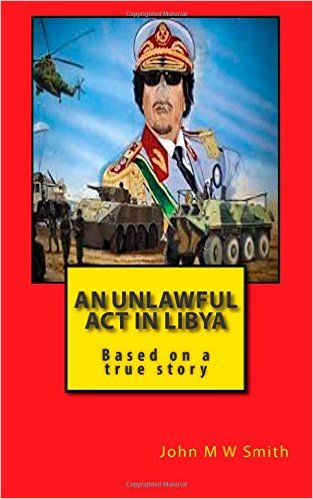
libya coverI’ve thought a lot about the reasons that John M.W. Smith’s short novel An Unlawful Act in Libya lingers in the mind. It isn’t just the poignant dilemma of the hapless Egyptian bookseller or the horrible fate of the Libyan taxi manager. Nor is it the deft telling storytelling of a born raconteur, or the nimble economy of style. What I think draws me to Smith is that this little book leaves the reader a little closer to understanding their own humanity: What if I had been Gamal? What if I had been Hamid?

Isn’t this the hallmark of enduring writing? In the days when we all read books made from paper, there was a simple test: When you finished a paperback on a train, you had two choices: Slip it between the seats, or put it in your bag. An Unlawful Act in Libya is the sort of book that you wouldn’t leave on the train. Read it and you’ll come away just a little changed.

Self new 1I put some questions to Smith, and he was generous enough to provide these very insightful responses:

 Stuart – Your main characters in An Unlawful Act in Libya are more complex and more sympathetically drawn than the standard ‘bad Arabs’ that we see in a lot of fiction and movies these days. How did this come about?

John – Our perceptions are determined entirely by the source through which they are channelled. Depending on a particular time in history when incomprehensible events have taken place, the public mood is suggestible and therefore willing to accept the most uncomplicated answer; there is a lot of fighting and killing that is going on in the Middle East where the Arabs live, so much so that it is spilling over to the West, and this obviously means that the Arabs are bad people, even primitive and bloodthirsty, right? Wrong! You cannot condemn an entire people for the misdeeds of a minority within them. Secondly, people will believe what they want to believe. Sadly, that is human nature. Blame has to be placed at a location which is convenient and will not be a constant and niggling irritation to our conscience. And also sadly, we happily accept the views of the media of our own country, which in turn reflect the needs and demands of the society in which we live. So how are we expected to arrive at the real truth about anything, let alone the truth about the nature of an entire people? Simple. We go and take a look for ourselves.

I worked for a big American publisher as an expatriate in Cairo for over a year. I met taxi drivers, and I met university professors, and just about everyone in between. I visited their homes and witnessed them at ease, with their guards down after a few drinks. I had their children crawling all over me and I had their smiling wives force food on me until I could barely struggle to my feet. I listened to their family problems. Their ambitions, hopes and aspirations. Saw the love in their family units. The thoughts and prejudices that shaped their attitudes. And what did I do? I yawned! There were no surprises. These people were no different from all the people I was used to back home. They were utterly and boringly the same. They wanted the same things, they laughed and cried at the same things…… and surprise, surprise, their set of moral principles were the same as ours. This was my experience. How could I then, in all conscience, portray these people whom I had lived with for over a year as caricatures of the devil so frequently found in certain sections of the Western media?

Stuart – You’ve mastered the art of the novella form, and I’m jealous! What’s the secret ingredient?

John – The secret ingredients are meticulous research and a lot of planning. Also the ability to be ruthless–to abandon a project even if a lot of work has already gone into it, simply because it doesn’t “feel” right. Because it fails to find that magical eureka moment similar to that experienced by Professor Higgins when Eliza Doolittle perfectly enunciated “the rain in Spain stays mainly in the plains!”

I do not consciously set out to write a novella. I am unmindful of how many words are produced in the end. I just try my best to sound interesting and simply come to a stop and I’m exhausted from the effort of doing so. There has to be a remarkable central event, the kind a reader would be unlikely to encounter in his or her 9-to-5 job and visiting the in-laws at the weekend. The ways in which each character in the story responds to that central event have to be very different. I need to focus keenly and make every sentence count, because in that lies the secret of a page-turner. I often do not know how the story will end. I only know that the end has to be utterly convincing. Perfectly reasonable. Wholly possible without too great a leap of faith being demanded of the reader. All I ever need is utter silence. A comfortable room. No interruption by a living creature. Yes, all of this in doses of 6 to 8 hours at a time.

Stuart – What are the cultural influences behind your writing? I can spot traces of Spike Milligan.

John – As for the cultural influences behind my writing, I am flattered to be even remotely compared to Spike Milligan. Even if his heyday was a bit before my time, I still remember being transfixed to the TV during the rare interview he gave in later life. I didn’t want to miss a word of what he was saying because every word came from his heart. He did not care what people would think of him after what he had said. Image-conscious? Forget it! He would not know what you were talking about.

Writers observe closely and often struggle to keep a sense of balance and proportion when arriving at their conclusions. In the end many find it so difficult that they simply home in on prevailing views and anxieties in society and end up saying what they think the readers would like to hear. What the reader can easily identify with, and quickly decide whether they love or hate it. But there are also many writers who observe closely and form their very own “take” based on what they have seen, and they do not care if the conclusions they have come to are in harmony with the prevailing zeitgeist. They are obsessed with telling it as they see it. They do not care who hates it or who loves it. They have not consciously set out to be commercial. They only want you to listen, and they do not want your attention to wander for even a second. Most of all, while you are listening they want you to be entertained and intrigued, for if you are not then how can you be expected to keep listening? My advice to any writer would be to forget trying to cater to a huge market. Concentrate on the market which is most in tune with your thoughts. It may not turn out to be a huge market but you will find it to be a fiercely loyal one…and it may well grow of its own accord if you are good at communicating what you have in your heart. I have been fortunate enough to have travelled a lot, which has given me more than a passing familiarity with many cultures. I really couldn’t ask for anything more. I would like to think that Spike Milligan would have been proud of me.

#

Read a free sample of An Englishman’s Guide to Infidelity  here. Buy Stuart Campbell’s books in paperback and ebook on Amazon by clicking on these title links:An Englishman’s Guide to Infidelity and The Play’s the Thing . Stuart Campbell’s covers are designed by Rachel Ainge .

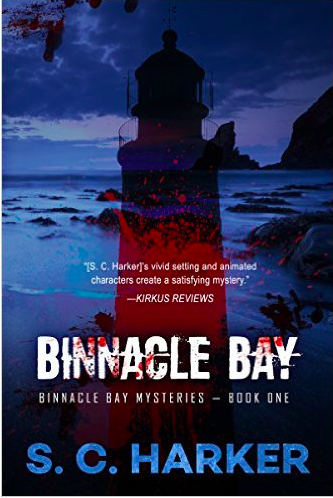
S.C. Harker’s ‘Binnacle Bay’: Hard cop, soft cop.

Screen Shot 2016-03-10 at 11.57.45 AMConfession #1: I’m a big city boy, and I’m generally sympathetic to the view – expressed to me by a drunken philosopher many years ago – that the countryside should be closed down and left to the fauna.

Confession #2: I’m obsessed by the USA and its vast kaleidoscope of landscapes. My imagination is gripped by its splendours and its ugliness, its coziness and its brutality. There is a standing joke in my house that one day we will visit New Iberia in Louisiana, where Tabasco Sauce is made. ‘Over my dead body’ is the punchline. Of course New Iberia is the home of James Lee Burke’s Dave Robichaux, the archetype southern deputy sheriff and hardboiled ex-alcoholic. How different can S.C. Harker’s Pat Fitzlaff be from Robichaux? The landscape is part of the explanation: Harker’s Binnacle Bay is in the coastal NorthWest; setting shapes a character, and there’s a whole continent between sweaty Lousiana and the bracing winds of coastal Oregon.

But Fitzlaff fascinated me from the outset; under the tough guy is an almost feminine sensibility. Harker’s competence as a writer gives him the requisite three dimensions, but I kept coming back to the small touches – his orderly house, his courtesy, his eye for detail in jewelry and clothing; there’s an extra dimension to this guy.

And of course there’s the immersive experience of Binnacle Bay: Nautical, cosy and small-town, with a cast of eccentrics you’d expect and some you wouldn’t. I said I was a big city boy: I feel more comfortable in Sydney or Paris or Manhattan, but there’s nothing like a vicarious vacation in Binnacle Bay or even New Iberia! You can find more details of Binnacle Bay and S.C. Harker’s other novels here.

My colleague Lesley Latte happened to be in Seattle recently and offered to track down the elusive S.C. Harker to pose a few searching questions. Here’s what Lesley learned:

Latte.  I felt that Pat Fitzlaff had a softer side than the standard hard-bitten cop. How did he get this way?

Harker.  That’s easy.  A violent death in the family.  Pat was born in a small town in central Nevada and spent much of his young life there.   As the only boy, he was particularly close to his father, an avid sportsman who loved hunting and fishing and never failed to take Pat with him on his rambles through the remote desert landscape. Pat was an expert in survival at an early age.

His two younger sisters idolized their brother, and their sibling relationships were normal for an average, small-town family.  In other words, the older brother mostly ignored the two girls, considering himself above what he considered their silly, juvenile behavior.

Then, when he was fifteen, Pat’s world was turned upside down.  The older of Pat’s sisters was brutally murdered, and the case was never solved.  This tragic incident was devastating to the family and had a profound impact on Pat, ultimately leading to his passion to become a homicide detective.  Conversely, rather than becoming bitter and hard-bitten, Pat is rather more sympathetic than most, especially toward the victims of crime.  It is one of his strengths.

Latte.  You create a great sense of place in the Binnacle Bay community. How did you invent this setting?

Harker.  I lived for a prolonged period of time on the Oregon coast in a house overlooking the sea.  We had a boat and fished the ocean for Salmon, Albacore, Halibut—you name it.  We had close encounters with whales and dolphin, and more than once had to rely on our GPS to find our way home in the fog.  Many times at low tide we walked down our hill and dug for clams.  We also crabbed whenever we got the chance and bought fresh oysters from the local farm.

Almost every day we took long walks on the beach with our two Brittany Spaniels.  By the way, though Murphy is a giant hound*, he is simply a dog at heart, and I learned about the true heart of a dog from my Spaniels.  Everything I write about Binnacle Bay is from experience and colored by my love of the ocean, dogs, small towns, and the people who inhabit them.

Latte.   Stuart Campbell tells me he likes to imagine having a drink with his characters, but is there anybody in Binnacle Bay who you’d avoid if they walked into a bar?

Harker.  There are always a couple of pains in the neck in every town.  Alba Enstadt is definitely someone I would avoid.  She appears in “The Bloody Lighthouse,” as does Beezer Arthur.  To have a drink with them I would have to go to Pirate’s Cove.  It’s not that I object to a low-class saloon every now and then, but Alba is a mean drunk who gets more and more combative as the night goes on.  And Beezer has the kind of unrelenting, smart-ass attitude that, as time goes on, makes you want to either get up and leave or, depending on how many drinks, to smash his face.

One person with whom I would never share a drink is the cold-hearted being who appears in “The Bloody Lighthouse” and again in “An Echo of Murder” (to be released later this year).

#

*Murphy is a canine character in the book – SC

Read a free sample of An Englishman’s Guide to Infidelity  here. Buy Stuart Campbell’s books in paperback and ebook on Amazon by clicking on these title links:An Englishman’s Guide to Infidelity and The Play’s the Thing . Stuart Campbell’s covers are designed by Rachel Ainge .

My tribute to author Pat Conroy, 1945-2016

When I heard this weekend that author Pat Conroy had passed away, I remembered something I wrote in 2013 when I had just finished reading The Prince of Tides. The piece was originally called Unimagining Literature with Google Maps. I was inspired to write it after reading the last pages of The Prince of Tides when Tom is sailing out of Charleston Harbour. Here it is:

———————————————–

One of my pleasures in reading is to meander through a genre and see where serendipity leads me. I’m an unashamed fan of James Lee Burke, the veteran novelist whose books lay bare the seamy and steamy underside of the southern states of the US through his flawed anti-heroes – Dave Robicheaux, Clete Purcell, Hackberry Holland and the rest of the sweating, gun toting, self-doubting crew. Even the women in Burke’s novels seem to have hairy chests. The landscape of the Dave Robicheaux novels is the worn-out, waterlogged settlements of New Iberia in Louisiana. I’ve never visited this region, and so I conjured up from Burke’s rich prose my personal imagined picture of Robicheaux’s world. It looked a bit like Bali. I was hooked and began to plan my literary tour of the Deep South.

Reality intruded when I looked up New Iberia on Google Maps. The images showed something quite different: Dead straight roads passing through an utterly flat green landscape, grey skies. Suddenly I didn’t want to go there anymore.

Despite the let-down, Burke piqued my curiosity and I began to follow leads to other writers of the South. I discovered a great deal of collateral detail: Tabasco Sauce is made in Avery Island, Louisiana; there is something called cracker culture, and it’s got nothing to do with biscuits; Mofro is a really interesting band. Moving up to Oklahoma, I found Glenn Ford in the 1960 movie Cimarron.

The two highlights of my Deep South reading were Thomas Wolfe’s Look Homeward, Angel and Pat Conroy’s The Prince of Tides (which most people probably know as the film version). Look Homeward, Angel is a great rambling, untidy, deeply moving mess of a book, which follows the rise and fall of the desperately alcoholic Oliver Gant, his sons, and his calculating wife. It took me months to read it in fits and starts, but at the end I felt the same feeling of emotional exhaustion that I had from Patrick White’s Riders in the Chariot.

Pat Conroy’s novel continues the despair and unresolved angst that seems to pervade the literature of the South: The terribly damaged Tom Wingo struggles to come to terms with his equally damaged sister Savannah and his brother Luke. He finds some resolution at the end of the book, and this state of mind is conveyed metaphorically as he sails through the South Carolina islands following the course he had taken many times with his father. Now here’s where it gets weird: I’m reading this on my Kindle and my hand is twitching to open Google maps. I weaken and open the laptop, and for the next half an hour I drift through the sea coast of South Carolina sitting behind Wingo on his boat while I watch with Google Maps from the shore. It was a very serene and beautiful – if peculiar – reading experience.

So are our imagined visions somehow violated when technology virtually (and I mean it in both senses) places us in almost any street in the world? I’m not sure: It’s an experience that we already know from film versions of books, but of course these films are themselves artistic interpretations, and not in the same realm as photographs. I tried making a quick scorecard of film or TV versions of novels that have (a) complemented and (b) violated my imagining of the novel: Pride and Prejudice: I can’t think of a film version that comes remotely close to affecting my enjoyment of the novel; McEwan’s Atonement: Hmm, it nibbled at the edges; The BBC series of Sebastian Faulks’ Birdsong: Oh dear.

The one that kept popping into my head, however was the 1969 movie Justine, based on part of Lawrence Durrell’s The Alexandria Quartet, which I drooled over in the early eighties. I read the Quartet before discovering the movie, but once I’d watched Justine, the character of Pursewarden was defined retrospectively and for all time thence by Dirk Bogarde. In fact, the movie Justine caused me to reimagine at least part of the book.

I’m reading James Lee Burke’s Feast Day of Fools right now. It’s his most gaunt and spare novel, set in a desert landscape on the Southwest Texas border with Mexico. I’m using a tablet now, so the Maps app is just a twitching finger away.


Read a free sample of An Englishman’s Guide to Infidelity  here. Buy Stuart Campbell’s books in paperback and ebook on Amazon by clicking on these title links:An Englishman’s Guide to Infidelity and The Play’s the Thing . Stuart Campbell’s covers are designed by Rachel Ainge .

Pamela Crane looks inside a murder victim’s heart.

Pamela Crane with Tinkerbell_author picIndie novelist Pamela Crane’s A Secondhand Life found its way into my Kindle this year. I needed a rest in my project to re-read all of William Faulkner’s main works, and Pamela’s book fell between As I Lay Dying and Soldier’s Pay. Did I need a rest! Did I need a crisp, refreshing read!

A Secondhand Life is based on a clever plot premise: Could the recipient of a transplanted organ experience the thoughts and feelings of the donor? Pamela Crane delves into the implications of the premise:  How would a donor recipient reconcile her own and the donor’s mind? Would it be possible to explore the details of memories evoked by the donor organ?

On top of this foundation, the author erects a thriller plot that makes for some highly original characterisations and twists. By the time I got to the ending, I had sticky fingers from counting red herrings. My five star review can be found here.

It has to be said, however, that the plot premise does have an antecedent. I did some checking and found that a 1971 UK comedy movie Percy runs a similar line; you don’t even need to click the link to guess which organ seventies comic actor Hywell Bennett received. The Kinks did the soundtrack, by the way.

My protégé Lesley Latte was unavailable to interview Crane, so I popped these questions over the email:

Q- What compels you to write?

A- Four little kids clambering for my focus all day, combined with no adult time, compels me to write. Writing is my break from reality…and it’s scary to say that living in the mind of a serial killer is much more exciting than changing diapers and housekeeping!

A- What would you (as author, not narrator) say to Brad if you met him in a bar?

Q- R.U.N. Run away from Mia Germaine as fast as you possibly can, Brad. A chick who chases serial killers–you don’t need that drama. Romantic relationships are tough enough without your significant other bringing a murderer into the mix.

A- When I write, my characters often take over the plot, and I am sometimes surprised at where they take the book. Does that happen to you?

Q- Even though I believe I create my characters, you’re right–they somehow live outside of my imagination and evolve independent of my will. As my characters develop through the story-writing phase, the plot needs to stay in line with who they are. In my thriller A Secondhand Life, Mia Germaine is stubborn (uh, nothing like me…but don’t ask my husband about this!), which causes her to nearly lose the love of her life, Brad. I hadn’t planned for that relationship tension, but it happened because of who she is (certainly not based on myself–did I say that already?).


Read a free sample of An Englishman’s Guide to Infidelity  here. Buy Stuart Campbell’s books in paperback and ebook on Amazon by clicking on these title links:An Englishman’s Guide to Infidelity and The Play’s the Thing . Stuart Campbell’s covers are designed by Rachel Ainge .

Sydney author slams “Young Kipper War” gaffe

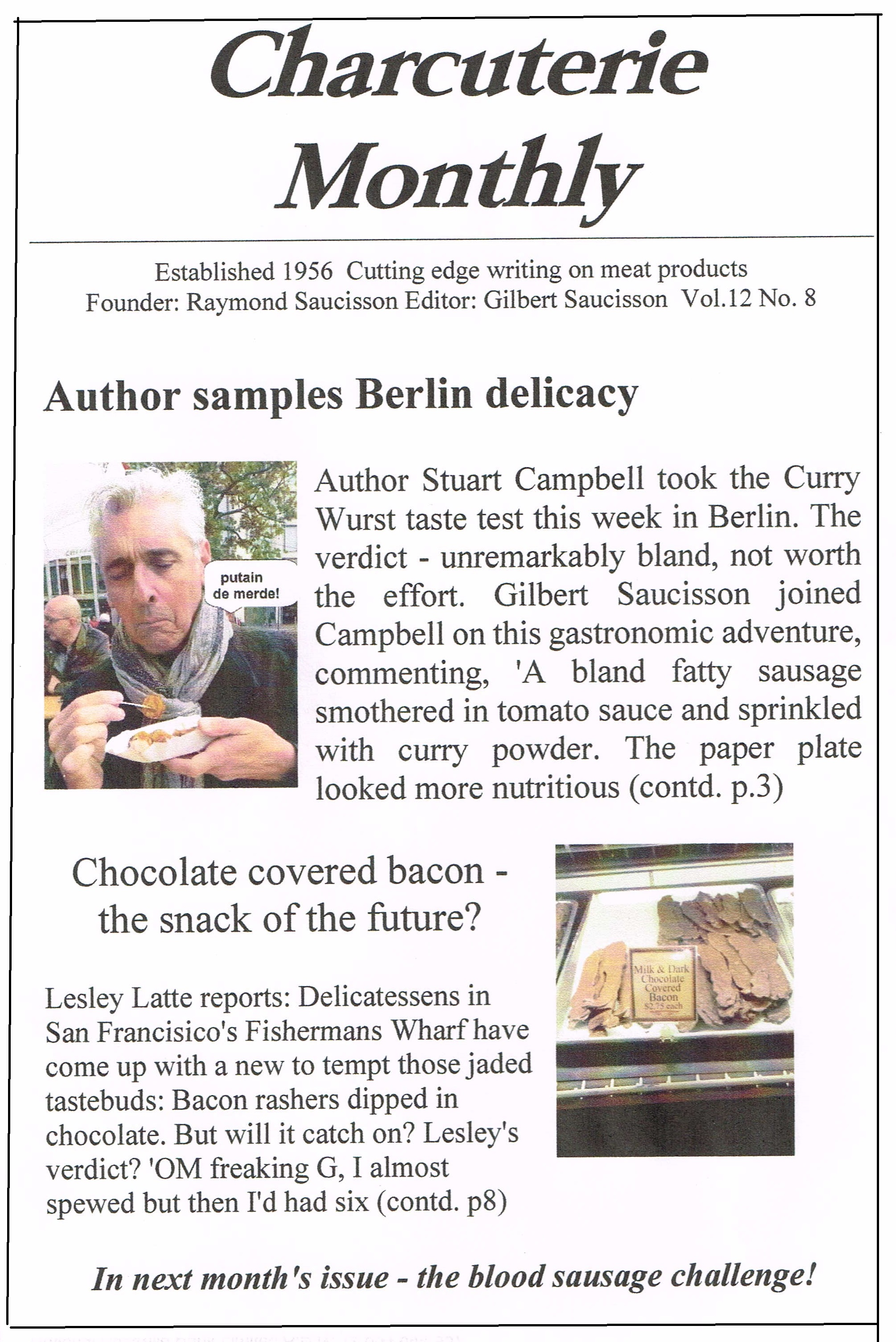
charcuterie monthy 002Sydney author Stuart Campbell says he is ‘disappointed and upset’ at Lesley Latte’s ambush interview with him in New Caledonia, in  which the roving correspondent said that Campbell’s new novel Cairo Mon Amour was set in the 1973 ‘Young Kipper’ War.  He has called on the new editor of Charcuterie Monthly, Gilbert Saucisson, to ‘send  Latte back to school to learn some history’.

In a brief statement, Saucisson said that Latte would be censured for h** error, adding that Charcuterie Monthly‘s editorial guidelines require that all articles include reference to meat, but not fish.


** Lesley Latte reserves the right not to disclose h** gender

Buy Stuart Campbell’s books in paperback and ebook on Amazon by clicking on these title links:

An Englishman’s Guide to Infidelity

The Play’s the Thing

Stuart Campbell’s covers are designed by Rachel Ainge .

The orientalist stripped bare

inscribed book
“To the English friend and guest of Egypt the orientalist Professor Stuart Campbell I give this book (author’s name redacted)

My third novel Cairo Mon Amour (publication July 2016) is set in Egypt in 1973 during the Yom Kippur War. I travelled to Egypt with my wife a few weeks before the  war started on October 6. I was to study at Cairo University, and my wife was to enjoy a reunion with her Armenian grandmother. We had  expectations of the Romantic Orient; these hopes were soon dashed.

I have written about our first days in Egypt in my memoir Cairo Rations!, and I have included the relevant section at the foot of this post. If you would like to have a free copy of the entire 11,000-word memoir, email me at stuartcampbellauthorATgmailDOTcom (replace the AT and DOT with @ and . so that I know you are human) and I will send you a copy and add you to my email news list.

Read a free sample of An Englishman’s Guide to Infidelity  here. Buy Stuart Campbell’s books in paperback and ebook on Amazon by clicking on these title links:An Englishman’s Guide to Infidelity and The Play’s the Thing . Stuart Campbell’s covers are designed by Rachel Ainge .

EXTRACT FROM CAIRO RATIONS!

THE ORIENTALIST STRIPPED BARE

The address we had been given was written in English: ‘Bustan Said’, and that was it. This piece of information had been passed along a chain of relatives from Egypt to Australia to Britain by letter and telephone, and via several languages and alphabets.

On our first night in Egypt we booked into the Hotel Cecil in Alexandria, where Somerset Maugham had stayed and the British Secret Service used to rent a permanent suite. Our mission was to travel to Cairo the next morning to find my wife’s relative’s boarding house. I spent the evening combing the telephone directory for anyone with Madame P’s surname and calling them up. “No, not here. Who’s that?”, “Who, who? Not here!” It didn’t help that the phone book was in Arabic and that Madame P’s Armenian name could have been spelt in at least six ways. But this was 1973: People didn’t expect to locate some exact spot on the surface of the earth in microseconds; people were used to being stood up, missing each other at planned meetings; people were used to unanswered phones. We went to bed without misgivings.

The train took us through the Delta to Cairo the next day, and I fought for and won a taxi at Ramses Station, asking the driver to take us to Bustan Said Street. I tried pronouncing ‘Said‘ in several ways – the four bald English letters gave about half the information needed to guess the Arabic word – and the driver lurched fatalistically into the traffic, no doubt praying that the mysterious location would magically appear before his rheumy eyes. It didn’t of course, although we did crawl up and down Bustan Street many times, craning to see past the bogged traffic and the sticky fingers of the child beggars on the car window, in case we saw a huge illuminated sign for Pension P. Nothing. “Take us to a hotel,” I said, and he drove for miles, eventually stopping outside an unmarked establishment in an empty street blighted with dusty urban poverty. We refused a squalid room upstairs with six frowzy beds, and resumed our journey. This time I said to the driver, “Take us to funduq urubbii“, ‘a European hotel’. I still cringe at the memory of the clumsy request. We were delivered to the posh Borg Hotel, where our room had just one bed.

My only experience of the Arab World had been our honeymoon in Tangier, a memory naturally tinted with romance, or more specifically The Romance of the Orient. Our taxi trip had left me with the impression that most of Cairo looked like a rubbish dump, but waking up in a decent hotel with a view of the Nile restored my hope that the Orient was out there to be found. Even better, the front desk staff knew exactly which street Pension P was in – Bustan El-Saeedi Street, right opposite the Filfila Restaurant. With the missing syllables restored to Madame P’s address, we checked out of the Borg and took another cab. And here we were, outside an Italianate apartment building in chaotic Bab El-Luq with all the prescribed features of The Orient around us: Men in nightshirts and turbans, donkeys, street stalls, thronging crowds, beggars, hullabaloo. We took the shuddering birdcage lift to the fourth floor and were admitted to a large vestibule with a dining table and a dozen or so chairs, and seven or eight doors leading to bedrooms around the sides. A couple of professional gents sat us down and politely explained that Madame P was out shopping. They sent out for fuul medammes and boiled eggs while we waited. The gents were two of Madame P’s boarders. Some weeks later, one of them – an army journalist – gave me a signed copy of a book he had written in praise of President Sadat. He inscribed it in Arabic, To the English friend and guest of Egypt the orientalist Professor Stuart Campbell I give this book.

Now might be a good point to take stock of how things stood with the Orient in 1973, at least among the people that I mixed with. Despite its glee at the dismantling of the colonial order, nouveau intellectual youth culture in the UK had inherited the cultural blueprint of the East drawn up by former generations: The Orient of the Beatles and the bandwagon Indian mystics was sensual, passive, spiritual, dismissive of material concerns. This hippy formulation wasn’t much different from that of T.E. Lawrence’s views of the Arabs he led at the fall of Damascus in 1918. As for me, I spent the first two years of my degree luxuriating in the works of old-time Orientalists like William Lane, Richard Burton and Gertrude Bell. The task, I believed, was for the West and the East to reach mutual understanding, mutual respect, world peace and all that. The bit that I missed was that we, the colonialists, had written the rules and the East didn’t have a say. Five years later the Palestinian-American scholar Edward Said launched his seminal book Orientalism, changing for ever the rules of intellectual engagement in the study of cultures. After Edward Said nobody wanted to be called an orientalist.

Let’s return to the dining room at Madame P’s. We had finished the fuul and eggs, and there was still no sign of the lady. The professional gents sent for a young man, a university student, who must have lived in the building, and he was told to take us around the neighbourhood to look for Madame P. We went from shop to shop while the student practised his English on us. I was expecting him to be interested and flattered (I cringe deeply again) that a British student had gone to the trouble of studying his language and his culture. Instead he questioned me brusquely about why I was in Egypt, eventually becoming quite sarcastic and tossing in terms like ‘imperialist’ and ‘invader’. We didn’t find Madame P, but by the time we returned to the Pension she was there, and the sour student slipped away. There were hugs and kisses, and my wife, her relative and an ex-orientalist settled down to catch up on family history.

Indie authors like Francis Guenette producing stellar work

Francis Guenette - author photo (1)
Francis Guenette

These days I seem to divide my reading between carefully selected indie authors and a long backlist of classics. A week or two back I found myself reading Canadian indie author Francis Guenette’s Disappearing in Plain Sight alongside Katherine Anne Porter’s Ship of Fools, which stormed the literary world in 1962.

The comparison was instructive: Both novels are driven by strong characters, and both immerse the reader in compelling settings. At the same time, there was a complementarity between the books: Porter’s scathingly critical analysis of the hapless passengers on a pre-war journey from Mexico to Europe; Guenette’s insistence on redemption for her damaged and difficult characters in rural British Columbia.

I haven’t reviewed Porter; after all, she did get a Pulitzer decades before the Kindle was a gleam in anyone’s eye. But  I did give Disappearing in Plain Sight five stars here

I’d love to ask Katherine Anne Porter some questions about Ship of Fools. Alas, I am 36 years too late. However, I popped a few questions to Francis about her thoughts on Disappearing in Plain Sight:

Q – What would you say to your character Izzy if you came across her in a coffee shop?

A – Hands down, I would ask her for more Caleb stories. Izzy’s first husband, Caleb, the man who created the paradise at Crater Lake that Izzy inhabits, is dead before the opening lines of Disappearing in Plain Sight and yet he has often been named as people’s favourite character. One reader went as far as to say that Caleb is the moral compass of the novel. Glimpses into this man’s personality and charisma saturate the entire Crater Lake Series. I know as the books add up and I move further from his death and into the lives of the people left behind, I will have to be more and more creative in my task of keeping him in the present narrative. Come on, Izzy. Help me out here.

Q – Did you fall in love with any of your characters when you were writing the book?

A – Hmmm … since a little bit of me is in every single character, I was narcissistically in love with each of them. Differing personality traits appealed to me. I admired Lisa-Marie’s feistiness. Who wouldn’t fall for Justin’s good looks and code of honour?  I fell madly in love with Beulah’s sharp wit and wry comments. My heart went out to Bethany for the cards life had dealt her. Liam’s strength and fragility wrenched my emotions every time I encountered him. And Izzy’s struggles with grief and professionalism buffeted me with echoes of many, many stories I’ve heard over the years. As you can probably tell, these characters mattered to me. If, as an author, I am not emotionally committed to my characters, how can I expect the readers to care?

Q – Do you ever wish you’d ended the book differently?

A – Absolutely not – the ending of Disappearing in Plain Sight gives me great satisfaction. The novel never started out to be the first book in a series. It was simply a story I had to tell. When I try now to answer questions about where the characters or ideas came from, I’m at a loss to provide an answer. All I do know is that the ending more than any other part of the book had the characters clamouring in my head to have the next chapters of their lives told. After three novels, they are still at it with new characters constantly making appearances and begging for attention.

The verdict after my week of parallel reading: Porter is deservedly part of the canon of English language literature, but  indie authors like Guenette are producing stellar work. Both books gave me immense satisfaction.

Read a free sample of An Englishman’s Guide to Infidelity  here. Buy Stuart Campbell’s books in paperback and ebook on Amazon by clicking on these title links:An Englishman’s Guide to Infidelity and The Play’s the Thing . Stuart Campbell’s covers are designed by Rachel Ainge .

A Dance to the Music of Flattery

© Sara Campbell 2015

I first tried writing fiction about thirty years ago. Thankfully none of my attempts are extant, but if I tell you that I was absorbed at that time with reading Anthony Powell’s twelve-volume fiction cycle A Dance to the Music of Time, you might guess what the writing was like. On the other hand you might not, because hardly anybody reads Powell these days. At any rate you would have groaned through elegantly wistful reminiscences of school days not unlike my own, and grimaced at characters crudely modelled on Powell’s X. Trapnel and Kenneth Widmerpool.

Powell published A Dance between 1951 and 1975, and my admiration for him went far beyond the pleasures of his elaborately ironic account of literary, political and military life from the second world war until the Flower Power era; it was his stamina and precision that astonished me. Who can match Powell in tracking his characters in such detail over half a century? For me the most impressive technical feat was Nick Jenkins, the Everyman narrator through whom the entire content of twelve novels is conveyed as either first or second hand reports. Remarkably, we know almost nothing about Nick Jenkins at the end of the cycle; he has been our eyes and ears, and that is about it.

When I began writing my novel The Play’s the Thing I wanted to pay homage to Powell but I didn’t intend to repeat my grovelling mistakes of thirty years ago. What I did was to model aspects of my character Alex Noble on Nick Jenkins: Alex begins and ends the novel, and he appears at various points not as a central character but as a device to help develop crucial plot elements. I created the idea of Alex playing the corpse in the Bandicoot Ridge Community Theatre with exactly this in mind; Alex is in the action but he’s not part of the action. And although we do learn something of Alex, his experiences serve as a backdrop to the story, not as drivers of the plot. This much, I felt, was sufficient as my thank-you to Anthony Powell; to speak through the single voice of Alex, as I considered at one point, would have tipped homage into flattery.

###

This little essay is from my anthology On Becoming a Butcher in Paris. If you would like to have a free e-copy of the entire 15,000-word collection, email me at stuartcampbellauthorATgmailDOTcom (replace the AT and DOT with @ and . so that I know you are human) and I will send you a copy and add you to my email news list.

Read a free sample of An Englishman’s Guide to Infidelity  here. Buy Stuart Campbell’s books in paperback and ebook on Amazon by clicking on these title links:An Englishman’s Guide to Infidelity and The Play’s the Thing . Stuart Campbell’s covers are designed by Rachel Ainge .

Escape from Egypt during the Yom Kippur War

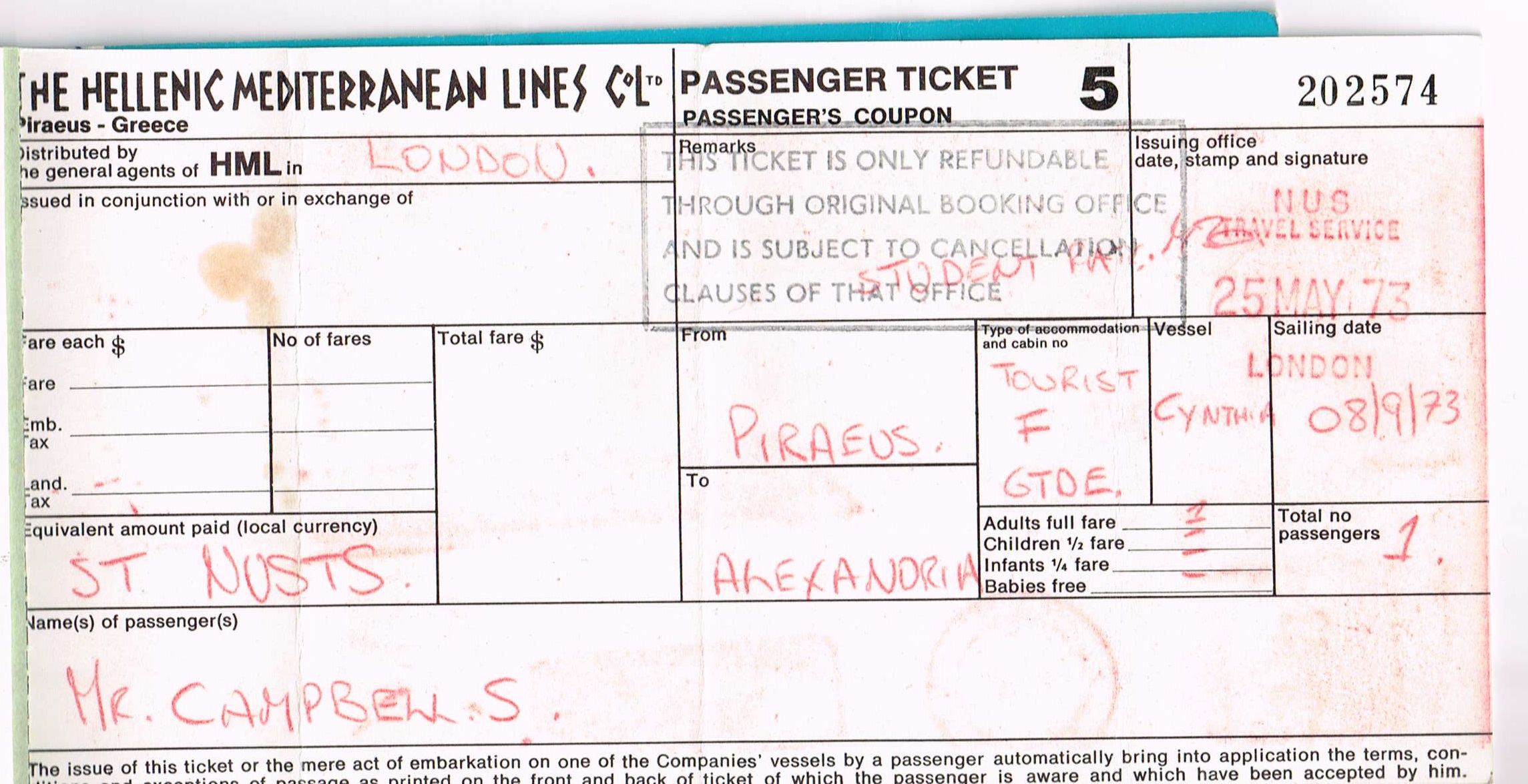
cynthia ticket 001My third novel Cairo Mon Amour (publication July 2016) is set in Egypt in 1973 during the Yom Kippur War. I happened to be a student in Cairo at that time, and as the borders closed, it became very difficult to leave Egypt. Several days into the war, we heard that a ship was to evacuate foreigners from Alexandria.

In the novel I have two of my characters, Pierre and Zouzou, flee the country on a ship around the same time. In my research among US diplomatic cables I discovered the actual ship was the Syria, and that it left Alex on  Thursday 11 October, five days after the war began. I could not find any contemporary descriptions of the Syria, except for an obscure article about the US diplomat Dean Dizikes*, who found the ship in Greece and organised the voyage. I drew on his description of the ship’s graceless departure in my story.

However, I was amazed to discover that US diplomats had tried unsuccessfully to requisition another ship,  the Cynthia, at Piraeus before obtaining the services of the Syria. Why amazed? Because I had sailed from Piraeus to Alexandria on the Cynthia just a month before. I have the ticket to prove it! So, in the interest of literary rather than historical integrity, I put Pierre and Zouzou on the Cynthia and wrote the Syria out of the Yom Kippur War.

The Cynthia was, by the way, a loathsome tub. I have written about my horrible voyage from Piraeus to Alex in my memoir Cairo Rations!, and I have included the relevant section at the foot of this post. If you would like to have a free copy of the entire 11,000-word memoir, email me at stuartcampbellauthorATgmailDOTcom (replace the AT and DOT with @ and . so that I know you are human) and I will send you a copy and add you to my email news list.

*The Yom Kippur War – an evacuation of the ungrateful

Read a free sample of An Englishman’s Guide to Infidelity  here. Buy Stuart Campbell’s books in paperback and ebook on Amazon by clicking on these title links:An Englishman’s Guide to Infidelity and The Play’s the Thing . Stuart Campbell’s covers are designed by Rachel Ainge .

EXTRACT FROM CAIRO RATIONS!

BY SCRAPHEAP FROM PIRAEUS TO ALEXANDRIA

We tried to catch a taxi at Piraeus station but couldn’t master the local technique of running alongside the moving vehicles, grabbing the door handles, and claiming possession. Instead I hefted our two heavy suitcases under a blinding September sun from the station to the dock. By the time we found the MV Cynthia my arms were as taut as fanbelts and my anaesthetized fingers looked like salami.

We had tickets to Alexandria for a double cabin, bought through the National Union of Students in London. The NUS wanted to sight our marriage certificate before they would sell us the tickets, and had thoughtfully franked the reverse of our Gibraltar Registry Office document with a big inky stamp.

When we arrived on the deck of the reeking Cynthia the purser shook his head in amazement that travellers with such cheap tickets could possibly believe they were entitled to a double cabin. My wife and I were separated and ordered to different parts of the stinking tub well below the waterline. I lugged the two huge suitcases to her cabin, dropped off the one we thought might contain her clothes, and then continued to drag the other one like a cockroach through the superheated rusting passageways. But I was spared: My assigned eight-berth cabin was festooned with frilly frocks – no place for a man. I used my last ounces of energy to drag the hated suitcase to the top deck. The grudging purser directed me to a double cabin above the waterline, and I threw myself onto the lower bunk and hung my throbbing hands over the side.

With the circulation to my fingers partly restored I went aloft, or perhaps abaft, and searched for my wife on the deck. The greenish tinge of her face augured badly; we were still tied up alongside the caisson wall, but the rocking of the ship, the stench of diesel, and the hot greasy miasma from the vents above the kitchens had started to do their work.

The MV Cynthia juddered out of the harbour at a funny angle like a water rat with a crushed leg. It was her last voyage before the scrapheap.

In the afternoon the ship’s swimming pool was filled up. It was barely big enough to fit six people standing but the weight of the water taken on board strained the heaving engines almost to a standstill. We hung around the canvas awning near the pool to escape the heat. An Egyptian man in swimming trunks did an elaborate callisthenic routine and introduced himself. He was captivated that I could pronounce his name properly, and asked me to repeat it over and over: “Please, what is my name?” We escaped to another part of the ship but wherever we went he seemed to be waiting in his trunks behind a lifeboat or a stanchion, and would pop out and inanely ask, “Please, what is my name?” I would repeat robotically,  “Mar’i Kamil S-“. I leave his last name incomplete in case he is still alive and wants to be my friend on Facebook.

In the evening the toilets overflowed and we had to hop through sewage to get to the hotbox  where dinner was served to the third class passengers. A waiter probably named Malvolio guarded the kitchen entrance with a filthy tea towel over his arm. The food – it hardly needed guarding – was Kit-E-Kat mashed into macaroni tubes. We gagged and picked over our bowls, but our table companions – cadaverous British hippies who had been in India for months – golloped theirs down, and then finished our leftovers. Our hearts leapt as fat peaches were handed out, and then shrivelled when they were cut apart to reveal the plump maggots within.

We parted late that night on the upper deck, but not before I had my first real conversation in Arabic outside a classroom. While my wife leaned over the rail to find some air that didn’t smell of Kit-E-Kat, I watched a Lebanese family chatting in the moonlight. There was another ship in the distance and a man in the group commented that it was from the same shipping line as the Cynthia. He actually said nafsi shirka, ‘the same company’. I grabbed my chance and attempted to join the conversation by loudly intoning nafsi shirka with a questioning intonation. On reflection I suppose I was saying, “Oh, family of complete strangers, is it indeed a fact that the ship we see is from the same company as the ship we are on?”

The family turned to stare at the apparition at the rail whence the odd utterance had come: A moustachioed wraith with shoulder length black hair supporting a young woman who was sobbing and retching under the moon.

I spent the night awake in terror listening to the stranger in the upper bunk making long rhythmic noises like a razor being sharpened on a leather strop.

At Beirut – not yet torn apart by the civil war – we ordered massive plates of rice and minted lamb in a restaurant but could barely eat a few spoonsful, so shrunken were our stomachs. We made it back to the Cynthia by smell alone, and fought the crush of Egyptians who were boarding with boxes of Lebanese apples as big as babies’ heads.

As we sailed for Cyprus a black and yellow flag was raised – cholera! – and instead of entering Limassol harbour we stood offshore in quarantine. A Mercedes Benz was hoisted from the Cynthia’s deck on davits and swung wobbling onto a wooden barge, which puttered off to Limassol with a few passengers.

Like a malodorous pariah, the Cynthia limped towards Egypt, its decks still stacked with boxes of apples. Officials came out to meet us in Alexandria harbour and we were lined up and each given a large white cholera pill, the composition and efficacy of which we knew nothing. The officials had a loud discussion about the apples and a decision was made: Destroy them! They may be infected! The boxes were broken apart and the passengers ate the apples.

Some hours later the Cynthia eased her dented flanks alongside the berth and the engines stopped grinding. We lined up in an immigration hall where men in uniform took all our passports and made a toppling pile of them on a desk. I watched in anxiety: How would they return the passports to the correct owners? What if I got the wrong passport and I had to spend the rest of my life as Mar’i Kamil S-?