‘Cairo Rations’ still #1 in its Amazon category!

graphic cover2Cairo Rations is still #1 in its Amazon category and still free! In fact, it’s permanently free on Amazon, Apple, Barnes & Noble and Kobo. Today’s stats:
Amazon Best Sellers Rank: #15,507 Free in Kindle Store (See Top 100 Free in Kindle Store)
#1 in Kindle Store > Kindle eBooks > Nonfiction > Travel > Africa > Egypt

Check here to see where to get it.


The memoir that inspired my new novel Cairo Mon Amour – get it here for free.

My third novel Cairo Mon Amour is still under wraps, but I will cairo rations  yellow coverrelease publication details in the near future.

Before I started Cairo Mon Amour, I wrote a memoir called Cairo Rations about  my time in Egypt during the 1973 war, to bring back memories of the settings that I wanted to use in the novel.

I’ve just published a new version of the memoir Cairo Rations, which I am distributing free. Click here to sign up for my newsletter and get a copy of Cairo Rations in pdf, mobi (for Kindle) or epub (for many e-readers).

If you have comments about any of my books, please respond through this blog or by email at stuartcampbellauthor@gmail.com .

###

The orientalist stripped bare

inscribed book
“To the English friend and guest of Egypt the orientalist Professor Stuart Campbell I give this book (author’s name redacted)

My third novel Cairo Mon Amour (publication July 2016) is set in Egypt in 1973 during the Yom Kippur War. I travelled to Egypt with my wife a few weeks before the  war started on October 6. I was to study at Cairo University, and my wife was to enjoy a reunion with her Armenian grandmother. We had  expectations of the Romantic Orient; these hopes were soon dashed.

I have written about our first days in Egypt in my memoir Cairo Rations!, and I have included the relevant section at the foot of this post. If you would like to have a free copy of the entire 11,000-word memoir, email me at stuartcampbellauthorATgmailDOTcom (replace the AT and DOT with @ and . so that I know you are human) and I will send you a copy and add you to my email news list.

Read a free sample of An Englishman’s Guide to Infidelity  here. Buy Stuart Campbell’s books in paperback and ebook on Amazon by clicking on these title links:An Englishman’s Guide to Infidelity and The Play’s the Thing . Stuart Campbell’s covers are designed by Rachel Ainge .

EXTRACT FROM CAIRO RATIONS!

THE ORIENTALIST STRIPPED BARE

The address we had been given was written in English: ‘Bustan Said’, and that was it. This piece of information had been passed along a chain of relatives from Egypt to Australia to Britain by letter and telephone, and via several languages and alphabets.

On our first night in Egypt we booked into the Hotel Cecil in Alexandria, where Somerset Maugham had stayed and the British Secret Service used to rent a permanent suite. Our mission was to travel to Cairo the next morning to find my wife’s relative’s boarding house. I spent the evening combing the telephone directory for anyone with Madame P’s surname and calling them up. “No, not here. Who’s that?”, “Who, who? Not here!” It didn’t help that the phone book was in Arabic and that Madame P’s Armenian name could have been spelt in at least six ways. But this was 1973: People didn’t expect to locate some exact spot on the surface of the earth in microseconds; people were used to being stood up, missing each other at planned meetings; people were used to unanswered phones. We went to bed without misgivings.

The train took us through the Delta to Cairo the next day, and I fought for and won a taxi at Ramses Station, asking the driver to take us to Bustan Said Street. I tried pronouncing ‘Said‘ in several ways – the four bald English letters gave about half the information needed to guess the Arabic word – and the driver lurched fatalistically into the traffic, no doubt praying that the mysterious location would magically appear before his rheumy eyes. It didn’t of course, although we did crawl up and down Bustan Street many times, craning to see past the bogged traffic and the sticky fingers of the child beggars on the car window, in case we saw a huge illuminated sign for Pension P. Nothing. “Take us to a hotel,” I said, and he drove for miles, eventually stopping outside an unmarked establishment in an empty street blighted with dusty urban poverty. We refused a squalid room upstairs with six frowzy beds, and resumed our journey. This time I said to the driver, “Take us to funduq urubbii“, ‘a European hotel’. I still cringe at the memory of the clumsy request. We were delivered to the posh Borg Hotel, where our room had just one bed.

My only experience of the Arab World had been our honeymoon in Tangier, a memory naturally tinted with romance, or more specifically The Romance of the Orient. Our taxi trip had left me with the impression that most of Cairo looked like a rubbish dump, but waking up in a decent hotel with a view of the Nile restored my hope that the Orient was out there to be found. Even better, the front desk staff knew exactly which street Pension P was in – Bustan El-Saeedi Street, right opposite the Filfila Restaurant. With the missing syllables restored to Madame P’s address, we checked out of the Borg and took another cab. And here we were, outside an Italianate apartment building in chaotic Bab El-Luq with all the prescribed features of The Orient around us: Men in nightshirts and turbans, donkeys, street stalls, thronging crowds, beggars, hullabaloo. We took the shuddering birdcage lift to the fourth floor and were admitted to a large vestibule with a dining table and a dozen or so chairs, and seven or eight doors leading to bedrooms around the sides. A couple of professional gents sat us down and politely explained that Madame P was out shopping. They sent out for fuul medammes and boiled eggs while we waited. The gents were two of Madame P’s boarders. Some weeks later, one of them – an army journalist – gave me a signed copy of a book he had written in praise of President Sadat. He inscribed it in Arabic, To the English friend and guest of Egypt the orientalist Professor Stuart Campbell I give this book.

Now might be a good point to take stock of how things stood with the Orient in 1973, at least among the people that I mixed with. Despite its glee at the dismantling of the colonial order, nouveau intellectual youth culture in the UK had inherited the cultural blueprint of the East drawn up by former generations: The Orient of the Beatles and the bandwagon Indian mystics was sensual, passive, spiritual, dismissive of material concerns. This hippy formulation wasn’t much different from that of T.E. Lawrence’s views of the Arabs he led at the fall of Damascus in 1918. As for me, I spent the first two years of my degree luxuriating in the works of old-time Orientalists like William Lane, Richard Burton and Gertrude Bell. The task, I believed, was for the West and the East to reach mutual understanding, mutual respect, world peace and all that. The bit that I missed was that we, the colonialists, had written the rules and the East didn’t have a say. Five years later the Palestinian-American scholar Edward Said launched his seminal book Orientalism, changing for ever the rules of intellectual engagement in the study of cultures. After Edward Said nobody wanted to be called an orientalist.

Let’s return to the dining room at Madame P’s. We had finished the fuul and eggs, and there was still no sign of the lady. The professional gents sent for a young man, a university student, who must have lived in the building, and he was told to take us around the neighbourhood to look for Madame P. We went from shop to shop while the student practised his English on us. I was expecting him to be interested and flattered (I cringe deeply again) that a British student had gone to the trouble of studying his language and his culture. Instead he questioned me brusquely about why I was in Egypt, eventually becoming quite sarcastic and tossing in terms like ‘imperialist’ and ‘invader’. We didn’t find Madame P, but by the time we returned to the Pension she was there, and the sour student slipped away. There were hugs and kisses, and my wife, her relative and an ex-orientalist settled down to catch up on family history.

Escape from Egypt during the Yom Kippur War

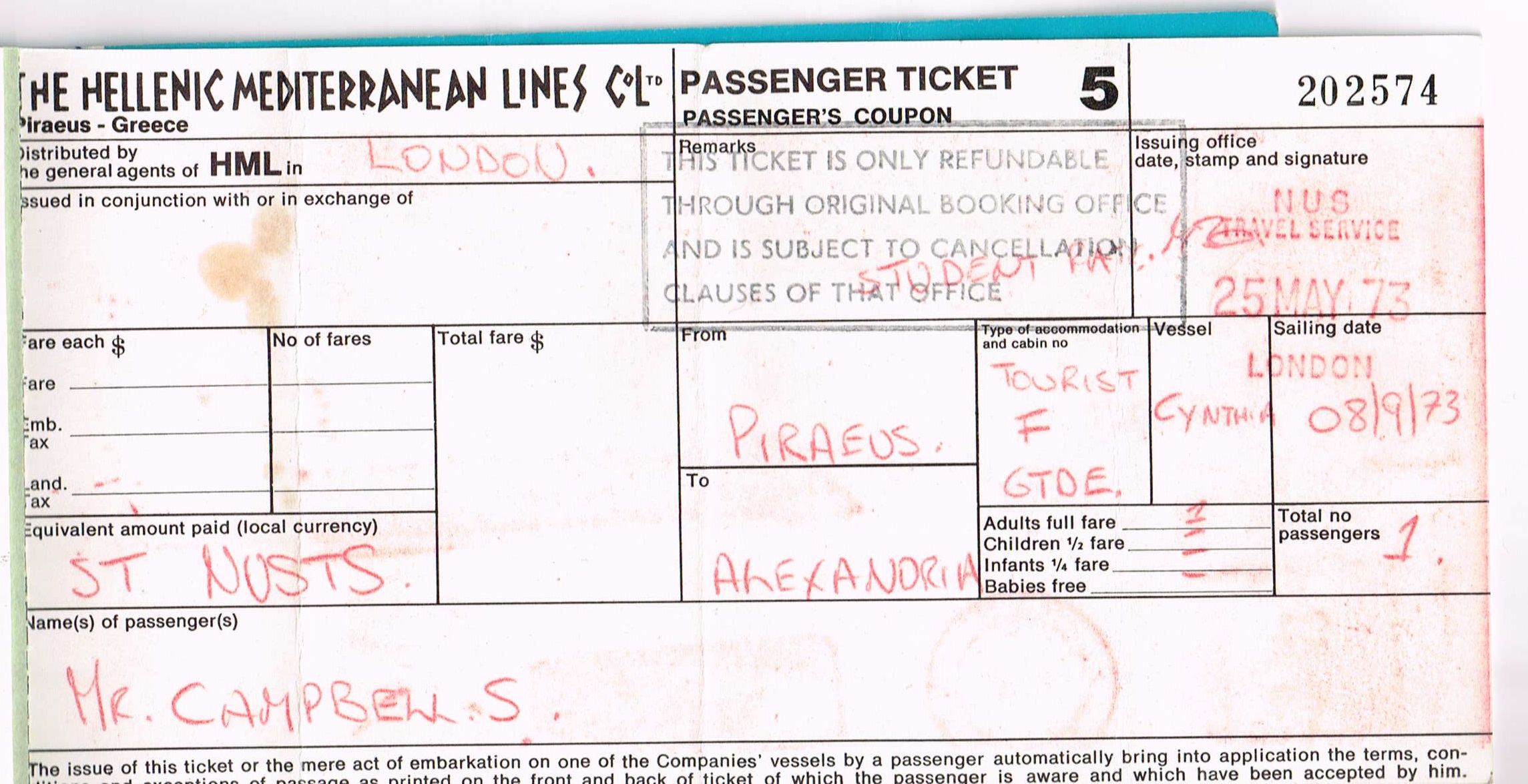
cynthia ticket 001My third novel Cairo Mon Amour (publication July 2016) is set in Egypt in 1973 during the Yom Kippur War. I happened to be a student in Cairo at that time, and as the borders closed, it became very difficult to leave Egypt. Several days into the war, we heard that a ship was to evacuate foreigners from Alexandria.

In the novel I have two of my characters, Pierre and Zouzou, flee the country on a ship around the same time. In my research among US diplomatic cables I discovered the actual ship was the Syria, and that it left Alex on  Thursday 11 October, five days after the war began. I could not find any contemporary descriptions of the Syria, except for an obscure article about the US diplomat Dean Dizikes*, who found the ship in Greece and organised the voyage. I drew on his description of the ship’s graceless departure in my story.

However, I was amazed to discover that US diplomats had tried unsuccessfully to requisition another ship,  the Cynthia, at Piraeus before obtaining the services of the Syria. Why amazed? Because I had sailed from Piraeus to Alexandria on the Cynthia just a month before. I have the ticket to prove it! So, in the interest of literary rather than historical integrity, I put Pierre and Zouzou on the Cynthia and wrote the Syria out of the Yom Kippur War.

The Cynthia was, by the way, a loathsome tub. I have written about my horrible voyage from Piraeus to Alex in my memoir Cairo Rations!, and I have included the relevant section at the foot of this post. If you would like to have a free copy of the entire 11,000-word memoir, email me at stuartcampbellauthorATgmailDOTcom (replace the AT and DOT with @ and . so that I know you are human) and I will send you a copy and add you to my email news list.

*The Yom Kippur War – an evacuation of the ungrateful

Read a free sample of An Englishman’s Guide to Infidelity  here. Buy Stuart Campbell’s books in paperback and ebook on Amazon by clicking on these title links:An Englishman’s Guide to Infidelity and The Play’s the Thing . Stuart Campbell’s covers are designed by Rachel Ainge .

EXTRACT FROM CAIRO RATIONS!

BY SCRAPHEAP FROM PIRAEUS TO ALEXANDRIA

We tried to catch a taxi at Piraeus station but couldn’t master the local technique of running alongside the moving vehicles, grabbing the door handles, and claiming possession. Instead I hefted our two heavy suitcases under a blinding September sun from the station to the dock. By the time we found the MV Cynthia my arms were as taut as fanbelts and my anaesthetized fingers looked like salami.

We had tickets to Alexandria for a double cabin, bought through the National Union of Students in London. The NUS wanted to sight our marriage certificate before they would sell us the tickets, and had thoughtfully franked the reverse of our Gibraltar Registry Office document with a big inky stamp.

When we arrived on the deck of the reeking Cynthia the purser shook his head in amazement that travellers with such cheap tickets could possibly believe they were entitled to a double cabin. My wife and I were separated and ordered to different parts of the stinking tub well below the waterline. I lugged the two huge suitcases to her cabin, dropped off the one we thought might contain her clothes, and then continued to drag the other one like a cockroach through the superheated rusting passageways. But I was spared: My assigned eight-berth cabin was festooned with frilly frocks – no place for a man. I used my last ounces of energy to drag the hated suitcase to the top deck. The grudging purser directed me to a double cabin above the waterline, and I threw myself onto the lower bunk and hung my throbbing hands over the side.

With the circulation to my fingers partly restored I went aloft, or perhaps abaft, and searched for my wife on the deck. The greenish tinge of her face augured badly; we were still tied up alongside the caisson wall, but the rocking of the ship, the stench of diesel, and the hot greasy miasma from the vents above the kitchens had started to do their work.

The MV Cynthia juddered out of the harbour at a funny angle like a water rat with a crushed leg. It was her last voyage before the scrapheap.

In the afternoon the ship’s swimming pool was filled up. It was barely big enough to fit six people standing but the weight of the water taken on board strained the heaving engines almost to a standstill. We hung around the canvas awning near the pool to escape the heat. An Egyptian man in swimming trunks did an elaborate callisthenic routine and introduced himself. He was captivated that I could pronounce his name properly, and asked me to repeat it over and over: “Please, what is my name?” We escaped to another part of the ship but wherever we went he seemed to be waiting in his trunks behind a lifeboat or a stanchion, and would pop out and inanely ask, “Please, what is my name?” I would repeat robotically,  “Mar’i Kamil S-“. I leave his last name incomplete in case he is still alive and wants to be my friend on Facebook.

In the evening the toilets overflowed and we had to hop through sewage to get to the hotbox  where dinner was served to the third class passengers. A waiter probably named Malvolio guarded the kitchen entrance with a filthy tea towel over his arm. The food – it hardly needed guarding – was Kit-E-Kat mashed into macaroni tubes. We gagged and picked over our bowls, but our table companions – cadaverous British hippies who had been in India for months – golloped theirs down, and then finished our leftovers. Our hearts leapt as fat peaches were handed out, and then shrivelled when they were cut apart to reveal the plump maggots within.

We parted late that night on the upper deck, but not before I had my first real conversation in Arabic outside a classroom. While my wife leaned over the rail to find some air that didn’t smell of Kit-E-Kat, I watched a Lebanese family chatting in the moonlight. There was another ship in the distance and a man in the group commented that it was from the same shipping line as the Cynthia. He actually said nafsi shirka, ‘the same company’. I grabbed my chance and attempted to join the conversation by loudly intoning nafsi shirka with a questioning intonation. On reflection I suppose I was saying, “Oh, family of complete strangers, is it indeed a fact that the ship we see is from the same company as the ship we are on?”

The family turned to stare at the apparition at the rail whence the odd utterance had come: A moustachioed wraith with shoulder length black hair supporting a young woman who was sobbing and retching under the moon.

I spent the night awake in terror listening to the stranger in the upper bunk making long rhythmic noises like a razor being sharpened on a leather strop.

At Beirut – not yet torn apart by the civil war – we ordered massive plates of rice and minted lamb in a restaurant but could barely eat a few spoonsful, so shrunken were our stomachs. We made it back to the Cynthia by smell alone, and fought the crush of Egyptians who were boarding with boxes of Lebanese apples as big as babies’ heads.

As we sailed for Cyprus a black and yellow flag was raised – cholera! – and instead of entering Limassol harbour we stood offshore in quarantine. A Mercedes Benz was hoisted from the Cynthia’s deck on davits and swung wobbling onto a wooden barge, which puttered off to Limassol with a few passengers.

Like a malodorous pariah, the Cynthia limped towards Egypt, its decks still stacked with boxes of apples. Officials came out to meet us in Alexandria harbour and we were lined up and each given a large white cholera pill, the composition and efficacy of which we knew nothing. The officials had a loud discussion about the apples and a decision was made: Destroy them! They may be infected! The boxes were broken apart and the passengers ate the apples.

Some hours later the Cynthia eased her dented flanks alongside the berth and the engines stopped grinding. We lined up in an immigration hall where men in uniform took all our passports and made a toppling pile of them on a desk. I watched in anxiety: How would they return the passports to the correct owners? What if I got the wrong passport and I had to spend the rest of my life as Mar’i Kamil S-?

LESLEY LATTE BLOWS H** EXCLUSIVE INTERVIEW WITH STUART CAMPBELL

Stuart Campbell's student card. Cairo University 1973
Stuart Campbell’s student card. Cairo University 1973

I was browsing some tempting sausages at the charcuterie stall in Nouméa’s municipal market last week when to my astonishment I saw Sydney author Stuart Campbell at the coffee stand.

An appointment with the reclusive and publicity-shy Campbell is hard to get – an impromptu interview a virtual impossibility. I approached him and gave him my finely honed elevator pitch. My luck was in. Was it the sultry laid-back groove of New Caledonia? Or perhaps the large glass of Pernod on the counter?

“I’ve got ten minutes,” he said with that trademark suave elevation of the slightly grizzled but really incredibly sculpted masculine eyebrow

OM Freaking G, I thought! Two weeks out of on-line journalism school, and I’ve scored an exclusive with the author of An Englishman’s Guide to Infidelity.

So tell me about your next book, I ventured.

Campbell nodded to the barman, who topped up the Pernod and brought another flask of water. Frankly, I don’t know how anybody can drink something that looks like what you spit out after you’ve cleaned your teeth, but old blokes seem to drink it all the time in France, or maybe they just look old because they drink so much of it and they’re, like, quite young really.

Anyway, I gather the new book is called Cairo Mon Amour. It’s set in Cairo in 1973 during a war, I think he said the Young Kipper? Not sure about that, but apparently he was a student in Cairo during that war and always meant to write a thriller about it. It’s coming out in July 2016.

At this point he asked me if I had an aspirin because he had an earache because he got some coral in his ears swimming and he’d gone deaf.

“Who do you say you write for?” he asked me.

“I’m an emerging social commentator and the roving correspondent for Charcuterie Monthly,” I responded.

“Didn’t you say The Guardian?”

“I might have done,” I confessed.

“Go back to your sausages,” he said.

Well, I don’t know about you, but his new book sounds like crap.

###

** Lesley Latte reserves the right not to disclose h** gender

Buy Stuart Campbell’s books in paperback and ebook on Amazon by clicking on these title links:

An Englishman’s Guide to Infidelity

The Play’s the Thing

Stuart Campbell’s covers are designed by Rachel Ainge .

A Soviet diplomat’s epiphany in Armenia

KPSU card 001This is a short extract from my novel in progress Cairo Mon Amour that deals with Ivan Zlotnik, a Soviet diplomat posted to Cairo in 1973. I built Zlotnik’s character on slivers of the biographies of numerous Soviet diplomats of the era.

The novel is partly an indirect homage to the Armenian Genocide, which explains why I chose Yerevan for Zlotnik’s epiphany.

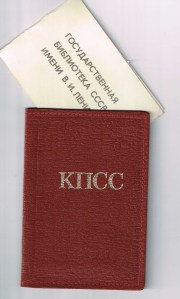
The illustration is my Communist Party of the Soviet Union membership card holder, a souvenir from my time as a student in Moscow, when I might have bumped into Zlotnik. Tucked into the card holder is my Lenin Library card.

A big thank you to my critical mates in the Write On! group in Sydney, who gave me input into an earlier draft.

I’d love to hear your responses to this extract.

©Stuart Campbell. Please respect my intellectual property by not copying the extract. There is lots of free stuff that you can legally share elsewhere on my site.

________________________________________________________________________

“You always had it made, Ivan,” his fellow MGIMO graduates would say. It was true: Barely out of university, he had the gaudy rewards of the elite in the tiny Moscow apartment, right down to the Everley Brothers records, the Marlboro cigarettes and a Playboy magazine. But when the drinking was under way –  a shot of Johnny Walker  between slugs of Stolichanaya – his pals’ resentment dissolved in alcoholic comradeship, the good old Soviet way: Drink until maudlin happiness is induced, that is if unconsciousness doesn’t set in first.

It didn’t matter that Yuri grew up in an orphanage while his father was in the Gulag, or that Pyotr was the son of a diesel mechanic from Kazan. They’d all made it through MGIMO and nobody could take away a degree from the Moscow State Institute of International Relations.

Zlotnik’s MGIMO friends seldom asked about his schooldays in Washington DC, where his father had been a diplomat. As for him, he preferred not to talk about being the one who sat out the Great Patriotic War in capitalist luxury while they froze their yaytsa off and lived on crusts. But his past made a difference; Zlotnik knew the West as an insider; he knew how the West felt. And this, he knew, made him dangerous, more susceptible to blandishments from beyond the Iron Curtain, a man to be carefully watched.

His parents had taken him home to Moscow in 1949, the year that Orwell’s 1984 was published. Zlotnik wolfed the book down a week before they left. But at seventeen, his political sensitivities were too undeveloped to fit the novel into a framework that included himself – Ivan Maksimovich Zlotnik, the American-speaking Russian kid who was going home. But something from Orwell must have stuck, and then it all came unstuck thirteen years later in 1962.

His was a life cut in half, he often thought: First, the years of hope and prospect and privilege when all you did made a kind of sense, and the bits that didn’t could be explained away, even his hollow marriage to Raisa. These were the years when you could reconcile the doublethink – how clever Orwell’s term was – by never daring to imagine that Soviet power was not impregnable; when as the son of a senior diplomat you had a responsibility to uphold the might of the state and prosecute its interests in Jakarta, in Hanoi, in Sydney, in corners of the world where a MGIMO graduate repaid his debt to the people. These were the years when you practised a refined dual consciousness that allowed you to lead a life based on the precepts of the Party in the sure knowledge that communism was doomed. These were the years when you reasoned away the sick in your gut when the Hungarian and Polish uprisings were crushed.

And then 1962, the height of Khrushchev’s thaw: One Day in the Life of Ivan Denisovich was in the Moscow bookshops, there for all to read uncensored from cover to to cover, not chopped up in bits of samizdat passed illegally from hand to hand; the Gulag was exposed in all its grinding, petty, bureaucratic cruelty. In May he took a copy to Yerevan, where he was sent to prepare a propaganda article on the removal of Stalin’s statue and the installation of the Mother Armenia monument. But his real job was to collect intelligence on dissidents in the small Russian community who lived among the Armenian majority.

The day before he left he met with his wife Raisa, who was passing through Moscow. She told him that her temporary posting to the hospital in Nizhniy Novgorod had been made permanent: A promotion, not to be turned down. They would get together when they could. He’d loved her, he thought, at the beginning. But she was a doctor, he a diplomat. Their futures belonged to the state, not to themselves.

***

Zlotnik was seduced by Yerevan: The dignified self-sufficiency of the people, the stubborn uniqueness of the culture, the resistance to having their Armyanskaya Sovietskaya Respublika swamped by Russians as all the other ethnic satellites were. It was balmy springtime, the wine was good, and the women were comely. He carefully read Denisovich in his hotel room with faint echoes of Orwell’s 1984 resonating with Solzhenistyn’s words. And something in his head – or was it his heart? – came unstuck.

For the next few days he suffered anxiety and shapeless unease. One night he downed a bottle of Armenian konyak and stood on his balcony drinking in the balm of spicy air that blew across the slopes clad with grape vines and citrus. Mount Ararat was fifty kilometres to the south inside Turkey, invisible but palpably sacred in the dark. Later, he often thought, the second half of his life began that night when he heard footsteps below his window. He looked down and a young, dark woman of astonishing beauty called up to him in Armenian from the floodlit car park.

“Sorry, don’t understand,” he mumbled stupidly in Russian.

She was perhaps a little younger than his twenty nine years, dark eyes, pale skin, dressed in a flouncy black dress and carrying a violin case.

“Did you see a car around here? A black Gaz? It’s my lift home.”

“Sorry comrade, I’ve been here all night.”

“Thanks comrade, perhaps I’ll take the tram,” she said, but then a pair of lights appeared on the road outside the hotel and she turned away.

“Before you go,” Zlotnik called out. “Where are you playing?”

She turned and he watched, charmed, as the taffeta dress swirled: “I’m playing in Anoush. At the Spendiarian Theatre. Come and see.”

The next night he traded a favour to get a ticket. Anoush, it turned out, was considered Armenia’s national opera. He was overwhelmed by the majestic gravity of the performance, by the unsettling fusion of oriental and western themes and cadences. He understood nothing of the text, but during the finale he put his head in his hands and silently cried for the loss of the first half of his life. Something had come unstuck, and he would never again be able to reconcile the doublethink; damn Orwell and his word!

In the morning he was recalled to Moscow to take up the second half – the equivocal, duplicitous, dissimulating half – of his life.

©Stuart Campbell

______________________________________________________________________

Buy Stuart Campbell’s books in paperback and ebook on Amazon by clicking on these title links:

An Englishman’s Guide to Infidelity

The Play’s the Thing


I think a war just started


P1020460This is an extract from my memoir Cairo Rations, which you can download free under a Creative Commons licence. I wrote the memoir as the launch pad for my novel in progress Cairo Mon Amour. The picture, by the way, is my 1973 Cairo University student card.

______________________________________________________________________

In hindsight there were portents in the week leading up to October 6 1973, the day that Egypt and its allies launched an attack on Sinai and the Golan Heights without warning.

People spoke anxiously about spies and secret police: “You can’t trust anyone. Be careful who you talk to.” English friends who went horse riding at Giza on October 5 galloped too close to a military area and just avoided being arrested, perhaps shot. A few days before that my wife and I were walking one evening past a disused museum when we were ordered into the gatehouse by a couple of Green Goons. These were the intelligence police recruited from university graduates, six inches taller than the black and white askari police who did the routine work of directing traffic and chasing street thieves. We sat in the gloom on hard chairs for half an hour while they studied our passports and asked us, Why are you in Egypt? Why do you want to study Arabic? Are you Jewish? We assumed when we were allowed to leave that they were simply bored, but perhaps they really were on the lookout for spies.

Consumer goods were scarce and, again with hindsight, the civilian population may have been hoarding in expectation of shortages. Some shops around the upmarket areas near Tahrir Square were selling one-offs – a bottle of perfume, a woman’s blouse, an ornament – that we were told were brought in by Egyptians flying home from Europe.

On the night of October 6 we went to Madame P’s guest house for dinner. The usual pattern of these visits was that we would arrive to find Madame P holding court in bed wrapped in a crocheted shawl and smoking a Craven A. Often there would be a friend in attendance – an elderly Armenian lady sharing with Madame P the woes of the world. The friend would be booted out in favour of binti and ibni – we’d been promoted to ‘daughter’ and ‘son’, and while the servants made dinner Madame P would regale us with an apparently infinite account of the family in diaspora. We would walk home trying to unpick the knots of Eddys, Dikrans, Roupens, Vartanouches, Sylvias and Serges in Paris, California and Beirut.

But the guest house was hushed and tense tonight. Those gentlemen residents who were at home stayed in their rooms. It was usual for casual diners to turn up during the meal – a mysterious old man in a beret who had been imprisoned in Nasser’s time and told my wife how he remembered her from when she was a child, frizz-haired woe-betiding distant aunties, a homeless cousin who lived with the families she sewed for. But nobody came tonight and we ate our lamb and aubergine alone at the big table with its checked oilcloth cover.

A notable absence was the army journalist. Because of his size, his hee-haw voice and his bonhomie, Mr. H was impossible to ignore. He was often at the big table drinking a bottle of Stella beer and eating cucumbers one after another – ‘like a donkey’, Madame P would whisper in the kitchen.

The evening grew gloomier. Now and again one of the gentlemen came out of his room, conferred with one of the other gentlemen in whispers, and then disappeared again. Then late in the evening as we were preparing to leave Mr. H arrived, except that he was now Major H in an army uniform. And he had in his hand a piece of grey painted wood from a packing crate with Hebrew letters stencilled on the side. It had come, he said, from the front. The gents came out of their rooms and gathered around Major H; the Arabic was fast, whispered, colloquial, and I couldn’t understand the detail. We retreated into Madame P’s room and probably all smoked a Craven A – my exact recollection is faint. But one of us said, “I think a war just started”.

My wife and I walked the few streets home from Bustan Saeed Street to our flat at 29 Muhammad Mahmoud Street. Farag the one-toothed doorkeeper said good evening. I don’t remember whether he called me ‘professor’, ‘captain’ or ‘head engineer’ – he never seemed sure which honorific to use.

The next morning I went out early into the hushed neighbourhood. There were knots of people on street corners listening as someone read the war news aloud from the newspaper. I bought a copy of Al Ahram and thanked providence that my Arabic was up to understanding most of the detail. On one page was a press picture of captured Israeli prisoners, which you can still find in the Al Ahram archives. Some of them looked like Frank Zappa.

Later that afternoon I returned from the university, whose gates were barred by a tank. Almost home, I heard a voice behind me calling gaasuus israa’eeli – Israeli spy. A small rock flew past my ear, and then a few more. A gang of boys was in pursuit, but I made the street corner ahead of them and dashed into our courtyard unseen.

When it was dark I scuttled through the back alleys as far as Tahrir Square, and then across the raised walkway to the Nile Hilton. There I had a haircut of the kind David Niven would have enjoyed in Monte Carlo in 1939. The sleek and deferential barber, with a pencil moustache that could have been measured in microns, used implements that I’d never seen in Watford; after cutting my hair with belt-driven clippers, he massaged my scalp with an electrical orange rubber vibrating pad; he rubbed in unguents and oils; and then he lit tapers to singe any single strand that dared to stand up from the shiny black dome of varnished hair he had moulded to my head.

I walked home looking like a ventriloquist’s dummy, ready to face my war.


Buy Stuart Campbell’s books in paperback and ebook on Amazon by clicking on these title links:

An Englishman’s Guide to Infidelity

The Play’s the Thing

Farts in their drawers: Using and abusing foreign proverbs in fiction

fartsOne of my most treasured books is Arabic Proverbs by  J. L. Burckhardt, a Swiss orientalist famous for travelling to Mecca disguised as a Muslim in 1814-15. I’ve always found the book fascinating, and I couldn’t resist drawing on it in writing my novel Cairo Mon Amour.

A difficult technical challenge in writing this book was finding a narrative voice for my Egyptian characters. I used proverbs here and there to give some oriental spice without stereotyping; I get tired of the Bad Arab Syndrome, a condition that seems to afflict many thriller writers. I’ve vowed that no character of mine will say, “By Allah, the infidel dog will taste bitter dates this night”.

One of my favourite characters is Zouzou Paris. She’s a film actress with a notorious reputation, the mistress of a shady senior military figure. She can barely act, and admits to her friend Pierre that ‘the owl became an actress’. Here she’s explaining to her friend Pierre how she got her start:

” … I couldn’t act, but I could – let’s say – give him the kind of companionship he needed. So with the help of his movie cronies the owl became an actress, as the old saying goes,” [Zouzou said].

“You’re known as a fine actress, hardly an owl.”

“You obviously haven’t seen any of my films…”

In fact, Burckhardt’s original proverb is ‘the owl has become a poetess’, intended to describe a person who is operating above their level of competence. I adapted it to the context and added a bit of support for the reader with ‘as the old saying goes’.

Later, Pierre describes Zouzou as ‘tough as a sheep’s ear’, but this isn’t one of Burkhardt’s: I made it up. My Arabic is reasonably good, but I have no idea whether the Egyptians say this. Does is matter? I think not.

My favourite appropriation is when I have two policemen complaining about their unappreciative superiors. Here’s a snippet:

“Ha! They whine about the breeze around their turbans, but what about the farts in their drawers?” one officer said bitterly.

“And we’re the ones sniffing their farts …”

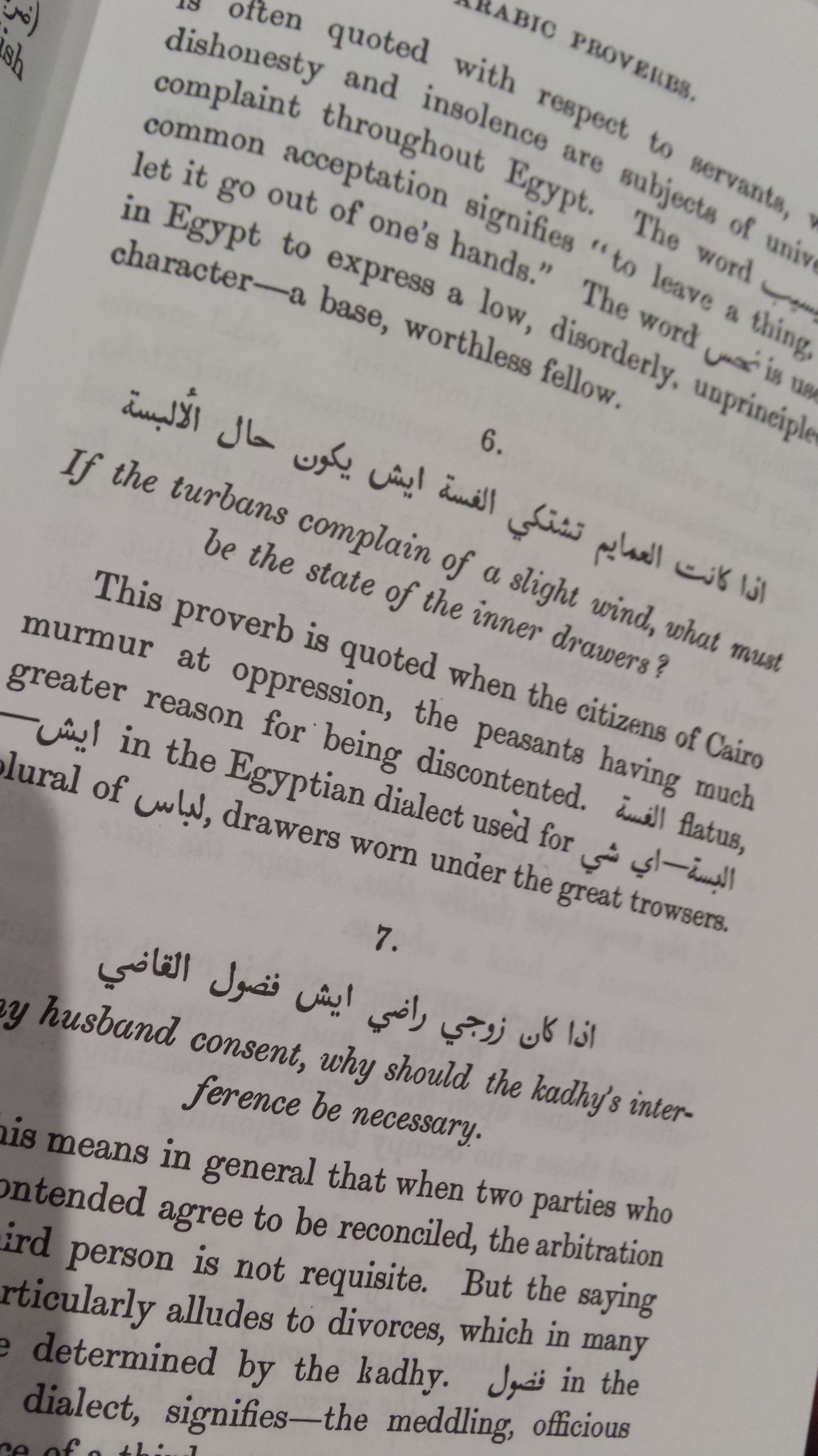
The original (see illustration) is somewhat different, and Burkhardt’s translation treats the fart word delicately: ‘a slight wind’ in the translation, and then the Latin flatus in the commentary. My version is as bawdy as the original, but I’ve modified the first part so that I give farts more emphasis by placing it later in the proverb. And I couldn’t resist adding the sniffing comeback.

I wonder if other writers have used this strategy?

Stuart Campbell

You can find out about my novels here.