The orientalist stripped bare

inscribed book
“To the English friend and guest of Egypt the orientalist Professor Stuart Campbell I give this book (author’s name redacted)

My third novel Cairo Mon Amour (publication July 2016) is set in Egypt in 1973 during the Yom Kippur War. I travelled to Egypt with my wife a few weeks before the  war started on October 6. I was to study at Cairo University, and my wife was to enjoy a reunion with her Armenian grandmother. We had  expectations of the Romantic Orient; these hopes were soon dashed.

I have written about our first days in Egypt in my memoir Cairo Rations!, and I have included the relevant section at the foot of this post. If you would like to have a free copy of the entire 11,000-word memoir, email me at stuartcampbellauthorATgmailDOTcom (replace the AT and DOT with @ and . so that I know you are human) and I will send you a copy and add you to my email news list.

Read a free sample of An Englishman’s Guide to Infidelity  here. Buy Stuart Campbell’s books in paperback and ebook on Amazon by clicking on these title links:An Englishman’s Guide to Infidelity and The Play’s the Thing . Stuart Campbell’s covers are designed by Rachel Ainge .

EXTRACT FROM CAIRO RATIONS!

THE ORIENTALIST STRIPPED BARE

The address we had been given was written in English: ‘Bustan Said’, and that was it. This piece of information had been passed along a chain of relatives from Egypt to Australia to Britain by letter and telephone, and via several languages and alphabets.

On our first night in Egypt we booked into the Hotel Cecil in Alexandria, where Somerset Maugham had stayed and the British Secret Service used to rent a permanent suite. Our mission was to travel to Cairo the next morning to find my wife’s relative’s boarding house. I spent the evening combing the telephone directory for anyone with Madame P’s surname and calling them up. “No, not here. Who’s that?”, “Who, who? Not here!” It didn’t help that the phone book was in Arabic and that Madame P’s Armenian name could have been spelt in at least six ways. But this was 1973: People didn’t expect to locate some exact spot on the surface of the earth in microseconds; people were used to being stood up, missing each other at planned meetings; people were used to unanswered phones. We went to bed without misgivings.

The train took us through the Delta to Cairo the next day, and I fought for and won a taxi at Ramses Station, asking the driver to take us to Bustan Said Street. I tried pronouncing ‘Said‘ in several ways – the four bald English letters gave about half the information needed to guess the Arabic word – and the driver lurched fatalistically into the traffic, no doubt praying that the mysterious location would magically appear before his rheumy eyes. It didn’t of course, although we did crawl up and down Bustan Street many times, craning to see past the bogged traffic and the sticky fingers of the child beggars on the car window, in case we saw a huge illuminated sign for Pension P. Nothing. “Take us to a hotel,” I said, and he drove for miles, eventually stopping outside an unmarked establishment in an empty street blighted with dusty urban poverty. We refused a squalid room upstairs with six frowzy beds, and resumed our journey. This time I said to the driver, “Take us to funduq urubbii“, ‘a European hotel’. I still cringe at the memory of the clumsy request. We were delivered to the posh Borg Hotel, where our room had just one bed.

My only experience of the Arab World had been our honeymoon in Tangier, a memory naturally tinted with romance, or more specifically The Romance of the Orient. Our taxi trip had left me with the impression that most of Cairo looked like a rubbish dump, but waking up in a decent hotel with a view of the Nile restored my hope that the Orient was out there to be found. Even better, the front desk staff knew exactly which street Pension P was in – Bustan El-Saeedi Street, right opposite the Filfila Restaurant. With the missing syllables restored to Madame P’s address, we checked out of the Borg and took another cab. And here we were, outside an Italianate apartment building in chaotic Bab El-Luq with all the prescribed features of The Orient around us: Men in nightshirts and turbans, donkeys, street stalls, thronging crowds, beggars, hullabaloo. We took the shuddering birdcage lift to the fourth floor and were admitted to a large vestibule with a dining table and a dozen or so chairs, and seven or eight doors leading to bedrooms around the sides. A couple of professional gents sat us down and politely explained that Madame P was out shopping. They sent out for fuul medammes and boiled eggs while we waited. The gents were two of Madame P’s boarders. Some weeks later, one of them – an army journalist – gave me a signed copy of a book he had written in praise of President Sadat. He inscribed it in Arabic, To the English friend and guest of Egypt the orientalist Professor Stuart Campbell I give this book.

Now might be a good point to take stock of how things stood with the Orient in 1973, at least among the people that I mixed with. Despite its glee at the dismantling of the colonial order, nouveau intellectual youth culture in the UK had inherited the cultural blueprint of the East drawn up by former generations: The Orient of the Beatles and the bandwagon Indian mystics was sensual, passive, spiritual, dismissive of material concerns. This hippy formulation wasn’t much different from that of T.E. Lawrence’s views of the Arabs he led at the fall of Damascus in 1918. As for me, I spent the first two years of my degree luxuriating in the works of old-time Orientalists like William Lane, Richard Burton and Gertrude Bell. The task, I believed, was for the West and the East to reach mutual understanding, mutual respect, world peace and all that. The bit that I missed was that we, the colonialists, had written the rules and the East didn’t have a say. Five years later the Palestinian-American scholar Edward Said launched his seminal book Orientalism, changing for ever the rules of intellectual engagement in the study of cultures. After Edward Said nobody wanted to be called an orientalist.

Let’s return to the dining room at Madame P’s. We had finished the fuul and eggs, and there was still no sign of the lady. The professional gents sent for a young man, a university student, who must have lived in the building, and he was told to take us around the neighbourhood to look for Madame P. We went from shop to shop while the student practised his English on us. I was expecting him to be interested and flattered (I cringe deeply again) that a British student had gone to the trouble of studying his language and his culture. Instead he questioned me brusquely about why I was in Egypt, eventually becoming quite sarcastic and tossing in terms like ‘imperialist’ and ‘invader’. We didn’t find Madame P, but by the time we returned to the Pension she was there, and the sour student slipped away. There were hugs and kisses, and my wife, her relative and an ex-orientalist settled down to catch up on family history.

Indie authors like Francis Guenette producing stellar work

Francis Guenette - author photo (1)
Francis Guenette

These days I seem to divide my reading between carefully selected indie authors and a long backlist of classics. A week or two back I found myself reading Canadian indie author Francis Guenette’s Disappearing in Plain Sight alongside Katherine Anne Porter’s Ship of Fools, which stormed the literary world in 1962.

The comparison was instructive: Both novels are driven by strong characters, and both immerse the reader in compelling settings. At the same time, there was a complementarity between the books: Porter’s scathingly critical analysis of the hapless passengers on a pre-war journey from Mexico to Europe; Guenette’s insistence on redemption for her damaged and difficult characters in rural British Columbia.

I haven’t reviewed Porter; after all, she did get a Pulitzer decades before the Kindle was a gleam in anyone’s eye. But  I did give Disappearing in Plain Sight five stars here

I’d love to ask Katherine Anne Porter some questions about Ship of Fools. Alas, I am 36 years too late. However, I popped a few questions to Francis about her thoughts on Disappearing in Plain Sight:

Q – What would you say to your character Izzy if you came across her in a coffee shop?

A – Hands down, I would ask her for more Caleb stories. Izzy’s first husband, Caleb, the man who created the paradise at Crater Lake that Izzy inhabits, is dead before the opening lines of Disappearing in Plain Sight and yet he has often been named as people’s favourite character. One reader went as far as to say that Caleb is the moral compass of the novel. Glimpses into this man’s personality and charisma saturate the entire Crater Lake Series. I know as the books add up and I move further from his death and into the lives of the people left behind, I will have to be more and more creative in my task of keeping him in the present narrative. Come on, Izzy. Help me out here.

Q – Did you fall in love with any of your characters when you were writing the book?

A – Hmmm … since a little bit of me is in every single character, I was narcissistically in love with each of them. Differing personality traits appealed to me. I admired Lisa-Marie’s feistiness. Who wouldn’t fall for Justin’s good looks and code of honour?  I fell madly in love with Beulah’s sharp wit and wry comments. My heart went out to Bethany for the cards life had dealt her. Liam’s strength and fragility wrenched my emotions every time I encountered him. And Izzy’s struggles with grief and professionalism buffeted me with echoes of many, many stories I’ve heard over the years. As you can probably tell, these characters mattered to me. If, as an author, I am not emotionally committed to my characters, how can I expect the readers to care?

Q – Do you ever wish you’d ended the book differently?

A – Absolutely not – the ending of Disappearing in Plain Sight gives me great satisfaction. The novel never started out to be the first book in a series. It was simply a story I had to tell. When I try now to answer questions about where the characters or ideas came from, I’m at a loss to provide an answer. All I do know is that the ending more than any other part of the book had the characters clamouring in my head to have the next chapters of their lives told. After three novels, they are still at it with new characters constantly making appearances and begging for attention.

The verdict after my week of parallel reading: Porter is deservedly part of the canon of English language literature, but  indie authors like Guenette are producing stellar work. Both books gave me immense satisfaction.

Read a free sample of An Englishman’s Guide to Infidelity  here. Buy Stuart Campbell’s books in paperback and ebook on Amazon by clicking on these title links:An Englishman’s Guide to Infidelity and The Play’s the Thing . Stuart Campbell’s covers are designed by Rachel Ainge .

Escape from Egypt during the Yom Kippur War

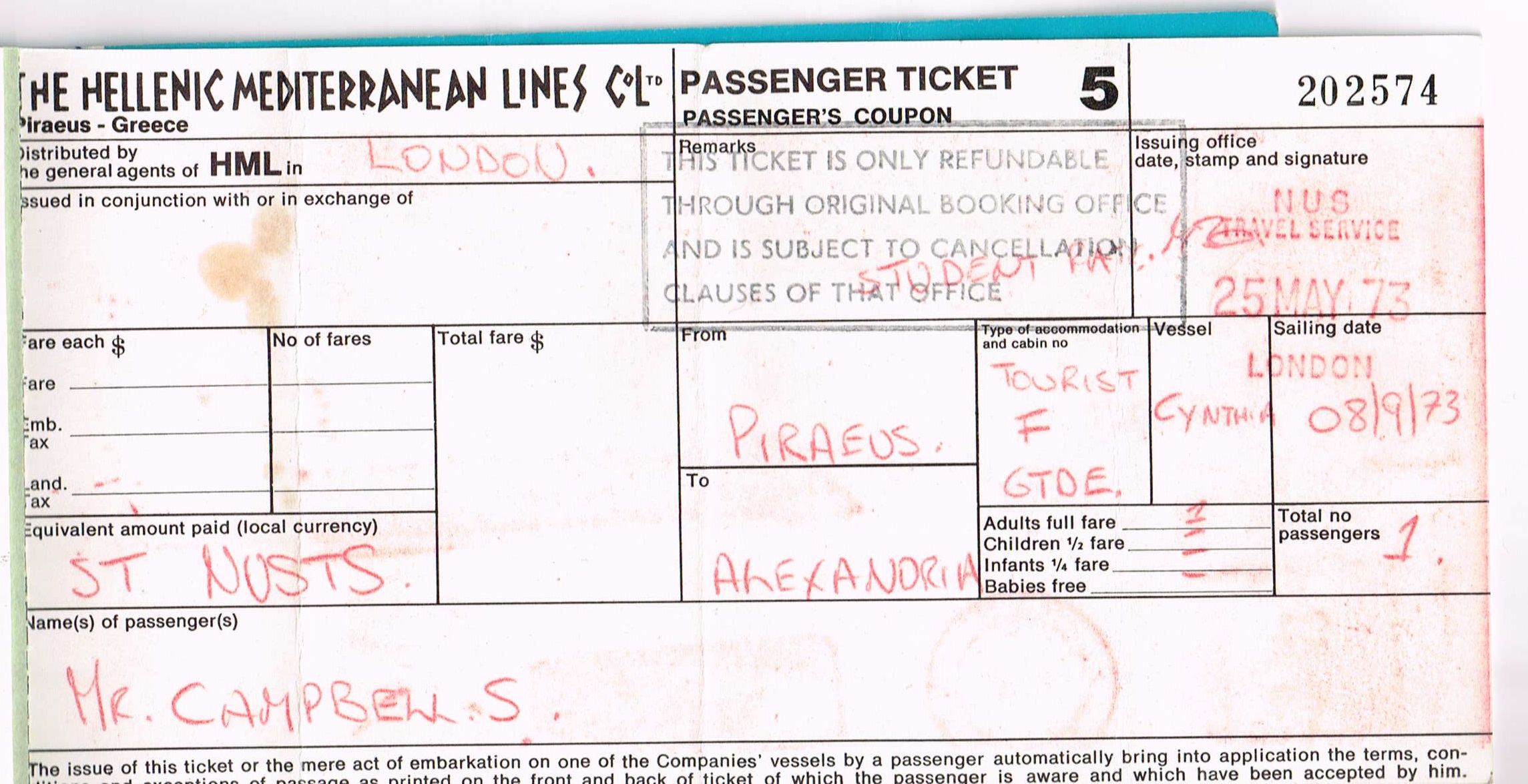
cynthia ticket 001My third novel Cairo Mon Amour (publication July 2016) is set in Egypt in 1973 during the Yom Kippur War. I happened to be a student in Cairo at that time, and as the borders closed, it became very difficult to leave Egypt. Several days into the war, we heard that a ship was to evacuate foreigners from Alexandria.

In the novel I have two of my characters, Pierre and Zouzou, flee the country on a ship around the same time. In my research among US diplomatic cables I discovered the actual ship was the Syria, and that it left Alex on  Thursday 11 October, five days after the war began. I could not find any contemporary descriptions of the Syria, except for an obscure article about the US diplomat Dean Dizikes*, who found the ship in Greece and organised the voyage. I drew on his description of the ship’s graceless departure in my story.

However, I was amazed to discover that US diplomats had tried unsuccessfully to requisition another ship,  the Cynthia, at Piraeus before obtaining the services of the Syria. Why amazed? Because I had sailed from Piraeus to Alexandria on the Cynthia just a month before. I have the ticket to prove it! So, in the interest of literary rather than historical integrity, I put Pierre and Zouzou on the Cynthia and wrote the Syria out of the Yom Kippur War.

The Cynthia was, by the way, a loathsome tub. I have written about my horrible voyage from Piraeus to Alex in my memoir Cairo Rations!, and I have included the relevant section at the foot of this post. If you would like to have a free copy of the entire 11,000-word memoir, email me at stuartcampbellauthorATgmailDOTcom (replace the AT and DOT with @ and . so that I know you are human) and I will send you a copy and add you to my email news list.

*The Yom Kippur War – an evacuation of the ungrateful

Read a free sample of An Englishman’s Guide to Infidelity  here. Buy Stuart Campbell’s books in paperback and ebook on Amazon by clicking on these title links:An Englishman’s Guide to Infidelity and The Play’s the Thing . Stuart Campbell’s covers are designed by Rachel Ainge .

EXTRACT FROM CAIRO RATIONS!

BY SCRAPHEAP FROM PIRAEUS TO ALEXANDRIA

We tried to catch a taxi at Piraeus station but couldn’t master the local technique of running alongside the moving vehicles, grabbing the door handles, and claiming possession. Instead I hefted our two heavy suitcases under a blinding September sun from the station to the dock. By the time we found the MV Cynthia my arms were as taut as fanbelts and my anaesthetized fingers looked like salami.

We had tickets to Alexandria for a double cabin, bought through the National Union of Students in London. The NUS wanted to sight our marriage certificate before they would sell us the tickets, and had thoughtfully franked the reverse of our Gibraltar Registry Office document with a big inky stamp.

When we arrived on the deck of the reeking Cynthia the purser shook his head in amazement that travellers with such cheap tickets could possibly believe they were entitled to a double cabin. My wife and I were separated and ordered to different parts of the stinking tub well below the waterline. I lugged the two huge suitcases to her cabin, dropped off the one we thought might contain her clothes, and then continued to drag the other one like a cockroach through the superheated rusting passageways. But I was spared: My assigned eight-berth cabin was festooned with frilly frocks – no place for a man. I used my last ounces of energy to drag the hated suitcase to the top deck. The grudging purser directed me to a double cabin above the waterline, and I threw myself onto the lower bunk and hung my throbbing hands over the side.

With the circulation to my fingers partly restored I went aloft, or perhaps abaft, and searched for my wife on the deck. The greenish tinge of her face augured badly; we were still tied up alongside the caisson wall, but the rocking of the ship, the stench of diesel, and the hot greasy miasma from the vents above the kitchens had started to do their work.

The MV Cynthia juddered out of the harbour at a funny angle like a water rat with a crushed leg. It was her last voyage before the scrapheap.

In the afternoon the ship’s swimming pool was filled up. It was barely big enough to fit six people standing but the weight of the water taken on board strained the heaving engines almost to a standstill. We hung around the canvas awning near the pool to escape the heat. An Egyptian man in swimming trunks did an elaborate callisthenic routine and introduced himself. He was captivated that I could pronounce his name properly, and asked me to repeat it over and over: “Please, what is my name?” We escaped to another part of the ship but wherever we went he seemed to be waiting in his trunks behind a lifeboat or a stanchion, and would pop out and inanely ask, “Please, what is my name?” I would repeat robotically,  “Mar’i Kamil S-“. I leave his last name incomplete in case he is still alive and wants to be my friend on Facebook.

In the evening the toilets overflowed and we had to hop through sewage to get to the hotbox  where dinner was served to the third class passengers. A waiter probably named Malvolio guarded the kitchen entrance with a filthy tea towel over his arm. The food – it hardly needed guarding – was Kit-E-Kat mashed into macaroni tubes. We gagged and picked over our bowls, but our table companions – cadaverous British hippies who had been in India for months – golloped theirs down, and then finished our leftovers. Our hearts leapt as fat peaches were handed out, and then shrivelled when they were cut apart to reveal the plump maggots within.

We parted late that night on the upper deck, but not before I had my first real conversation in Arabic outside a classroom. While my wife leaned over the rail to find some air that didn’t smell of Kit-E-Kat, I watched a Lebanese family chatting in the moonlight. There was another ship in the distance and a man in the group commented that it was from the same shipping line as the Cynthia. He actually said nafsi shirka, ‘the same company’. I grabbed my chance and attempted to join the conversation by loudly intoning nafsi shirka with a questioning intonation. On reflection I suppose I was saying, “Oh, family of complete strangers, is it indeed a fact that the ship we see is from the same company as the ship we are on?”

The family turned to stare at the apparition at the rail whence the odd utterance had come: A moustachioed wraith with shoulder length black hair supporting a young woman who was sobbing and retching under the moon.

I spent the night awake in terror listening to the stranger in the upper bunk making long rhythmic noises like a razor being sharpened on a leather strop.

At Beirut – not yet torn apart by the civil war – we ordered massive plates of rice and minted lamb in a restaurant but could barely eat a few spoonsful, so shrunken were our stomachs. We made it back to the Cynthia by smell alone, and fought the crush of Egyptians who were boarding with boxes of Lebanese apples as big as babies’ heads.

As we sailed for Cyprus a black and yellow flag was raised – cholera! – and instead of entering Limassol harbour we stood offshore in quarantine. A Mercedes Benz was hoisted from the Cynthia’s deck on davits and swung wobbling onto a wooden barge, which puttered off to Limassol with a few passengers.

Like a malodorous pariah, the Cynthia limped towards Egypt, its decks still stacked with boxes of apples. Officials came out to meet us in Alexandria harbour and we were lined up and each given a large white cholera pill, the composition and efficacy of which we knew nothing. The officials had a loud discussion about the apples and a decision was made: Destroy them! They may be infected! The boxes were broken apart and the passengers ate the apples.

Some hours later the Cynthia eased her dented flanks alongside the berth and the engines stopped grinding. We lined up in an immigration hall where men in uniform took all our passports and made a toppling pile of them on a desk. I watched in anxiety: How would they return the passports to the correct owners? What if I got the wrong passport and I had to spend the rest of my life as Mar’i Kamil S-?

“The writing is smooth and delicious”

It was terrific to see this blog post by Canadian author Fran Guenette about An Englishman’s Guide to Infidelity today. I can’t disagree with her view that “the writing is smooth and delicious”!


Read a free sample of An Englishman’s Guide to Infidelity  here.


Buy Stuart Campbell’s books in paperback and ebook on Amazon by clicking on these title links:

An Englishman’s Guide to Infidelity

The Play’s the Thing

Stuart Campbell’s covers are designed by Rachel Ainge .


LESLEY LATTE BLOWS H** EXCLUSIVE INTERVIEW WITH STUART CAMPBELL

Stuart Campbell's student card. Cairo University 1973
Stuart Campbell’s student card. Cairo University 1973

I was browsing some tempting sausages at the charcuterie stall in Nouméa’s municipal market last week when to my astonishment I saw Sydney author Stuart Campbell at the coffee stand.

An appointment with the reclusive and publicity-shy Campbell is hard to get – an impromptu interview a virtual impossibility. I approached him and gave him my finely honed elevator pitch. My luck was in. Was it the sultry laid-back groove of New Caledonia? Or perhaps the large glass of Pernod on the counter?

“I’ve got ten minutes,” he said with that trademark suave elevation of the slightly grizzled but really incredibly sculpted masculine eyebrow

OM Freaking G, I thought! Two weeks out of on-line journalism school, and I’ve scored an exclusive with the author of An Englishman’s Guide to Infidelity.

So tell me about your next book, I ventured.

Campbell nodded to the barman, who topped up the Pernod and brought another flask of water. Frankly, I don’t know how anybody can drink something that looks like what you spit out after you’ve cleaned your teeth, but old blokes seem to drink it all the time in France, or maybe they just look old because they drink so much of it and they’re, like, quite young really.

Anyway, I gather the new book is called Cairo Mon Amour. It’s set in Cairo in 1973 during a war, I think he said the Young Kipper? Not sure about that, but apparently he was a student in Cairo during that war and always meant to write a thriller about it. It’s coming out in July 2016.

At this point he asked me if I had an aspirin because he had an earache because he got some coral in his ears swimming and he’d gone deaf.

“Who do you say you write for?” he asked me.

“I’m an emerging social commentator and the roving correspondent for Charcuterie Monthly,” I responded.

“Didn’t you say The Guardian?”

“I might have done,” I confessed.

“Go back to your sausages,” he said.

Well, I don’t know about you, but his new book sounds like crap.

###

** Lesley Latte reserves the right not to disclose h** gender

Buy Stuart Campbell’s books in paperback and ebook on Amazon by clicking on these title links:

An Englishman’s Guide to Infidelity

The Play’s the Thing

Stuart Campbell’s covers are designed by Rachel Ainge .

John MW Smith – a born story teller

After six months of reading and re-reading  British and American classic works*, I packed some carefully selected independent writers onto my battered Kindle for the summer break.
Englishman John MW Smith was a quirky surprise: A writer hard to categorise, he has a ripe sense of the bizarre and the storytelling knack of a barroom raconteur. He reminds me somewhat of my fellow Australian writer Robert Salisbury, whose work I describe as ‘Spike Milligan meets Don Quixote’.

My five-star  review of Smith’s An Unlawful Act in Libya can be found here. Strongly recommended.


*The three standouts were Hardy’s Jude the Obscure, Faulkner’s Soldier’s Pay, and Katherine Anne Porter’s Ship of Fools. I’m thinking of writing a novel that places the basic plot of Jude the Obscure in a future dystopia when western societies have largely forgotten how to do mathematics. Mad? Maybe.

And here’s a request: I saw the movie of Ship of Fools some time in the last century, around the time that Cuban heels were in fashion. Does anyone know where I can find a copy or a streaming source?

Buy Stuart Campbell’s books in paperback and ebook on Amazon by clicking on these title links:

An Englishman’s Guide to Infidelity

The Play’s the Thing

Stuart Campbell’s covers are designed by Rachel Ainge .

Call me a perfectionist …

perfectionist 1953 quiffI’ve issued a revised version of An Englishman’s Guide to Infidelity in e-book and paperback that corrects some typos and fixes some punctuation issues. The e-book also now includes a clickable table of contents. You can find the revised versions here.

Sarah Bourne launches ‘Two Lives’

mini book launch
Stuart Campbell missing Sarah Bourne’s book launch

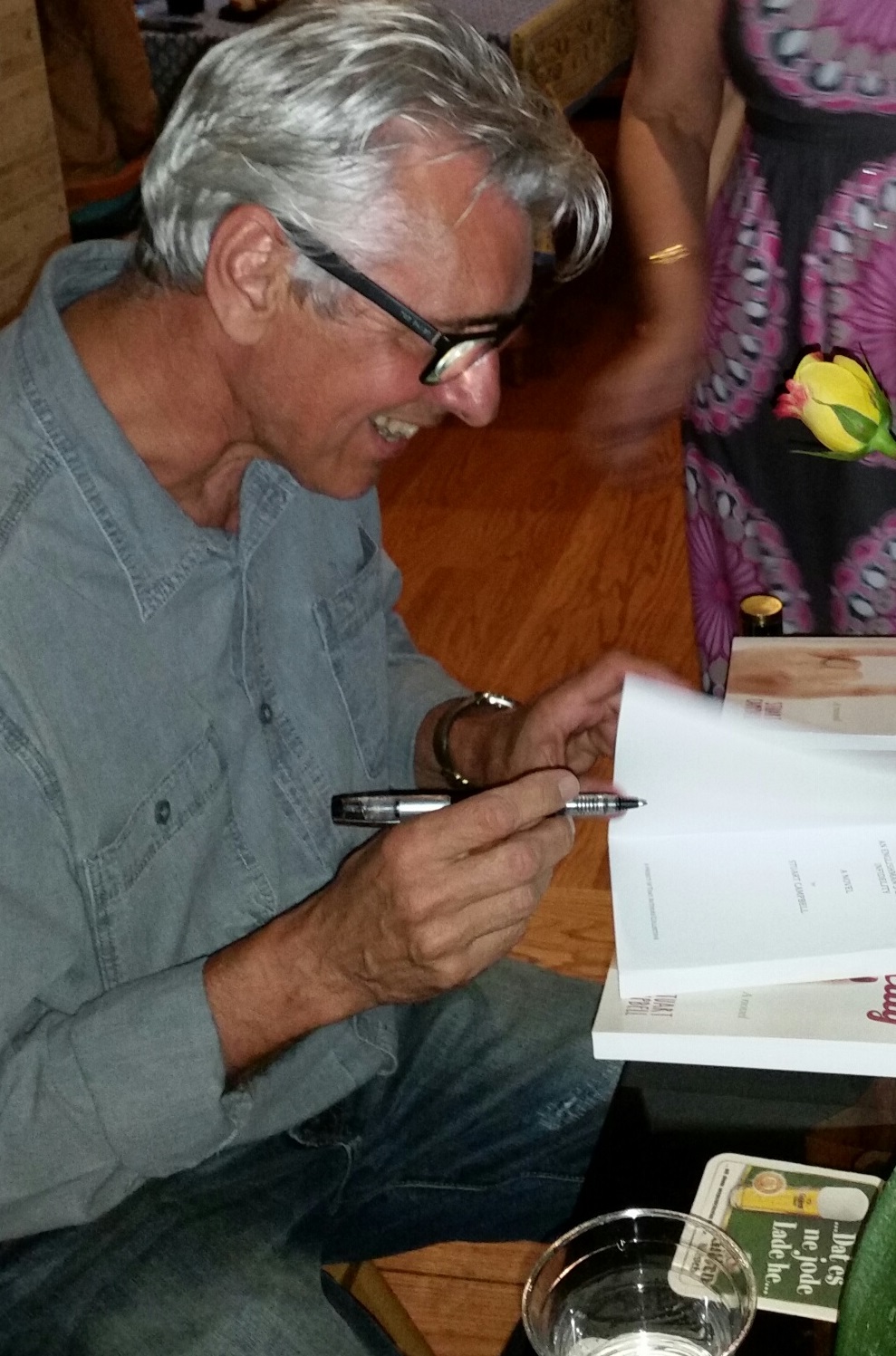
Congratulations to my good friend Sarah Bourne on the recent Sydney launch of her novel Two Lives, available here. Unfortunately I couldn’t be at the launch because at the time I was fighting off the fans as I signed copies of one of my novels in San Francisco (well I signed four books at my wife’s aunt’s house), but you can read about Sarah’s event here, and you can read my review of her book here.

Being a fan of book launches, especially the well lubricated variety, I couldn’t resist including one in my novel An Englishman’s Guide to Infidelity. Here it is, narrated by my character Fiona Salmon.

My time as a widowed gym-addicted police officer hadn’t left time for anyone outside professional contacts, let alone friends or casual acquaintances. But my author’s book launch crowd were a stratum of cathedral town society I’d never known existed: Earnest students – the kind who look like Che Guevara and Janis Joplin, whichever era they are born in; elderly amateur intellectuals – the women with close cropped hair and large red framed glasses, and the men with embroidered waistcoats and brown trainers; comfy young couples in conservative wear paired together like lovebirds; assorted old lecturers and young tutors from the university, looking harassed and twitchy from marking essays into the early hours; and the old codgers and their mates on the scrounge for a plastic cup of Rioja and as many cheese cubes as they could snaffle up. My author greeted them at the door and I milled around shaking hands and topping up the plastic cups. I couldn’t remember when I’d last spent time with forty or so people who demanded nothing of me.

My author had appointed a stand-up comic – a friend who didn’t expect a fee – to MC the event and launch the book. The comic rang a small bell and stood on a shelving stool.

“Fank you ladies and gentlemen. I note that all the wine has gone so you can fuck off ‘ome,” he said, and walked out of the door and into the street, at which a couple of Che Guevaras rushed outside, captured him and stood him back on the shelving stool. And that set the tone for the rest of the evening. The wine did indeed soon run out, but I gave two Janis Joplins fifty quid, and they came back with half a dozen bottles of something exiled from the New World. My author autographed and sold fifteen copies of the novel and listened philosophically as the old codgers lectured him on using the f-word on the first page.

###

Buy Stuart Campbell’s books in paperback and ebook on Amazon by clicking on these title links:

An Englishman’s Guide to Infidelity

The Play’s the Thing