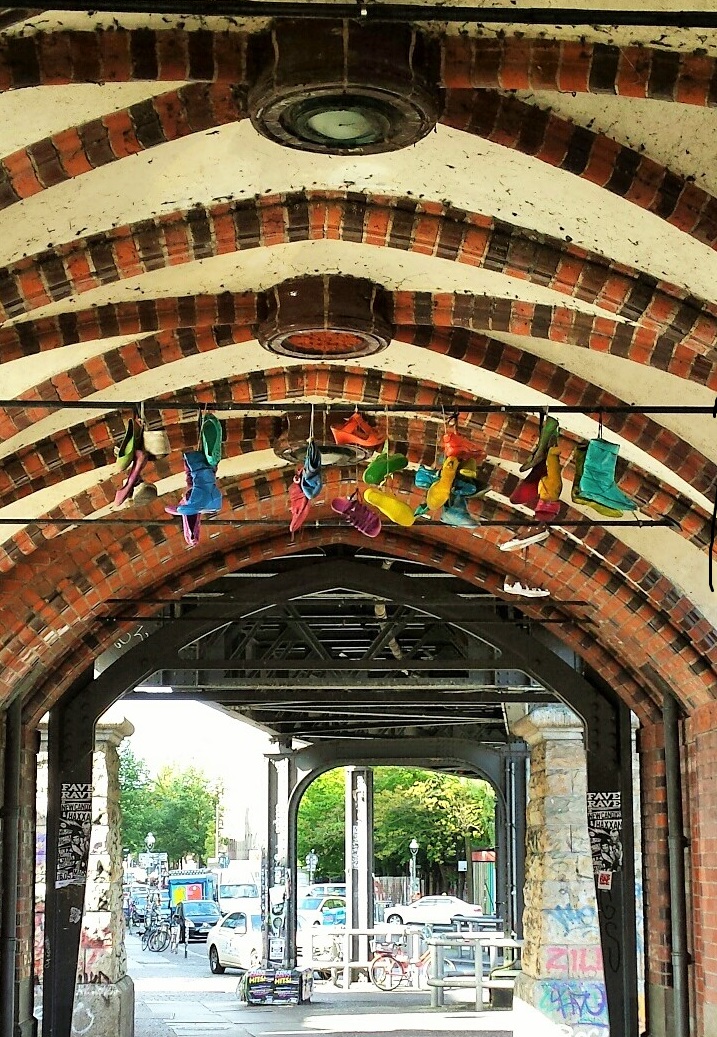
Shoes under a bridge, Kreuzberg

shoes under bridge 3We took a river trip through the centre of Berlin today, and somewhere near Monbijou Park I watched a troupe of young people – puppetry students? – in black hats and white faces, following a floppy orange skeleton plodding along the river bank, controlled by long sticks manipulated by the students. There was an earnestness about the performance that I suspect might lie behind a lot of the seemingly spontaneousness art you see in Berlin.

The sponge skeleton and its disciples reminded me of our early morning walk across the quaint Oberbaumbrücke bridge, with its fairy tale towers and vaulted ceilings. The shoes hanging from the ceiling are bright and apparently new. In Australia, shoes hanging from a power line are supposed to mark a drug deal location, but are more likely the spot where a drunk had his shoes pulled off by his mates.

So what happened here? An art school assignment? A short film for a competition? Site of a spectacular drug transaction? Or did fifteen drunk people have their coloured shoes pulled off by their mates?


Find out about Stuart Campbell’s novels here.


Micro drama at Warschauer Strasse

warschauer strasse 2A day with Australian friends in gentle Charlottenburg: Saturday morning market, asparagus in season, cake, coffee, a walk to the Schloss, wine and chat in their flat.

When we leave for home, police are massed at the S-Bahn watching the soccer supporters disembark. We take the train east, and at Warschauer Strasse station the evening hordes are streaming over the bridge to the clubs and bars in gritty Friedrichshain.

London voices behind us, a girl and boy:

“Laura said she’d love her dog as much as her child.”

“She really said that?”

“Yeah.  And Ben said he’d love his dog as much as his child.”

“Naah.”

“Yeah, Ben said that.”

“That’s so f*cked up.”


Buy Stuart Campbell’s books in paperback and ebook on Amazon by clicking on these title links:

An Englishman’s Guide to Infidelity

The Play’s the Thing
 

Late afternoon drinks in Friedrichshain, Berlin

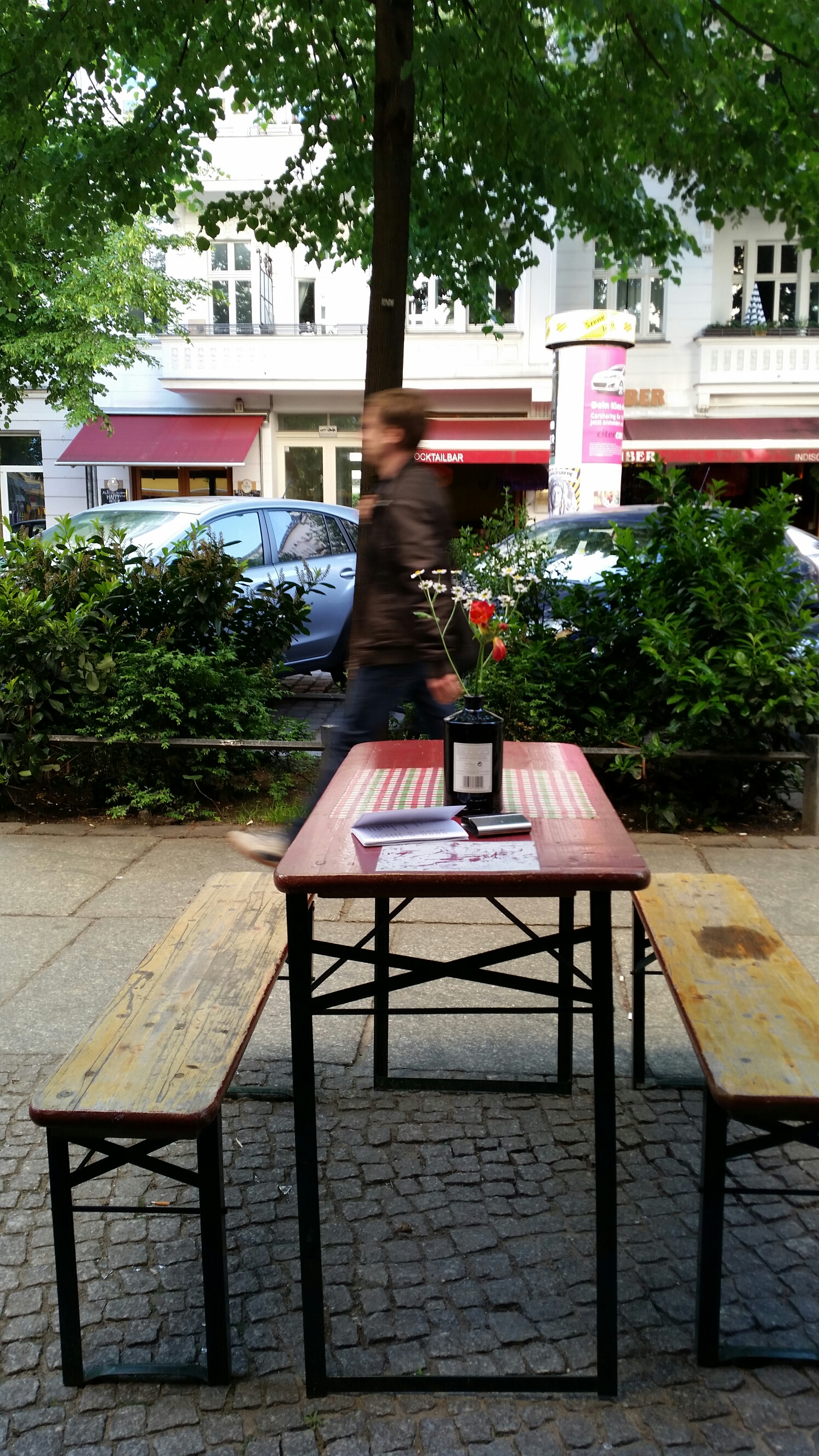
friedrichshainThe last of the sun glints through the lime tree canopy and lights up the straw-coloured Riesling in our glasses. There’s a parade past our bench on the cobblestones of Simon-Dach Strasse – a procession of defiantly liberal weirdness, no two people alike, as if each person belongs to their own tribe: A nut brown man in an Alpine hat and peculiar shorts, girls in meticulously studied scruffiness, an elaborately tattooed man in a short sleeved linen shirt with suit lapels, an angular faced woman, pale and wearing clownish tights. Tipsy on our Riesling, we wonder if the defiance of authority here – the graffiti, the public urinating, the ostentatious beer drinking on the trains – is a reaction to the city’s past oppressions. But what do we know?

Yesterday on a train I eavesdropped on two American boys, hotel management students, cranking up their campness. “I hate America,” one of them said, overdoing things a bit, perhaps wanting too hard to be a piece of Berlin.

On the way back to our flat, the same ginger bearded rapper is pounding out poetry at the Warschauer Strasse U-Bahn. It’s seven in the evening and the hordes, the tribe of tribes, flow out of the U-Bahn, pressing against us in the rush to join the parade in Simon-Dach Strasse.


Buy Stuart Campbell’s books in paperback and ebook on Amazon by clicking on these title links:

An Englishman’s Guide to Infidelity

The Play’s the Thing


Ascension Day holiday, Berlin

From the bridge where Warschauer Strasse crosses the railway you can look back across sheet metal warehouses and flat industrial badlands to the TV Tower, the needle with the fat bobble that shoots into the air from Alexanderplatz. To thelidl 2015 east and south there are excavations, rubble sites, graffiti, bicycle graveyards: After that, the square laid streets of austere five storey apartment blocks, many framed with the scaffolding of gentrification.

It is the Ascension Day holiday, cloudy and cool. Ragged crowds pass through the knot of snack bars at the top of the steps leading down to the railway platform. A gang of youths in padded jackets block the way, drinking beer and singing along to a music player. At the U-Bahn station down the hill, a rapper with a ginger beard has attracted a small crowd of onlookers taking pictures with their phones; four or five men with pink ears and red hoodies are swigging from beer bottles as they perform a clunky dance in front of the rapper.

At the back steps of the U-Bahn lies this gaunt street, with the businesses closed for the holiday. Just past the LIDL supermarket is a Billiard Hall where they do breakfast from 6.30. It was open yesterday, very lively, with men drinking coffee and smoking on chairs outside.

Buy Stuart Campbell’s books in paperback and ebook on Amazon by clicking on these title links:

An Englishman’s Guide to Infidelity

The Play’s the Thing

Is Moroccan the new black?

almaghrib

Groping in the shower for the plastic bottles last week I noticed that we had switched to Kazakh shampoo. Mmm, a warm spicy blend to replenish the vital oils my scalp lacks. I popped out at lunchtime to the bookshop to get some ideas for a dinner party and I was staggered at how many Kazakh cookbooks there were. ‘Chuck an ‘andful of cumin and coriander at a lump of lamb, sling a blob of yoghourt on top, whip it onto the BBQ and yer got an authentic  Kazakh feast,’ somebody called Jamie wrote in his book.

I’ve met perhaps half a dozen people who’ve been to Kazakhstan, a country of almost no economic significance to Australia, to which we exported $8m of goods in 2011-2012 and imported $23m. That’s even less than our trade figures with Peru.

Hang on, did I say Kazakhstan? Actually I meant Morocco, that other trade colossus to which we exported $17m of goods and imported $51m, most of which was crude fertilizer. But at least I know a few more people who’ve actually been there than to Kazakhstan. By the way, I couldn’t find any Australian visitor numbers for Morocco, which means that they must be very low. And I think I probably know most of the Moroccans in Australia.

So why I am I picking on poor neglected Morocco? The reason is that I am astonished by the way that the word Moroccan has been appropriated by the food industry and its publishing handmaidens. Every other box of over processed dust or pulp on Sydney supermarket shelves seems to be Moroccan. Search for Moroccan in Amazon books, and the list of cookbooks goes on interminably. I came across a book by somebody with a clearly non-Moroccan name, that contained one hundred and fifty Moroccan tagine recipes! Is this Moroxploitation or what? Is the author a gastroanthropologist who spent years at the feet of peasant women in the Rif Mountains feverishly scribbling in notebooks?  The statistics just don’t work: If the basic protein variants in a tagine are chicken, lamb, fish or pulses, how do you get nearly forty variants on each? The only solution I can think of is to omit ingredients one by one, e.g.  hold the parsley! (that makes eighty four), halve the cumin! (eighty five), put the saffron away! (eighty six), etc. Before I stop let me tell you quite truthfully that I have just found in my fridge a container of Moroccan Minestrone soup! I’m sure I saw a can of Peruvian Goulash in the cupboard last week …

My real purpose for writing about Morocco is to mention that besides an appropriated cuisine, Morocco has some captivating literary associations with the non-Arab world. I was reminded of this when I was recently dipping into an excellent bilingual reader of Arabic short stories, translated and edited by Ronak Husni and Daniel L. Newman and published by the equally excellent Saqi Books. My tactic with this book is to plod through the Arabic text on the right hand side while I use short eyeball flicks to speed read the English translation on the other side.

The book fell open at a story by Mohamed Shoukri, the Moroccan ‘poet of the dispossessed’ who the editors tell us, was illiterate until his mid-twenties but went on to be one of the most celebrated writers in the Arab World. Shoukri had an important connection with Paul Bowles, the American composer and writer who spent much of his life in Tangier, where he was visited by literary figures like William Burroughs and Christopher Isherwood (who named Sally Bowles after him, for those who remember Cabaret). Now, somehow I’d missed Shoukri’s novel For Bread Alone, translated by Bowles and apparently much celebrated in the seventies; presumably I was too busy collecting arcane degrees to fit in celebrated novels. Coincidentally I happened to be in Tangier in 1971, but being ignorant of Bowles and Shoukri, may well have brushed past them in the Petit Socco.

At any rate, Bowles, despite his long residence in Morocco, did not read Standard Arabic, although he was proficient in the spoken dialect of Morocco, which is about as different from the standard language as German is from Dutch. The formerly illiterate Shoukri in the meantime had written his novel in Standard Arabic (as all Arab novelists do), so he orally translated the text into dialect so that Bowles could render it in English. Tangier was then a multilingual city where almost everyone spoke Arabic, French and Spanish, and Bowles tells us in the introduction to For Bread Alone that he and Shoukri would use French or Spanish to help work out shades of meaning.

It’s hard to find an analogy, but imagine that a Moroccan writer comes to live on a cattle station in outback Australia and learns to speak a variety of Pidgin English from the Aboriginal stockmen. One of the stockmen’s children comes back from Sydney after getting an Arts degree and writing a novel about his early life in the bush. He sits down with the Moroccan writer and retells his novel in Pidgin. The Moroccan writer translates it into Arabic and it becomes a hit in the Middle East. Weird or what?

Of course I swiftly downloaded an e-book copy of For Bread Alone and finished in just over one sitting. The verdict: This is the novel that the word gritty was invented for. It follows Shoukri’s squalid childhood and adolescence as he endures beatings, poverty,  grinding work, and a descent into a grim stew of alcohol, hashish and sordid brothels.  The colloquial style – apparently an artefact of the translation process – is elusive and fast moving. Quite a contrast from tagines and shampoo.

So this is my dinner party story gift to you, dear reader. Have a rewarding read of Mohamed Shoukri so that you can set the record straight the next time you are served Moroccan taco dipping sauce that tastes like crude fertilizer.

I originally wrote this article a part of an anthology called ‘On Becoming a Butcher in Paris’. You can download the whole collection for free under a Creative Commons Licence here.

Buy Stuart Campbell’s books in paperback and ebook on Amazon by clicking on these title links:

An Englishman’s Guide to Infidelity

The Play’s the Thing

1976 Minority Rights Group Report on the Armenians well worth returning to

armenian lessons 001The centenary of the Armenian Genocide in April 2015 has seen a deluge of online publications about the events of 1915. But there wasn’t always such a plethora of materials. I became interested in the Armenian question in the seventies, but there was very little scholarly literature available. I was saved by the 1976 Minority Rights Group Report on the Armenians, and I got hold of copy, I think by sending away for it. It was somehow lost during house moves over the decades, but I was delighted to find this week that it is available to download on the Minority Rights Group website, along with a 1987 update.

It is still an impressive document, but what I’d forgotten on a rereading was that there had been virtual silence on the Armenian question from 1923 until 1965. As the report says, ‘It suited all parties to keep quiet’ – and this included the USSR. How things have changed!

I was also rash enough to try to learn some Armenian in 1976. The only guide I could find was a grammar book in French. I decided that if I translated it into English, I’d learn some Armenian on the way. The picture is a page of my translation.

Forty years on, I’m writing a novel that is in part a homage to the Armenians. The amount of research material is almost overwhelming – a long way from the days when a scholar in London sent off a stamped addressed envelope and a postal order to obtain the MRG report. Download it and see what you think.

Whatever it takes – a short story

raymondMy friend Professor Stuart Campbell asked me to comment on this short story he has written. I regret to say that I think the story is in dubious taste, but as I often say, chacun à sa saucisse. Raymond Saucisson*, editor, Charcuterie Monthly

Whatever it takes by Stuart Campbell

When he angled one shoulder forward and narrowed his eyes, the figure in the mirror looked almost feminine. Dr Kim Pope experimented with several poses until he had the optimum configuration: Head turned slightly to the right and tilted a little downward; knees together and turned to the left; one arm resting on his lap, the other supporting the chin with the index finger placed against the side of the face. He repeated Peter’s mantra: I am relaxed but resolute. He fine tuned the facial expression: Less macho, Peter had said, widen the eyelids a fraction, sweeten the smile.

“The big moment’s almost here, Kim. Are you ready?” It was Peter. He hung a DO NOT DISTURB sign on the outside of the dressing room door and then pulled it shut.

“What about Millie?” Kim asked. He’d suggested – no, insisted – that she be with him today to take him through some of the tricky questions.

“She’ll give us a special knock on the door,” Peter said. “Let’s start with the unmentionables. Just pop behind the screen.”

“No need Pete. We’ve known each other long enough,” Kim said. He kicked off his shoes and socks, unknotted the tie, peeled off the business shirt and dropped his suit pants. He stepped out of his jocks.

“They’re on the dressing table Kim. Help yourself.”

Kim had kept his body depilated for the last few week, and the sheer material of the panties glided over his calves and thighs. The garment barely contained his wedding tackle, but the full skirt that Peter had chosen would mask the bulge. He hooked the padded bra at the front, then twisted it around his trunk so that the two little mounds perked up from his chest. He was lightly built, fair complexioned, a youthful fifty year old.

“Give us a twirl Kim.”

“Don’t take the piss Pete. We’re professionals. Let me get the pantihose on.”

Peter Donaldson, Oscar nominee for Best Makeup, waited while his friend smoothed the stockings, then handed him a silk wrap. They’d been pals at school, and later Kim had married Peter’s sister Chrissie. Kim sat in the salon chair and Peter started to apply foundation. Chrissie had tried making him up but despite his sandy hair she hadn’t worked out how to hide his shave. But she’d figured out the trick with the hair: They’d let it grow out gradually and swept it into a thicker version of his normal masculine quiff, reducing the bulk with wax. Chrissie had shaped and sculpted it so that once the wax was washed out, the hair could be whipped into a gamine bob with a feathery fringe dipping over the forehead.

But she’d taken some convincing when he’d put the whole idea to her six months before. “You want to become a woman?” she asked. “I’ve heard some mad ideas from you over the years, but a sex change? Can we be serious now?”

“I have to become a woman. I’ve always thought that I was a woman inside.” They sat up till the early hours while he told his story. At last she nodded and said, “Yes, yes. I’m with you Kim.” She was always with him. They’d told their teenaged children the next evening. Zachary listened and muttered, “Whatever,” while Pixie stared at them, from one to the other, and said, “I can’t say I’m surprised.” Well, Pixie was right; the family had had to cope with a good many U-turns during Kim’s career.

There was a coded knock and Peter let in Millie Ransom, biographer to billionaire grocers, divas, and celebrity criminals. They’d had six or seven meetings, Millie gently probing Kim’s memories, taking notes, nodding impassively. It was during the third meeting that he’d broached the issue of his transgender ‘journey’. He liked that word ‘journey’; it chimed with the dynamism and advancement that defined his career. Millie hadn’t blinked – just made notes. She never lost her cool demeanour, even that time when he’d contrived to squeeze her bottom as he ushered her out through the office door.

“How long till the press conference, Dr Pope?”

“We’ve got five minutes Millie. You’re going to witness history today.”

“I’ve got your questions,” Millie said as Kim rose from the chair, face meticulously made up. Peter unwound the wrap from his brother in law’s shoulders and unclipped a blouse and skirt from a clothes rack.

“Dr Pope, of all the factors that have brought you to this point, what stands out in your mind – at this very moment – as the one driving motivation for your decision to become a woman?” Millie looked down at her notebook as Kim stepped into the black skirt.

“Well Millie, my father taught me a vital lesson in life. He told me, ‘Be yourself, be authentic. If you’re a phoney, people will catch you out.’ And that lesson has served me well. I am being myself. I am projecting myself as the woman I’ve always known I am”.

“Cynics might say that your journey, as you call it, has more to do with expediency, even survival.”

“Millie, I’ve heard this opinion in the media. I think it’s a tragic indictment on the values of this country when a person – especially a person in public life – is exposed to ridicule or insult because of his or her sexuality.”

“Dr Pope, is your wife Chrissie apprehensive about the journey ahead?”

“Well, this is a very personal matter, but let me just say that my wife will face the challenges ahead with the courage she has shown throughout my career.”

“And is surgery on the near horizon?”

“That’s a hypothetical at this stage Millie, but it’s a matter that I will consider in full consultation with my wife.”

“Dr Pope, since the redrawing of your electoral boundary you are sitting on the slimmest of margins, and your constituents now include the highest proportion of lesbian, gay, bisexual and transgender voters of any electorate in the country. Some people might ask to what extent your change of gender will increase your chances of retaining your seat?”

There was a knock on the door. A voice said, “One minute Prime Minister.” Kim put on the blouse and Peter buttoned it up. He squeezed his feet into the size 11 high heeled shoes that Chrissie had found at a special online store and strode out to meet the press.

©Stuart Campbell 2015

* Raymond Saucisson was kind enough to write the introduction to my anthology of essays On Becoming a Butcher in Paris.

Buy Stuart Campbell’s novels in paperback and ebook on Amazon by clicking on these title links: An Englishman’s Guide to Infidelity The Play’s the Thing

“Debate needed on return of slavery” says magazine editor

raymondMy attention was recently drawn to a news report claiming that an Australian government minister ‘has called for a “discussion” about the death penalty’. While the report suggests that the minister does not support the death penalty, the gentleman said that ‘many Australians supported capital punishment’.

If I may interpose my own thoughts on the subject, I am approached regularly by friends and professional colleagues who bemoan the difficulty of obtaining good domestic staff at affordable rates. Some have even suggested that they support the return of slavery. While I abhor such a barbaric notion, I do believe that a sensible government ought to call for a discussion about the matter.

Raymond Saucisson

Editor – Charcuterie Monthly


A Soviet diplomat’s epiphany in Armenia

KPSU card 001This is a short extract from my novel in progress Cairo Mon Amour that deals with Ivan Zlotnik, a Soviet diplomat posted to Cairo in 1973. I built Zlotnik’s character on slivers of the biographies of numerous Soviet diplomats of the era.

The novel is partly an indirect homage to the Armenian Genocide, which explains why I chose Yerevan for Zlotnik’s epiphany.

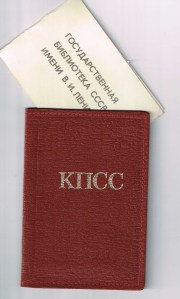
The illustration is my Communist Party of the Soviet Union membership card holder, a souvenir from my time as a student in Moscow, when I might have bumped into Zlotnik. Tucked into the card holder is my Lenin Library card.

A big thank you to my critical mates in the Write On! group in Sydney, who gave me input into an earlier draft.

I’d love to hear your responses to this extract.

©Stuart Campbell. Please respect my intellectual property by not copying the extract. There is lots of free stuff that you can legally share elsewhere on my site.

________________________________________________________________________

“You always had it made, Ivan,” his fellow MGIMO graduates would say. It was true: Barely out of university, he had the gaudy rewards of the elite in the tiny Moscow apartment, right down to the Everley Brothers records, the Marlboro cigarettes and a Playboy magazine. But when the drinking was under way –  a shot of Johnny Walker  between slugs of Stolichanaya – his pals’ resentment dissolved in alcoholic comradeship, the good old Soviet way: Drink until maudlin happiness is induced, that is if unconsciousness doesn’t set in first.

It didn’t matter that Yuri grew up in an orphanage while his father was in the Gulag, or that Pyotr was the son of a diesel mechanic from Kazan. They’d all made it through MGIMO and nobody could take away a degree from the Moscow State Institute of International Relations.

Zlotnik’s MGIMO friends seldom asked about his schooldays in Washington DC, where his father had been a diplomat. As for him, he preferred not to talk about being the one who sat out the Great Patriotic War in capitalist luxury while they froze their yaytsa off and lived on crusts. But his past made a difference; Zlotnik knew the West as an insider; he knew how the West felt. And this, he knew, made him dangerous, more susceptible to blandishments from beyond the Iron Curtain, a man to be carefully watched.

His parents had taken him home to Moscow in 1949, the year that Orwell’s 1984 was published. Zlotnik wolfed the book down a week before they left. But at seventeen, his political sensitivities were too undeveloped to fit the novel into a framework that included himself – Ivan Maksimovich Zlotnik, the American-speaking Russian kid who was going home. But something from Orwell must have stuck, and then it all came unstuck thirteen years later in 1962.

His was a life cut in half, he often thought: First, the years of hope and prospect and privilege when all you did made a kind of sense, and the bits that didn’t could be explained away, even his hollow marriage to Raisa. These were the years when you could reconcile the doublethink – how clever Orwell’s term was – by never daring to imagine that Soviet power was not impregnable; when as the son of a senior diplomat you had a responsibility to uphold the might of the state and prosecute its interests in Jakarta, in Hanoi, in Sydney, in corners of the world where a MGIMO graduate repaid his debt to the people. These were the years when you practised a refined dual consciousness that allowed you to lead a life based on the precepts of the Party in the sure knowledge that communism was doomed. These were the years when you reasoned away the sick in your gut when the Hungarian and Polish uprisings were crushed.

And then 1962, the height of Khrushchev’s thaw: One Day in the Life of Ivan Denisovich was in the Moscow bookshops, there for all to read uncensored from cover to to cover, not chopped up in bits of samizdat passed illegally from hand to hand; the Gulag was exposed in all its grinding, petty, bureaucratic cruelty. In May he took a copy to Yerevan, where he was sent to prepare a propaganda article on the removal of Stalin’s statue and the installation of the Mother Armenia monument. But his real job was to collect intelligence on dissidents in the small Russian community who lived among the Armenian majority.

The day before he left he met with his wife Raisa, who was passing through Moscow. She told him that her temporary posting to the hospital in Nizhniy Novgorod had been made permanent: A promotion, not to be turned down. They would get together when they could. He’d loved her, he thought, at the beginning. But she was a doctor, he a diplomat. Their futures belonged to the state, not to themselves.

***

Zlotnik was seduced by Yerevan: The dignified self-sufficiency of the people, the stubborn uniqueness of the culture, the resistance to having their Armyanskaya Sovietskaya Respublika swamped by Russians as all the other ethnic satellites were. It was balmy springtime, the wine was good, and the women were comely. He carefully read Denisovich in his hotel room with faint echoes of Orwell’s 1984 resonating with Solzhenistyn’s words. And something in his head – or was it his heart? – came unstuck.

For the next few days he suffered anxiety and shapeless unease. One night he downed a bottle of Armenian konyak and stood on his balcony drinking in the balm of spicy air that blew across the slopes clad with grape vines and citrus. Mount Ararat was fifty kilometres to the south inside Turkey, invisible but palpably sacred in the dark. Later, he often thought, the second half of his life began that night when he heard footsteps below his window. He looked down and a young, dark woman of astonishing beauty called up to him in Armenian from the floodlit car park.

“Sorry, don’t understand,” he mumbled stupidly in Russian.

She was perhaps a little younger than his twenty nine years, dark eyes, pale skin, dressed in a flouncy black dress and carrying a violin case.

“Did you see a car around here? A black Gaz? It’s my lift home.”

“Sorry comrade, I’ve been here all night.”

“Thanks comrade, perhaps I’ll take the tram,” she said, but then a pair of lights appeared on the road outside the hotel and she turned away.

“Before you go,” Zlotnik called out. “Where are you playing?”

She turned and he watched, charmed, as the taffeta dress swirled: “I’m playing in Anoush. At the Spendiarian Theatre. Come and see.”

The next night he traded a favour to get a ticket. Anoush, it turned out, was considered Armenia’s national opera. He was overwhelmed by the majestic gravity of the performance, by the unsettling fusion of oriental and western themes and cadences. He understood nothing of the text, but during the finale he put his head in his hands and silently cried for the loss of the first half of his life. Something had come unstuck, and he would never again be able to reconcile the doublethink; damn Orwell and his word!

In the morning he was recalled to Moscow to take up the second half – the equivocal, duplicitous, dissimulating half – of his life.

©Stuart Campbell

______________________________________________________________________

Buy Stuart Campbell’s books in paperback and ebook on Amazon by clicking on these title links:

An Englishman’s Guide to Infidelity

The Play’s the Thing


I think a war just started


P1020460This is an extract from my memoir Cairo Rations, which you can download free under a Creative Commons licence. I wrote the memoir as the launch pad for my novel in progress Cairo Mon Amour. The picture, by the way, is my 1973 Cairo University student card.

______________________________________________________________________

In hindsight there were portents in the week leading up to October 6 1973, the day that Egypt and its allies launched an attack on Sinai and the Golan Heights without warning.

People spoke anxiously about spies and secret police: “You can’t trust anyone. Be careful who you talk to.” English friends who went horse riding at Giza on October 5 galloped too close to a military area and just avoided being arrested, perhaps shot. A few days before that my wife and I were walking one evening past a disused museum when we were ordered into the gatehouse by a couple of Green Goons. These were the intelligence police recruited from university graduates, six inches taller than the black and white askari police who did the routine work of directing traffic and chasing street thieves. We sat in the gloom on hard chairs for half an hour while they studied our passports and asked us, Why are you in Egypt? Why do you want to study Arabic? Are you Jewish? We assumed when we were allowed to leave that they were simply bored, but perhaps they really were on the lookout for spies.

Consumer goods were scarce and, again with hindsight, the civilian population may have been hoarding in expectation of shortages. Some shops around the upmarket areas near Tahrir Square were selling one-offs – a bottle of perfume, a woman’s blouse, an ornament – that we were told were brought in by Egyptians flying home from Europe.

On the night of October 6 we went to Madame P’s guest house for dinner. The usual pattern of these visits was that we would arrive to find Madame P holding court in bed wrapped in a crocheted shawl and smoking a Craven A. Often there would be a friend in attendance – an elderly Armenian lady sharing with Madame P the woes of the world. The friend would be booted out in favour of binti and ibni – we’d been promoted to ‘daughter’ and ‘son’, and while the servants made dinner Madame P would regale us with an apparently infinite account of the family in diaspora. We would walk home trying to unpick the knots of Eddys, Dikrans, Roupens, Vartanouches, Sylvias and Serges in Paris, California and Beirut.

But the guest house was hushed and tense tonight. Those gentlemen residents who were at home stayed in their rooms. It was usual for casual diners to turn up during the meal – a mysterious old man in a beret who had been imprisoned in Nasser’s time and told my wife how he remembered her from when she was a child, frizz-haired woe-betiding distant aunties, a homeless cousin who lived with the families she sewed for. But nobody came tonight and we ate our lamb and aubergine alone at the big table with its checked oilcloth cover.

A notable absence was the army journalist. Because of his size, his hee-haw voice and his bonhomie, Mr. H was impossible to ignore. He was often at the big table drinking a bottle of Stella beer and eating cucumbers one after another – ‘like a donkey’, Madame P would whisper in the kitchen.

The evening grew gloomier. Now and again one of the gentlemen came out of his room, conferred with one of the other gentlemen in whispers, and then disappeared again. Then late in the evening as we were preparing to leave Mr. H arrived, except that he was now Major H in an army uniform. And he had in his hand a piece of grey painted wood from a packing crate with Hebrew letters stencilled on the side. It had come, he said, from the front. The gents came out of their rooms and gathered around Major H; the Arabic was fast, whispered, colloquial, and I couldn’t understand the detail. We retreated into Madame P’s room and probably all smoked a Craven A – my exact recollection is faint. But one of us said, “I think a war just started”.

My wife and I walked the few streets home from Bustan Saeed Street to our flat at 29 Muhammad Mahmoud Street. Farag the one-toothed doorkeeper said good evening. I don’t remember whether he called me ‘professor’, ‘captain’ or ‘head engineer’ – he never seemed sure which honorific to use.

The next morning I went out early into the hushed neighbourhood. There were knots of people on street corners listening as someone read the war news aloud from the newspaper. I bought a copy of Al Ahram and thanked providence that my Arabic was up to understanding most of the detail. On one page was a press picture of captured Israeli prisoners, which you can still find in the Al Ahram archives. Some of them looked like Frank Zappa.

Later that afternoon I returned from the university, whose gates were barred by a tank. Almost home, I heard a voice behind me calling gaasuus israa’eeli – Israeli spy. A small rock flew past my ear, and then a few more. A gang of boys was in pursuit, but I made the street corner ahead of them and dashed into our courtyard unseen.

When it was dark I scuttled through the back alleys as far as Tahrir Square, and then across the raised walkway to the Nile Hilton. There I had a haircut of the kind David Niven would have enjoyed in Monte Carlo in 1939. The sleek and deferential barber, with a pencil moustache that could have been measured in microns, used implements that I’d never seen in Watford; after cutting my hair with belt-driven clippers, he massaged my scalp with an electrical orange rubber vibrating pad; he rubbed in unguents and oils; and then he lit tapers to singe any single strand that dared to stand up from the shiny black dome of varnished hair he had moulded to my head.

I walked home looking like a ventriloquist’s dummy, ready to face my war.


Buy Stuart Campbell’s books in paperback and ebook on Amazon by clicking on these title links:

An Englishman’s Guide to Infidelity

The Play’s the Thing