Once every few months I head for Elizabeth’s Bookshop in Newtown, a daggy-chic inner Sydney suburb where hard-up students rub along with social housing tenants and real estate investors. Elizabeth’s isn’t just a second-hand book paradise, it’s my antidote to the enshittification of culture; because when I buy old books I am completely immune to marketing, reviews, and algorithms. I cruise the shelves on autopilot, selecting books according to some mysterious internal instinct. Here are some of my latest haul:
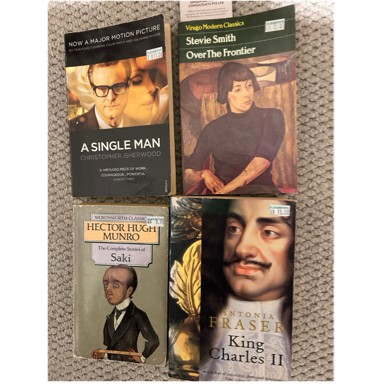
Stevie Smith, Over the Border
Antonia Fraser, King Charles II
Christopher Isherwood, A Single Man
Hector Hugh Munro, The Complete Stories of Saki
In the case of Stevie Smith, I know her poetry but not her novels. Antonia Fraser is super famous but I’ve never read her – and I have a soft spot for Charles II. I’ve been an Isherwood fan for decades, but I’ve never read A Single Man. And as for Saki, he’s so famous that I felt embarrassed that I didn’t have a clue who he was. More on my haul in a moment.
I read voraciously as a child in England. My mum signed me up for the public library: I can still feel the comfort of fat hardbacks wrapped in soft polythene dust covers. My dad had a little collection of highbrow books I read as a teenager. I remember stories by Somerset Maugham and the E.V. Rieu translations of The Iliad and The Odyssey. On reflection, it was escapism that drew me to books. I wanted to be anywhere but the dreary suburbs where we lived.
But I also became hooked on words. The first book I bought with my own money was Kit and the Mystery Man by Mollie Chappell, in which someone found themself in imminent jeopardy. I was desperate to know what it meant, and when I found out I shoehorned it into my school compositions. I’ve recently been chewing over Stevie Smith’s description of a freshly tidied garden as like a child with a washed face and a clean pinafore. I’m hooked on beautifully arranged words.
And I think it is escapism that has driven a lifetime of eclectic reading: Escaping into other times and places; escaping into a writer’s consciousness; escaping into other spiritualities; nowadays escaping from algorithms and grim headlines. When I began to write fiction seriously fifteen years ago, I carried back fragments of those other worlds and minds, using them to shape the new worlds and minds I created in my own novels and stories. Thus a perfect circular feedback mechanism developed: Reading and writing became two sides of a coin, input and output fused.
So here’s my take on the four books I mentioned:
Stevie Smith, Over the Border
Those new to Stevie Smith may at least know the title of her 1957 poem Not Waving but Drowning, which you can listen to here. She’s known principally as a poet but wrote three novels. Over the Border, set in 1936, follows Smith’s peculiar alter ego Pompey Casmilus as she mopes after a romance breakup in London and somehow finds herself in the midst of an opaque espionage adventure in WWI Germany. Pompey’s narration meanders through style shifts, syntactic recursions, and odd frenchified vocabulary. I read it very slowly, stopping from time to time to gaze at a paragraph and wonder where it was going. What to make of this for example?
Why now certainly this Pompey is becoming very sad-case and dippy, for see now I am crying …
Over the Border somehow reminds me of a weird buffet restaurant in Japan where I filled all the bento box compartments with unrecognisable foods, then grazed around it discovering that many of the items were Yōshoku – adaptations of western food, e.g. cold mashed potato topped with pink fish mousse, oddly spiced bolognese sauce. With Over the Border, you graze among the sentences savouring tasty tidpits and ending up feeling quite sated without knowing quite why.
Antonia Fraser, King Charles II
This book is – like those massive fridges you can buy these days – a big unit. It’s huge, it’s detailed, it’s a magnificent work of scholarship, but written with such a deft hand that after 670 pages you don’t realise a fortnight has gone by. Notably, Charles II emerges from the pages as a great guy you’d love to have a goblet of Sack with.
Christopher Isherwood, A Single Man
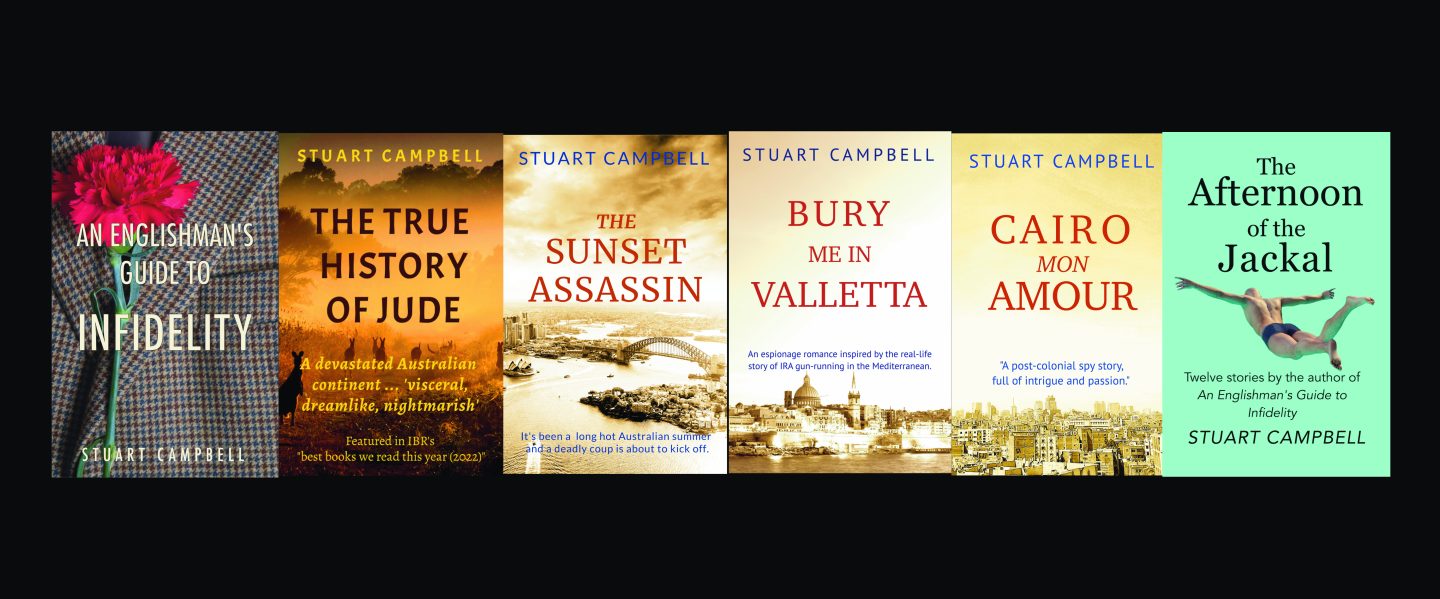
I’ve probably read Isherwood’s Mr Norris Changes Trains a dozen times, and even used it as a device to bring two lovers together in my novel An Englishman’s Guide to Infidelity. How on earth did I miss A Single Man? It was worth the wait: Isherwood embeds us deep in the mind of bereaved British professor George Falconer as he spends his last day on earth in a US university. The writing is silky and sly, infused with suppressed irony and black humour. It’s 1962, and Falconer’s students are gauche and gawky; the barrier between him and them is like those invisible and impenetrable force fields in sci-fi movies. Delighted with the book, I streamed the movie. Twenty minutes in (in defiance of the critics) I was wondering why I bothered. There’s no denying that Colin Firth acts well (he did get an Oscar) but I felt that (a) all the principal characters were hopelessly miscast, and (b) the internal monologue of the novel seemed to have been replaced by gay sex scenes laid on with a sweaty shovel. Sure, Falconer’s gay but he is so much more.
Hector Hugh Munro, The Complete Stories of Saki
This is a one-off. Hundreds of quirky stories by an English toff with British India connections crammed into 700 pages of microscopic text. Under the pen name Saki (from the Arabic saaqii water bearer), Munro created a world of Edwardian house parties peopled by blowhard dowagers and crusty retired colonels. His most famous protagonist is Clovis Sangrail, a posh young fellow who pokes fun at Edwardian manners through pranks and veiled slights. Clovis, who is sometimes described as epicene (what a delicious word), is devilishly witty and mature well beyond his years (he seems to be about seventeen). Some of the stories are hilarious, some fall flat, most are very short. Poor Saki’s life was complicated, as was his background. Contemporary portraits show a man bearing a burden. He enlisted at the age of 43 and was killed by a sniper in France in 1916. He is best enjoyed in small bites; I estimate I’ll have got through The Complete Stories of Saki in about five years.
###

