In 2017 I visited my mate Paul in Rhodes. I wrote a short post about how disappointed I was to find that there had been no guns at Navarone Bay. It’s been my most visited post, but I don’t really know why. I can only think that when someone remembers the film The Guns of Navarone and Googles it, my post comes up. Here’s the link if you’d like to join the crowd.
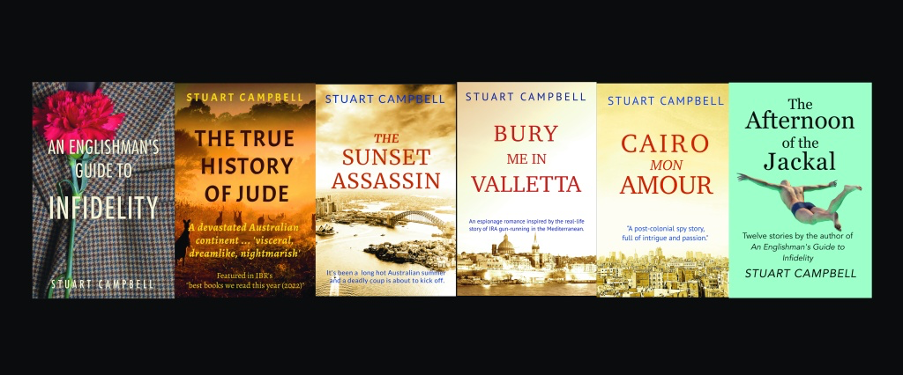
On the other hand, if you’d like to read something more informative and edifying, check out my books here.
This short story was written for my Free Shorts project, which culminated in a twelve-story collection entitled The Afternoon of the Jackal. In 2025, I’m releasing one of the stories each month free on my website. Happy reading, and please leave a comment to let me know if you enjoy my work.
***
A man in his sixties was found wandering the docks last night in a confused state, apparently having suffered excision of the tongue. Authorities are urging members of the public to come forward if they have information about the individual’s identity.
The island grew from a smudge on the horizon to a green hump crowned by low cloud. Within an hour the steamer was standing a hundred yards off, and the island revealed itself as a broad escarpment perhaps twenty miles long, carpeted with terraced fields. The crew lowered a rowboat and passed down boxes of medicines, mail, paraffin, and various tools. Before climbing down the rope ladder, I took my leave of the captain.
“Until the autumn, then,” he said. “I hope you complete your work successfully.”
And I pray my real mission is not discovered, I silently told myself.
Out on the open water I hitched my greatcoat tighter against a light drizzle while the crewmen puffed over the oars. I steadied my leather trunk as a wave lifted the boat and dropped it with a smack. A figure on the jetty in a squat top hat raised a hand: The mayor of the principal village, no doubt.
The crewmen offloaded me and took on board a cargo of cheeses and preserved meats. The steamer would return in six months.
“Mr Rose, welcome.” The mayor had a rustic, windblown complexion; the top hat was perhaps enjoying its twice-yearly outing. We had corresponded via the six-monthly mail deliveries, agreeing after several exchanges that Mr Albert Rose of the Royal Office of Works would visit the island in the spring to ‘conduct a geographical survey of the island.’
Mr Albert Rose existed, however, only in my imagination and in the forged letters I had sent the mayor.
The mayor hoisted my luggage onto his trap, and we set off at a steady trot to his cottage, where I was installed in an attic room with the afternoon rain tapping on the glass and misting the green slopes outside. I checked that the door locked from the inside before unpacking my notebooks, drawing instruments, tape measures, and a surveyor’s theodolite I had taught myself to use for measuring elevations and angles.
Concealed under a panel in the trunk’s floor was my copy of Jessop’s Field Guide to Practical Lexicography, with the notation inside the front cover Property of Professor P. Grammaticus. I slipped the book back under the panel, covering it with a pile of shirts. I had told my fellow scholars that I was sailing to New York City to study – incognito – the criminal cant of the street gangs, and had my landlady lock my rooms for six months, rent paid in advance.
Three years before, a conversation with a sailor in a portside tavern had provoked my interest in the island. Disguised as a sweeper, I was collecting secret words used by longshoremen to conceal their talk of pilfering from ships’ cargoes. The sailor told me in a gin-soaked whisper about an island where the people spoke a ‘diabolical tongue’ that ‘addled the senses’ and ‘drove men half demented’. I questioned him for more details without success, but as a discerning judge of character I was largely convinced that his account was authentic. I immersed myself in the university and government archives, discovering that the island had somehow avoided official scrutiny for many decades. The dusty volumes yielded up a further hint in the records of the city jail: A woman who had fled the island by ship had been arrested for using ‘satanic speech’. The opportunity was too tempting to miss for Professor Paul Grammaticus, Fellow of the Royal Society of Lexicographers, editor of The Encyclopaedia of Esoteric Tongues, and pioneer of clandestine scholarly investigation methods.
The imposter enjoyed a solid dinner that night with the mayor’s family – four polite ruddy-faced teenaged children and a handsome wife with blonde hair and strong hands. The family spoke fluently in my language, even if their speech had an old-fashioned lilt in tune with the rural caps and smocks they wore. I held no qualms of conscience about posing as a surveyor; my calling as a student of the human condition outweighed such considerations. My sole worry was to be found out.
As the meal ended, I enquired after tomorrow’s weather: Would there be rain?
“There is rain every afternoon,” the eldest son said.
The youngest daughter added, “And sun every morning. But tomorrow we will have …”
I felt momentarily faint. No, not faint, but something more complex, troubling and profound, accompanied perhaps by a strain of distant celestial music. I must be tired from the journey.
***
My bogus work adapted itself to the rhythms of the island weather: Sunny mornings in some hillside hamlet surveying the contours of the land, measuring the fields, noting the crop varieties, and interviewing rustic families; rainy afternoons when I made fair copies of my maps and tables in the attic room. All activities beyond noon were suffused with rain, something that bothered the islanders not one whit.
Besides studying the physical dimensions of the island, I learned that they bartered goods on fair grounds of exchange, with all receiving sufficient for their needs. Brides from the mainland bolstered the strength of the islanders’ breeding stock. A wholesome recreation of dances and country sports seemed to sustain social needs. I was intrigued by the absence of churches or indeed any evidence of religion. My own religious instincts had long ago yielded to the rational principles that governed my life; but was it possible that simple rural folk could be similarly liberated?
Among their talk of animal litters, irrigation, and family ancestors, there was no hint of the ‘diabolical tongue’. Had it been the gin talking three years ago? Or were the islanders hiding something?
***
The faintness I had experienced at the first meal with the mayor’s family recurred. Almost every day I would suddenly be overcome – just for a few seconds – by a certain wooziness and faint strains of heavenly music that dissolved as I strained to hear them. Had I acquired a cerebral disorder – a tumour, a haemorrhage, a brain microbe? The medical services on the island were sparse, no more than an extension of the veterinary skills the farmers practised to keep the livestock healthy. Following my habit of systematic observation, I took to noting the dates and times of the fainting spells.
One rainy afternoon I donned stout boots and an oilskin to tramp to the top of the long escarpment dividing the island into the bleak windward side and the fertile leeward side. The vista from the peak evoked a pellucid calmness of mind. The patchwork of serene fields and the boundless vigour of the sea expelled all workaday thoughts. But this day a nagging idea disturbed the calm. As the rain shifted with the wind, the idea emerged clear into the light. I clapped hand to brow and strode home in the drizzle, arriving in a state of agitation. I drew a grid on a large sheet of paper, combed each of my notebooks, and cross-referenced my survey work with the dates of the fainting episodes. Soon a hypothesis emerged. Within a short while it was confirmed: Each spell occurred while I was conversing with the local folk. A further hypothesis suggested itself and with some effort solidified into a speculative finding. I stared at the grid shaking my head: Could it be that the fainting happened when people were talking about rainfall?
At dinner that night I steered the conversation to the weather, skilfully drawing from the farmer’s children’s anecdotes about working the fields in wet weather. They responded with a faint orchestra of heavenly sounds. I brought all my forces of perception to bear as I questioned the children more, until a glorious chorus began to ring in my ears. A flood of joy fogged my mind. I struggled to focus my senses on each celestial utterance, desperate to preserve the memory of its sound and meaning. When the conversation faltered, I excused himself. Lying on the bed in a state of equal parts enervation and exhaustion, I formulated my revelation: Like the tribes that have forty-two words for maize or sixty words for snow, the villagers had numerous words for rain. But wait, didn’t my own language have drizzle, spitting, pouring, precipitation, shower, downpour? No, these islander words belonged to another dimension in their meanings and their unworldly musico-phonetic forms.
I snatched a notebook and quill pen to scribble in plain letters the meanings of some of the throat melodies (a term I coined in mid-thought) I had heard during the meal:
rain that brings happiness
rain that brings false hope
***
In the privacy of the attic room I devised a diabolically complex system of symbols to represent the sounds of the throat melodies. Such was my fervour that I neglected the surveying work. Instead of recording the banal details of fields and cowsheds, I began to spend most mornings conversing with villagers about the weather, carefully transcribing the throat melodies I heard. In the rainy afternoons when the mayor’s family worked outside, I practised saying the ethereal words aloud. The first time I said aloud rain that brings happiness, I was startled to hear from my own throat its celestial peals, and to be immersed in a maelstrom of joy in which I spied flashes of memories—my dear mother, my first puppy, a child’s birthday party.
One afternoon I was practising rain that lessens melancholy when there was a creak on the stair.
“Who’s there?” I called out. The stair creaked again and a door closed downstairs. Through the window one of the ruddy-faced sons could be seen loping away from the cottage.
It was a month until the steamer returned, and I must avoid discovery; perhaps the boy had heard nothing.
My notes – safely concealed in a cavity in the wall – confirmed ninety-nine words (or throat melodies) for rain, and I had begun to draft the paper I would read at the Royal Society to crown my reputation as the world’s foremost expert on esoteric languages. I had even dared to hypothesise a spiritual dimension to the matter – that the islanders’ minds were collectively connected to Mother Nature, or even (I once mused) to Pythagoras’s music of the heavens, although I squashed these absurdly irrational notions whenever they crept into my mind.
The last month of my sojourn on the island passed without any hint that I was under suspicion. But as the day of my departure approached, I was troubled by a bluntness of intellect and a growing unease about the future. When I read through the draft of my Royal Society paper, it was if another Paul Grammaticus had written it – a cynical, vain version of myself, devoid of compassion or empathy.
A communal supper was to take place the day before the steamer was due. I polished my boots with duck fat and attached my only shirt collar with a pearl stud. Stepping out into the lane I joined the throng strolling to the barn in a vigorous downpour. The jolly islanders jostled and laughed as they squeezed through the barn door and took their places at long tables.
Before the food was served, the mayor made a speech praising the islanders for the harvest, mentioning the rain that caresses the leaves and half a dozen other throat melodies. I was suddenly taken with an irresistible urge to speak up. I stood – uninvited – and launched into an unrestrained lexical romp, showering the diners with lilting, warbling, fluting rain melodies. The audience were momentarily stunned, then threw away all caution, cheering and singing out in answer. And as their rain words mingled with mine, my mind – or perhaps spirit – entered a new realm of perception where we all shared the rapture of rain, swirling in emotions of unimaginable profundity and serenity. I was at one with the island and its inhabitants for eternity.
***
The mayor took me aside when the supper ended. “Walk with me, Sir, whoever you might be.”
A passer-by said goodnight and the mayor replied, using the word rain that portends sorrow.
“We trusted you, and you stole from us,” he told me. The rain fell more heavily, its intensity swelling so that I could hardly see or hear amid its gushing roar. The mayor guided me to a barn used for veterinary procedures. I stumbled through the door to face half a dozen sad-faced islanders.
My mind raced. How could I outwit these simple folk and return to the mainland tomorrow with my notebooks? But I faltered. I had passed through the austere deserts of rationality into a lush, magical paradise. Return to what? To the acclaim of my peers for stealing the keys to heaven and reducing them to inked letters for the sake of my own vanity?
“Let me stay, I beg you. I have seen eternity here.”
Two men gripped my arms and forced me onto a cart. Another thrust a pair of tongs into my mouth and drew my tongue out. I glimpsed a gleaming knife to one side of my head and a red poker to the other.
###
If you enjoyed this story, you can find details of my books here.
I love to get feedback on my novels. Readers’ comments motivate me to keep writing, and help me to spread the word about my work.
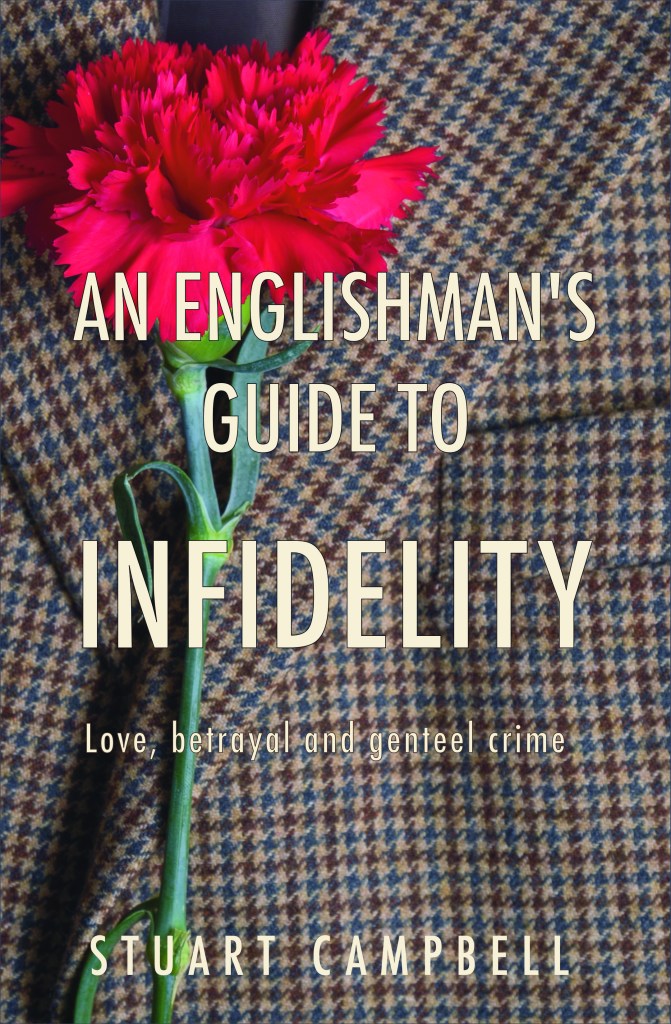
If you enjoyed An Englishman’s Guide to Infideliy, scroll down to the Leave a Reply box below and tell me why. You can write an essay or just a few words!





 Stuart Campbell author