Here’s a terrific review from an Australian reader:
In The True History of Jude, Stuart Campbell dares you to look away from the world he presents on the page. But the thing is, you can’t. Told through an epistolary form, and through the eyes of young Jude and distinguished professor Sue (or is it?), the story traces their struggles and journeys–and ultimately their love–in a post-Australia world. The world-building is exceptional as are the characters who populate this story. The story brings front and centre the possible future of Australia, and the world, we currently glimpse in our peripheral vision. If you are after an intellectual dystopian love story, then I highly recommend The True History of Jude.
‘At my first lecture this year, I had to ask all the ladies wearing tall wimples to sit at the back,’ writes Professor Susan Bridehead in my genre-defying novel The True History of Jude.
The book combines a coming-of-age-tale, a time-shifting love story, and a reimagining of a Thomas Hardy novel—all embedded in a dystopian setting.
And as a fantasy, it gave me the power to project a set of contemporary themes to their potential extremes: I predicted a climate-ravaged and depopulated Australia leased to the world community for uranium mining, a corporatised global authoritarian system controlled by an Australian royal dynasty, and the destruction of artistic creativity under the crushing conformity of an information monopoly.
Could it happen?
When I was studying Russian in the USSR in 1974, could I have imagined the fall of the Soviet empire? When we basked in the Australian summer of 2019, could we have imagined a pandemic that would upend the world?
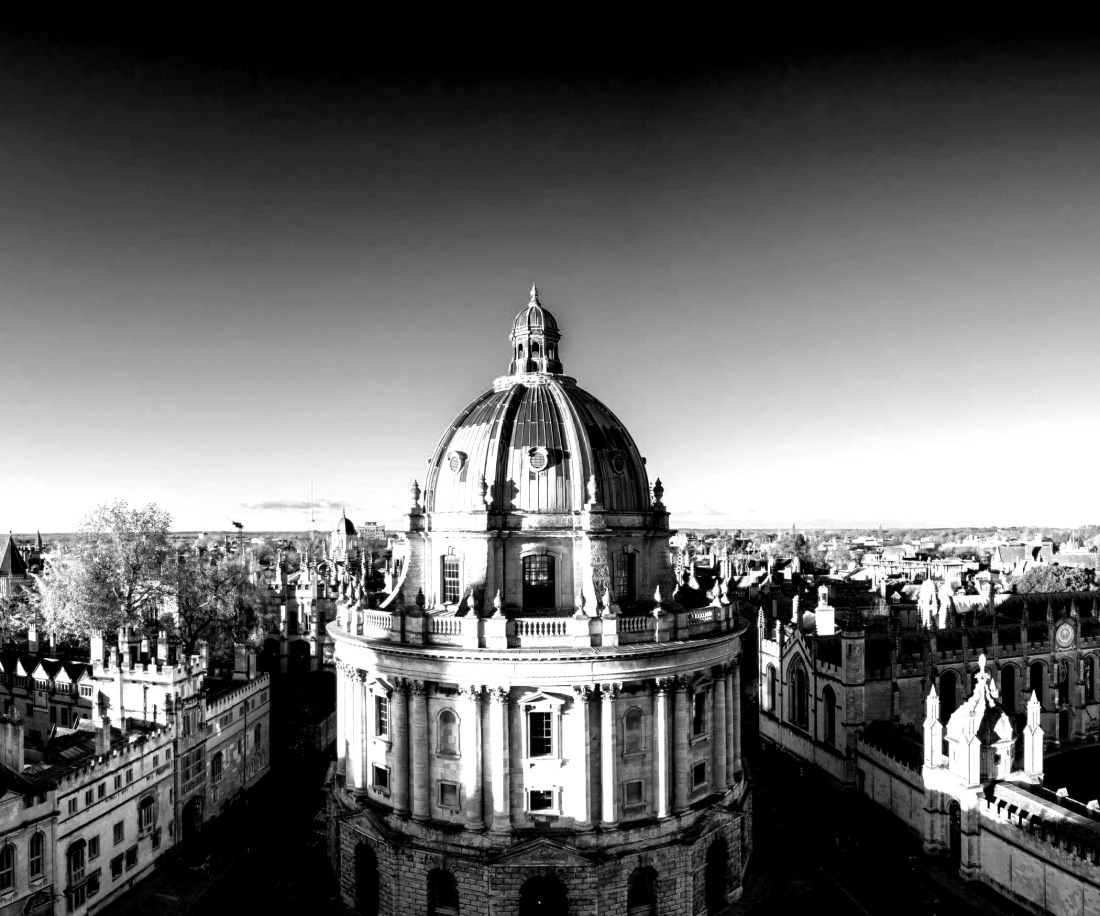
Back to the wimples: The Australian monarchy is the world’s first virtual state, having excised itself from its own territory*. The Palace operates from leased premises at Oxford University. Across the city is the exiled campus of my alma mater The University of Sydney. It’s from here that the elderly Susan writes fawning hagiographies of the Australian royals and teaches history to their offspring and aristocratic cronies whose royal stipends make it unnecessary for them to get jobs. The students return year after year to take the same courses, some even passing away from old age during lectures. Cosplay is a campus obsession: This year’s theme is Medieval, thus the tall wimples blocking the lecture hall sightlines.
It’s satire of course, but I’m certain that many academics will identify the threads I’ve pulled to weave scenarios like these: The banning of paper and handwriting so that all student work is created and archived online; the obligatory use of AI text generators to write assignments that result in randomly generated grades; works of fiction proscribed; professionals trained not at the university but in online polytechnics run by a consortium of three global consulting companies.
I’ve spent decades of my professional life helping create Australia’s higher education system. What I observe today is a quantum leap away from the undergraduate degree I took in the UK in the seventies—no internet, no credit point system, no fees, no student support service, no assignment mills, no student surveys, no casual lecturers. My future scenario for the university in The True History of Jude may seem outlandish, but the threads are clear to see today.
*The Australian Parliament excised the mainland from Australia’s migration zone in 2013.
Copyright 2022 Stuart Campbell
To check out The True History of Jude and my other books click here.
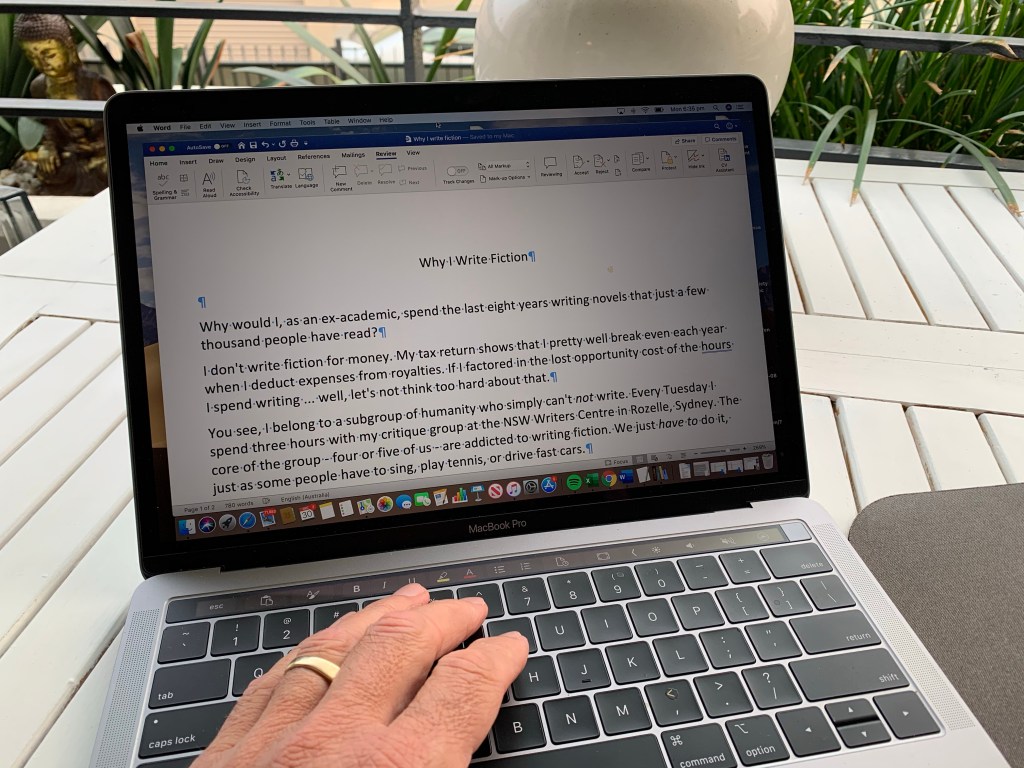
Why would I, as an ex-academic, spend the last eight years writing novels that just a few thousand people have read?
I certainly don’t write fiction for money. My tax return shows that I pretty well break even each year when I deduct expenses from royalties. If I factored in the lost opportunity cost of the hours I spend writing … well, let’s not think too hard about that.
You see, I belong to a subgroup of humanity who simply can’t not write. Every Tuesday I spend three hours with my critique group at the NSW Writers Centre in Rozelle, Sydney. The core of the group – four or five of us – are addicted to writing fiction. We just have to do it, just as some people have to sing, play tennis, or drive fast cars.
Perhaps I inherited this compulsion. My father wrote constantly – photo essays for Hertfordshire Countryside, articles on fingerprint techniques for The Police Review, textbooks on fraud investigation and police corruption. I suspect there were a few half-written novels among the typewriter tapping I remember from my childhood.
But it’s more than just raw compulsion. There are other motive forces behind my need to write. One is my fascination with the power of fiction, and the desire to master that power. George Orwell was the first novelist who showed me the force of fiction; his books shaped who I am today, and they shape how I write now. Through the years, others sculpted my intellect and sensibilities – Thomas Hardy, Jane Austen, Anthony Powell, Patrick White, Margaret Drabble … and on goes the parade of geniuses who have wielded the power of stories over me.
But I’m not a best seller – just a mere prawn in the curry of life (that’s a line I’m going to put into the mouth of one of my characters soon); my power to influence is tiny. But (and I know this might sound pathetic), I am almost moved to tears when even one person says, “I loved your book”, or “it was absolutely compelling”.
Here’s an example of job satisfaction: I gave an advance review copy of my latest novel to a friend. I forgot all about it until I got an email from him saying, “Oh no, Ralph died!” with a sad-face emoji. So what did I make of this? (a) He was reading the book – a triumph in itself because it’s harder than you might think to motivate people to read fiction, and (b) he was so affected by Ralph’s sudden death that he instantly emailed me. I walked around with a silly grin for the rest of the day.
There are different kinds of power: Writing fiction gives me the power to entertain, amuse, sadden, satisfy. But let’s get back to the power to shape ideas and beliefs. Despite their tortuous plots, all my novels have what I think of as a moral core: In one, I explore the precariousness of middle-class morality; another has the plight of the Armenians as a backdrop; and they all contain a strand dealing with the way men negotiate partnerships with strong women.
Moral cores aside, writing fiction is, for me, a fascinating intellectual process. I’ll spare you the fine details, but suffice to say that juggling plot, setting, characters, and style is an intoxicating blend of creativity and technique. As an academic linguist, I hesitate to drift into metaphysics, but there are writing days when I enter what I call a ‘state of grace’ with the sentences flowing without obstacle. There are other days when it’s like shoving a barrow of shit uphill.
Let me finish with what might be the most important reason I write. The four novels and one novella I’ve written so far are best described as being on the more intellectual end of popular fiction. If you were to ask who I see as models, I might suggest people like Lucie Whitehouse and Philip Kerr. My books entertain, amuse, sadden, and satisfy. But for the last three years, I’ve been grappling with a dystopian novel called Patria Nullius that deals with a climate apocalypse. I started the novel because I felt so helpless for the future of my grandchildren. It has been a pig of a book to structure. I’ve chopped and chipped at it, turned it on its head, but I’ve vowed to get it finished in 2020. I’m writing it because it will give me the power to influence in an existentially crucial way – even to a tiny extent.

 Stuart Campbell author