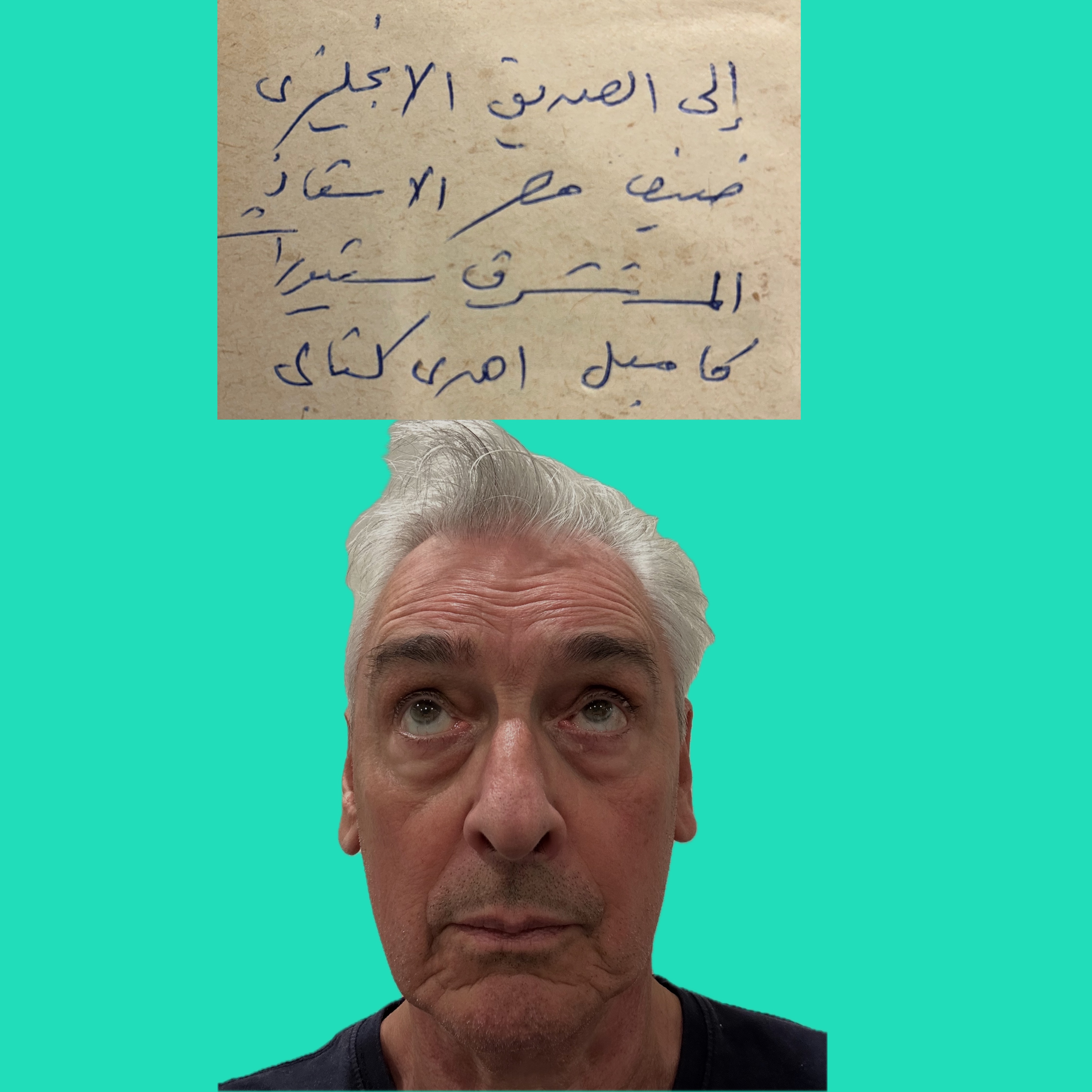
The Accidental Arabist

Some people plan their life trajectory. For me, serendipity has often trumped planning. How else did I find myself unexpectedly signing up to an Arabic degree more than fifty years ago? Recently I began to ask myself how half a century of knowing Arabic has shaped the way I think and feel. How different has it made me from the person I might have been if I’d never taken this path?

It was 1971, and I’d applied for a languages degree at the Polytechnic of Central London (now the University of Westminster). The Russian interview went well; I could only offer a GCE ‘O’ Level, but Russian wasn’t widely studied in the secondary education system at that time. I had a GCE ‘A’ Level in French, but they were two a penny in the UK. Sorry, the French lecturer sniffed, your grammar’s not good enough; try the Arabic room down the corridor, they start from scratch.

The Head of Arabic sat in an empty classroom staring out over the roofs of Bloomsbury: I was signed up in minutes for a journey that would shape the rest of my life. For most of my adult years, Arabic and Arab culture have been embedded in my mind, helping to shape my world view, my scholarship, my values. In signing up on that day in 1971, I joined an exclusive club of English speakers who know something about the world of the Arabs from the inside, rather than through the smeared lens of ignorance, prejudice and habituated racism.  I find it impossible to imagine a me who didn’t wander into that classroom in 1971.

I’d had a messy flirtation with Arabic in 1969. After leaving school at sixteen, I stumbled into a civil engineering traineeship which ended with me failing my maths exams three years in a row. Freshly unemployed, I headed for Gibraltar and picked up a job driving a grocery van with a crew of Moroccans. I spoke schoolboy French with them, but I was fascinated by their throaty Arabic. I bought a copy of Teach Yourself Arabic and slogged through the chapters for a couple of weeks, but there was no connection between what the book said and what my Moroccan buddies said. Much later I learned that the Moroccan Arabic dialect is pretty well incomprehensible to anyone but Moroccans, and that the high-flown language of Teach Yourself Arabic isn’t used by van drivers.

Arabic installed itself in my mind quite differently from the way that French or Russian did. I learned French at school between the ages of 11 and 15. As soon as I arrive in France or New Caledonia, I open my mouth and bad French pours out based on prepubscent rote learning.

I studied Russian alongside Arabic from age 20 to 25, but while Arabic dazzled me, learning Russian was like pouring grey sand into a holey bucket. It seemed to need ten times more effort to find places in my head where it would stick. Cyrillic script looked like a row of Soviet era radiators, unlike the dramatic flourish of Arabic.  Beyond the teaching staff you never met a Russian in the Polytechnic cafeteria. Poor, unattractive Russian was trapped inside cheap Soviet textbooks. But in 70’s London you met with a whole stream of Arabs – Lebanese communists, Yemeni poets, Libyans on Gaddafi’s big oil scholarships. You went to parties with Arabs in their expensive flats on the Edgware Road. Russian didn’t stand a chance.

And unlike Russian, Arabic words entered my brain dressed up in their own colourful costumes, where they had a jolly time mixing with new friends – words like Al-Urwah Al-Wuthqa, ‘The Firmest Bond’, the title of a short-lived Egyptian revolutionary journal that was key in initiating the Arab revival of the late nineteenth century. My teacher mistranslated it as ‘the reliable handle’ and I have used it for decades to describe useful household items like spanners (Wow, I bought a real Urwah Wuthqa at the hardware store today). A Libyan taught me a filthy poem in high-flown Classical Arabic that I can still reel off. I knew a Tunisian girl called Buthaina, and learned that her name is a slang word for pussy cat. I have a habit of commenting on Arab names when I watch TV. That guy’s name means ‘glory of the religion’, I might mutter. Then I remember the Arabic saying al-asmaa’ laa tu’allal, ‘names are not to be explained’, told to me by a man whose name meant ‘war sparrow’.

Thus Arabic poured into me, along with a jumble of memories, associations, emotions, stories, relationships, people, and images.

The aesthetic of the east was part of the attraction of Arabic: In my mind, the Arab World belonged to the exotic and sensual Orient – alongside India, joss sticks, flowing robes and sitar music – that coloured my generation in the late sixties. If I’d been offered a course in Hindi or Bengali that day at the Poly, I’d probably have taken it. It would be eight years until Edward Said would challenge the West to examine the underbelly of its relationship with the East and to frame a postcolonial conception of East-West relations. Not even the Beatles were spared postcolonial scrutiny; was their appropriation of Indian culture imperialistic,  just dressed in psychedelic garb? I unconsciously modelled this worn-out worldview: I was doing the Arabs a favour by learning their language. In 1973, I was proud when an Egyptian journalist gave me a book of his inscribed in Arabic ‘to the orientalist Stuart Campbell’. I groan at my naivete now.

The inner workings of an immature psyche aside, it was the sheer alien complexity of Arabic that got me hooked, from the sweeping right-to-left script, the mad plug-in word-building system, and the pharynx-bending phonetics. Our Egyptian lecturers utilised a traditional classroom method of slog, repetition and memorisation with minimal use of English. The core materials were a kind of cultural studies curriculum strongly infused with the long-forgotten creed of Arab Socialism, handwritten and printed on a Roneo machine. The early texts had two sentences per page in big handwriting, the fourth year ones were on a par with newspaper Arabic. Our job was to memorise it all – hundreds of word roots, jagged morphological patterns, unpredictable plurals, alien sentence constructions, unexpected semantic frameworks, none of it remotely like the European languages we had learned at school. It was pure slog, every spare moment with nose in notebook memorising, self-testing, silently chanting like an acolyte in an occult sect.

I quickly cracked the Arabic dictionary code: You don’t look words up alphabetically by the first letter; you search the word for its three-consonant root and look up the root, under which the whole word family is listed. I’m on my second Hans Wehr Arabic-English Dictionary, the first of which ended up stuck together with gaffer tape until it disintegrated after twenty years of look-ups. The Arabic dictionary is as much a learning tool as a reference tool; it’s impossible to look up a word without mentally evoking – and reinforcing – the grammatical rules needed to search for it. I didn’t realise how the Hans Wehr had become almost an extension of my psyche until I opened it last year and found that my eyesight had deteriorated so badly that I couldn’t read the tiny text; I was so distraught that I brought forward my cataract surgery.

Writing Arabic entailed less mental rewiring than I expected.  I dimly recall copying loops and lines from right to left, but I must have learned so quickly that few traces remain. I have a completely unscientific intuition that there is something more ‘natural’ about writing in Arabic. Writing in English entails a contradictory ergonomics: Maintaining a horizontal progress using an up and down sawtooth motion. Arabic entails a horizontal sweep interrupted with loops and ticks. It feels fluid, liquid, relaxed to write – as you might expect from a script that was traditionally written with a reed pen rather than chiselled into stone.

There are delicious stylistic features such as kashida, a kind of kerning that emphasises the horizontal sweep of Arabic: A word can be stretched across the page as in Figure 1, where both words contain a kashida, indicated by the curved sweeps.

Fig 1.

The elegance and ease of writing Arabic is, however, contradicted by the difficulty of reading aloud: Arabic script mostly omits short vowels, leaving it up to the reader to work out the pronunciation. The exceptions include the Qur’an and some language learning materials, where short vowels are indicated. But as you steadily absorb word patterns and grammatical rules, the opacity of vowelless script clears. Nevertheless, reading errors abound even for native speakers, and purists delight in spotting mistakes. A Lebanese friend who used to read the evening news on a Sydney Arabic radio station always received corrections from indignant listeners the next morning.

The challenge of reading aloud leads to the broader topic of learning to speak Arabic. For me there were two salient issues: The phonetics of Arabic and the dialect problem. Foreigners often describe Arabic as ‘throaty’. The phonetics component of the Polytechnic’s mandatory linguistics strand explained in scientific terms what ‘throaty’ meant. In no time I revelled in being able to produce pharyngeal fricatives and uvular stops. There was an immense satisfaction in performing these phonetic tricks, especially executing tongue twisters, or more accurately throat twisters.

But even with authentic pronunciation, gaining fluency was a challenge. The speaking part of our course focussed on reading aloud, and our model was the oratorical style of our male teachers. Amazingly, it is only at my keyboard today that I realise that no woman ever spoke to us in Arabic at the Poly. I based my speaking style on the Egyptian chaps so that I sounded like those newsreaders with moustaches who pump out the party line on TV in dictatorships.

I had anticipated the dialect issue. In fact, some months before our class went off to study in Cairo, I led a delegation of students to request that the Poly offer some teaching of Egyptian dialect before we departed. We were assured that we would ‘pick it up’, but the staff were uncomfortable with the idea that a low status dialect might have grammatical rules.

After two years at the Poly, we were sent off to Egypt with vague instructions to report to a certain Professor at Cairo University (in contrast to modern study abroad programs that entail detailed risk analysis and in-country fixers). My wife and I arrived at her Armenian grandmother’s boarding house in central Cairo to find that the lady had gone shopping. The gentleman boarders were amused and intrigued at meeting an Englishman who knew Arabic. They called in a student who lived in the block; he would take us out to look for Madame. Here, I quote from my memoir Cairo Rations:

We went from shop to shop while the student practised his English on us. I was expecting him to be interested and flattered … that a British student had gone to the trouble of studying his language and his culture. Instead, he questioned me brusquely about why I was in Egypt, eventually becoming quite sarcastic and tossing in terms like ‘imperialist’ and ‘invader’.

Madame was eventually found. She didn’t speak English, so I barked at her in my Egyptian lecturer fashion but immediately sensed a horrible dissonance. This weird alpha male persona wasn’t me! And Madame spoke back in Egyptian dialect, not newsreader Arabic!

My dialect fluency peaked in 1974 due to the demands of living in a country at war – queuing for ration cards, being chased in the street as a suspected Israeli spy, being detained and questioned by police.

This incident with the angry student was an epiphany, a signal that there was a fatal crack in my thinking and that of my generation. When Edward Said blew the lid off Orientalism five years later, I’d already gained a deep understanding of anti-Arab racism in its many forms, both subtle and explicit. But Said’s writings helped me recognise that in 1973 I had stood at the confluence of two intellectual streams – the old Orientalism that infantilised the Arabs, and the postcolonial era that exposed the West’s racist condescension. In later years I did research on anti-Arab attitudes in the Australian press, and wrote the Siranoush Trilogy of espionage novels that challenged the ‘bad Arab’ trope that infests popular literature and film.

While studying Arabic helped form my worldview, it also opened unexpected doors to academic research – serendipity again. A relative gave me an archaic-looking illustrated manuscript in Arabic script: “I got this in Saudi Arabia. You might find it interesting.” It was actually in Persian, replete with Arabic loanwords, but I noticed an anomaly in the spelling of some of the nouns. By chance, I was doing some work on Indonesian at the time and was surprised to find the same Persian spelling anomaly in the borrowed Arabic words in Indonesian and Malay. According to indigenous scholars, the Arabs who brought Islam to the Malay world sailed straight from Arabia. Then how did the Arabic words acquire Persian spellings? Over the next few years, I developed and published an account showing that Arabic words entered the Malay world in three historical layers, one of which was Persianised. This work was a major historiographic advance that is unchallenged to this day.

Today, the impact of Arabic on my life is evident from my curriculum vitae: A career in teaching and researching Arabic linguistics and Arabic translation; senior university roles; a string of PhD students, most of Arab background; books and refereed journals. But how has Arabic contributed to my worldview? How am I different from a Stuart Campbell who might never have taken those few steps down the corridor?

I’m fairly sure that the political and social consciousness of my alter ego would have aligned with the real me: The Cold War, Vietnam and the Palestine conflict shaped the foundational thinking of many of my generation. But the extra element conferred by Arabic is an enhanced insight into the Arab world. It’s the ability to look behind the English language news media about the Middle East because you can read the Arabic press; it’s the ability to bypass the slipshod and stereotyped characterisation of the Arabs because you’ve known and worked with so many of them; it’s the ability to watch a TV interview with an Arab politician or a Syrian refugee or a Dubai Bling star, and decode the signals that the translation won’t give you: What does the accent tell you about the speaker’s origins and class? How is the level of language formality shaping the message? What does the person’s name tell you about their background? How do they address the other speakers and why do they use this or that form? How often is God evoked, and what does that tell you about the speaker’s emotional state? What does that place name mean, and what glories and tragedies are infused in it? What does that graffiti mean?

I was always intrigued in Cairo by the way that people in the street addressed me. My favourite was bash muhandis, ‘chief engineer’. For me, this evokes a whole set of questions – what sort of person would address me thus, why is there a Turkish element in the expression? And how I would address the person back?

That’s the kind of thing that sticks in your head after you wander into a room and sign for a fifty year stretch.

###

If you want to read more of my writing check here to find out about my short stories and novels.

Creating Arabic-speaking foreigners in fiction

Introduction

I’m an academic linguist turned novelist, and my academic training has been tangled with my creative practice ever since I tried to write fiction.

This article began out of curiosity. After I completed a trilogy bristling with Arabic speakers, it occurred to me that I’d achieved the technical effects of making them sound foreign virtually on autopilot. I started drafting a blog post trying to analyse the techniques I’d used to create foreignness.

Around the same time, I was reading Cormac McCarthy’s fiendishly challenging The Crossing with its swathes of untranslated Spanish dialogue. McCarthy brought me up with a start: His treatment of foreignness was a universe away from my own.

I had to look more widely. I put my blog post aside.

The framework

I made a fresh start with an article called How authors create foreigners and foreignness in fiction, where I used examples from Philip Kerr, Michael Mohammed Ahmed, Agatha Christie, Cormac McCarthy and Ernest Hemingway to develop a framework of propositions about how authors create foreign characters in fiction. In summary, what I proposed was:

Foreignising is manifested in voice—that of narrator, author or character.

The purpose of foreignising varies according to voice.

Foreignising techniques include:

  • Foreigner talk
  • Untranslated terms and dialogue
  • Definitions, including: Explicit definitions, Implied definitions

With a set of propositions to hand, I was in a position to return to my trilogy. and to further develop the framework.

The Siranoush Trilogy

The trilogy comprises a series of stand-alone novels, Cairo Mon AmourBury me in Valletta and The Sunset Assassin, set in Egypt, Malta and Australia respectively between 1973 and 1978. Each novel is written from alternating points of view of the key protagonist Pierre Farag and several others, all in close third person. This allowed me to foreignise the protagonists’ inner thoughts as well as their dialogue. For the sake of simplicity, I’ll stick with Pierre rather than bringing in the other characters.

Pierre is a half-Armenian and half-Coptic private detective from Cairo. He is inadvertently entangled in an espionage plot during the Yom Kippur War, which launches him on a chain of perilous scrapes across the world, ending on a crocodile farm in remote northern Australia. I portray him as an Arabic speaker since I know quite a lot about Arabic (my Armenian is so poor that I remained silent on that dimension of Pierre’s linguistic world).

Dialogue, inner thoughts, and a hall of mirrors

Foreignising dialogue is relatively straightforward, notwithstanding the mental tricks the reader has to unconsciously perform: If the character is supposed to be speaking in a foreign language, the author naturally composes the dialogue in English, but may choose to play some tricks to make it sound Arabic-flavoured, Russian-flavoured, etc. But if the character is speaking in English, the writer might tweak it with some foreigner talk using nonstandard grammar, odd vocabulary choices or even spelling out an accent.

The fragile notion of ‘inner thoughts’ throws up its own exquisite dilemmas. I frame Pierre’s thoughts for the reader in English, but I tacitly ask you to suspend disbelief and assume they occur mainly in Arabic. But it gets more tricky: I’m asking you to assume those thoughts rattle around his head in perfectly formed Arabic sentences that happen to look like perfectly formed English sentences on the page*.

A hall of mirrors, indeed.

Voice

Based on the proposed framework, I firstly foreignise Pierre as character, typically through his manner of speech; and when he holds the current point of view, I foreignise him as  author, typically through his inner thoughts.

Character

Pierre is pedantically precise in his multilingual skills and restrained in his emotions—a man ‘closed in on himself’, who thinks carefully before he speaks. I often foreignise him by placing tripwires in his English competence. For example, in The Sunset Assasin, he travels to the remote Australian town of Broken Hill to interpret for a Syrian in a court case. But he is told on his arrival that the gentleman has “karked it overnight”.

“Oh dear,” Pierre said, disguising his puzzlement. Perhaps the police sergeant meant the Syrian had changed his plea. “Should I have a word with him nevertheless?”

I’m careful not make Pierre into a caricature through foreigner talk. The ‘bad Arab’ trope is so deeply entrenched in novels and films that I absolutely refuse to propagate it (see further discussion here) .But I justified a drop of foreigner talk in these examples from minor characters in Cairo Mon Amour, the first of which attempts to portray Russian being spoken badly by an Arabic-speaking Soviet Embassy driver:

“Comrade boss. Why Russian lady all go home?”

And in the second case, which depends purely on accent, an Arabic-speaking waitress repeats a customer’s order made in English:

“Tea wiz milk shocolate kek.”

Author

The locus of author is where the hard work of foreignising goes on in The Siranoush Trilogy. Here is Pierre in Cairo Mon Amour on the last ship to leave Alexandria at the outbreak of the Yom Kippur War. He hasn’t had much to do with Americans, and he is shocked at the behaviour of the fleeing US diplomatic staff:

Braying like donkeys, [the Americans] complained that they “only ever sailed in fucking first-class” or “wouldn’t stand for a fucking starboard cabin.” The very air was thick with the ugly English word. It was as if a race of civilised beings had reverted to savagery. The women, Pierre thought, were even more vulgar than the men.

In Bury me in Valletta, Pierre reflects on finding his arch-enemy Colonel Dimashqi confined to an iron lung. He inwardly reflects with baroque verbal ornamentation:

… was this an evil dish cooked up from British duplicity and Egyptian bald-faced guile? Oh, the tricks of la perfide Albion.

And here, Pierre experiences a Wimpy Bar for the first time in 1975:

He’d seen the English seated before these Wimpies through the window of the ‘Bars’ where they were purchased: Flat anaemic buns containing a strip of grey meat, next to desiccated yellow potato chips.

Numerous other examples of the author voice occur in the following section, where we turn to foreignising techniques. As we will see, the discussion will elaborate the framework set out in the introduction.

A learnable set of Arabic terms

I chose a small set of Arabic words—initially defined and then left in the original—for the reader to learn through repetition and prompts. Several of these occur through the entire trilogy, e.g. khawaga ‘foreigner’, bawwab ‘doorman’, shabkah ‘network’, sharmouta ‘bitch’. The whole set amounts to about ten words in total, with no more than eighteen instances of a word in any of the books—just enough in my reckoning to garnish the text without overloading the reader. The words bawwab and shabkah, for example, are part of an important plot device: Pierre’s work as a private investigator entails maintaining his ‘network’, which includes Cairo’s doormen, his eyes and ears on the city’s apartment blocks.

Here’s how I embedded an explicit definition into Pierre’s inner thoughts:

He had spent most of the previous evening consulting his shabkah, as Fawzi called it; well, you could call it a ‘network’ if the word adequately described the troupe of misfits, malcontents, blackmailers, and square pegs in round holes who fed him scraps of information, shreds of rumour and dollops of sheer spite.

There’s a really smart trick here (I modestly aver): shabkah in line 1 is the signal for us to pretend Pierre is thinking in Arabic; the quote marks around ‘network‘ in line 2 signal that the pretence is briefly lifted.

Sometimes I tutored the reader obliquely with an implied definition, again in those slippery inner thoughts:

And then what if the lawyers discovered that he had been keeping the sharmouta in luxury all this time? How would she bear the shame?

Zouzou Paris, a ‘bitch’? Well, she would say that. Everybody else did.

Let me round off my set of learnable Arabic words with ya’ni, the Arabic conversational filler roughly equivalent to ‘I mean’ or ‘you know’, which occurs about a dozen times in Cairo Mon Amour. Here I put it in the mouth of Major Fawzi, a man who relishes his prowess in the English language:

“My dear friend Pierre Farag,” he began, “has persuaded me that your situation presents opportunities for all of us to profit. We have ya’ni put our noggins together in your absence.”

“Noggins?” Bellamy wasn’t sure whether Fawzi’s quaint English was part of a sophisticated act or simply the result of a diet of Noel Coward and P.G. Wodehouse.

Well-known Arabic expressions

I also added a handful of Arabic expressions like In shaa’ Allah, inserted without translation in the hope that the reader will recognise them without help. Habibi and habibti, as Zouzou and Pierre address one another, fall into this category, occurring consistently untranslated throughout the trilogy.

Crosslinguistic puns

These can be pressed into foreignisation service if you’re lucky enough to find one or two. In Bury me in Valletta, Pierre and his wife Zouzou are involved in a conspiracy involving Stash, a political extremist who poses as a hippy; I have Pierre use the word khunfus (beetle) eleven times to describe Stash. It’s a colloquialism used in Egypt in the seventies, supposedly because hippies were associated with the Beatles. It comes in for some handy wordplay when Stash is found murdered:

“So the khunfus is a police informer,” Zouzou said. “Squashed like a cockroach.”

Cultural motifs

Soon after this remark, Pierre’s wife Zouzou has a glass of karkady, which by now the reader has learned is hibiscus flower tea. She yearns for a glass of this comforting drink at times of stress; the further the couple stray from Cairo, the stronger the yearning. I’d categorise this further as a cultural motif that pervades the trilogy. I had fun in The Sunset Assassin when a Sydney journalist visiting Zouzou mistook karkady for Ribena.

Another such cultural motif was kushari, the hi-carb Cairo street food; I used a kushari stall repeatedly as a meeting point; much more colourful that meeting at the Post Office! The reader’s tuition was delivered by an English speaker through an implied definition:

“As long as I don’t have to eat that horrible kushari stuff. If I have to make a run for it, I don’t want a belly full of lentils and macaroni.”

Unique Arabic words and phrases

Items occurring only once or twice in the trilogy were popped in with a definition when I felt I needed to remind the reader that the language in use is Arabic; I’m obsessively careful to know who is supposed to be speaking what in any piece of dialogue. This example is the sole instance of masri where I used an editorial definition to explain the meaning, and to confirm that Pierre is thinking in Arabic:

If anyone had bothered to ask him, “What are you?” he’d have said “masri”, ‘Egyptian’.

And in the next case, we have some brinkmanship between two Arabic-speaking British diplomats, this time with the implied definition tactic applied to a unique Arabic phrase:

“You’ve got some nerve. Bloody nerve, I’d call it. I don’t know why I don’t take you outside, point at you and yell gasus isra’ili.”

“Perhaps I am an Israeli spy, Don. Walk out the door and give it a try.”

And the following implied definition of a unique word occurred when Pierre’s nemesis Dimashqi asks Pierre’s forgiveness as he lies gasping in an iron lung. I have Pierre implicitly define bashar in his inner thoughts after the stricken Dimashqi utters the word in dialogue:

“I can offer a token of expiation.”

“There is no need. You have my forgiveness.”

“But still, we live in this material world. We are bashar, with debts to pay and accounts to be settled.”

Bashar– human? The man had lived the life of a devil. What kind of token could stand in expiation?

And here’s another tactic—a repeat definition of a unique expression, when the English version is uttered immediately after the Arabic phrase:

Allah yarhamuh.” The woman looked away, and then said, “I had a son too.”

“He died?”

“Nineteen sixty-seven.”

Allah yarhamuh, God bless his memory,” Lucy said.

Translated and repurposed Arabic proverbs

I threw in two of these for exotic effect:

“Ha! They whine about the breeze around their turbans, but what about the farts in their drawers?”

To quote the note background notes to Cairo Mon Amour, the ‘breeze around their turbans’ remark is my modification of an Egyptian proverb in J.L. Burckhardt’s Arabic Proverbs, (Curzon Press, 1994, p.3). The translation of the original reads, ‘If the turbans complain of a slight wind, what must be the state of the inner drawers?’

The second is my modification of another of Burckhardt’s proverbs. In the original (p. 114), ‘The owl has become a poetess’. I refashion this as:

“So with the help of his movie cronies the owl became an actress, as the old saying goes.”

I should add that Johann Ludwig Burckhardt died in 1817, so I’m not sure that the originals would be recognised in contemporary Egypt. But that’s not the point; the repurposed versions are an Orientalist-inspired strategy to add exotic flavour to the text.

Let me add one more related device, the translated foreign simile, an example being ‘as confused as an ant’. I think this works in foreignising the text simply because English does not use this simile.

Conclusion

I hope you’ve enjoyed this article. I haven’t set out to establish an exciting new academic subdiscipline that will bridge linguistics and fiction writing; I learned long ago that they don’t march in step, but they do have interesting encounters from time to time.

While I was writing this article, I was conscious that I had focussed solely on writing in English. I’d love to hear from linguists or authors about how languages other than English create foreigners. Let’s start a conversation.

I’d also love to hear more generally from other linguists who write fiction: Right now I’m the sole example I know!

*I should make it clear that the notion of ‘inner thoughts’ discussed here is not underpinned by psychological theories about inner speech proposed by scholars such as Vygotsky.

###

You can find details of my novels here.

Copyright © 2022 by Stuart Campbell