‘Cairo Rations’ still #1 in its Amazon category!

graphic cover2Cairo Rations is still #1 in its Amazon category and still free! In fact, it’s permanently free on Amazon, Apple, Barnes & Noble and Kobo. Today’s stats:
Amazon Best Sellers Rank: #15,507 Free in Kindle Store (See Top 100 Free in Kindle Store)
#1 in Kindle Store > Kindle eBooks > Nonfiction > Travel > Africa > Egypt

Check here to see where to get it.


The memoir that inspired my new novel Cairo Mon Amour – get it here for free.

My third novel Cairo Mon Amour is still under wraps, but I will cairo rations  yellow coverrelease publication details in the near future.

Before I started Cairo Mon Amour, I wrote a memoir called Cairo Rations about  my time in Egypt during the 1973 war, to bring back memories of the settings that I wanted to use in the novel.

I’ve just published a new version of the memoir Cairo Rations, which I am distributing free. Click here to sign up for my newsletter and get a copy of Cairo Rations in pdf, mobi (for Kindle) or epub (for many e-readers).

If you have comments about any of my books, please respond through this blog or by email at stuartcampbellauthor@gmail.com .

###

Dave Stanton’s ‘Stateline’ free download for a few more hours

stateline coverI really enjoyed Dave Stanton’s Hard Prejudice earlier this year*.

Dave’s novel Stateline is free on Amazon for a few more hours. Get it right here.

I just downloaded it, and I’ll be reviewing it in the next few weeks.

*My review of Hard Prejudice is here.

###

Learn about Stuart Campbell’s books at http://www.stuartcampbellauthor.com


The secret recipe behind a successful writers group?

with gusto coverIn my fourth year with the Write On! writers group in Sydney, it’s time to reveal the ingredients. The basics are simple: A committed convenor, eight writers, a weekly three-hour meeting, and a room in the NSW Writers Centre.

But turning the basics into a successful writers group takes more than just a quick stir and a bit of heat. Here’s my attempt to list the secret herbs and spices:

Simplicity: We do the same thing every week: Each writer reads aloud 1000-1500 words of their work in progress. The rest of us listen and annotate the handout of the text, and then go round the circle giving our critique. We’ve tried varying the model on the odd occasion, but we always revert to the basics.

Time management: We don’t waste time chatting about the weather or politics. We keep a firm but not too firm eye on the clock to make sure that everybody’s work gets a fair exposure.

Diversity: Our group includes traditionally published and self-published writers, as well as what we like to call ‘emerging’ writers. We cover novels, nonfiction, memoir, and poetry. Our novels probably cluster around the upper ranks of ‘general fiction’, but we have our fingers in thrillers, chick lit, historical periods spanning two thousand years, and lots of exotic locations. Our members are professionals, working or retired, with backgrounds in business, diplomacy, academia, design, nutrition, and other areas.

Honesty and respect: It’s not unusual for a few of us to go home each week having been told that what we’ve read is a pile of junk. Inevitably, someone else will go home with a D-minus the following week. We are honest in our critique, and we respect the opinions of our work. It isn’t always easy: I kept bringing back to the group a chapter of ponderous claptrap, cutting bits off each time until just a couple of sentences of the original remained.

Humour: This is reserved mainly for sex scenes. Most weeks we laugh our socks off. Especially when togas are involved.

Leadership: Our convener has been running this group since 2009, and our turnover of members is very small. She maintains it as a closed group, so you have to apply to join when we have a vacancy, and you are admitted only after a trial period. Exclusive and cliquey? Yep!

In my four years with Write On! I have written three novels. About fifty percent of my output went through the critical grinder in our room at the NSW Writers Centre, and it came out fifty percent better. I’m still searching for that final secret ingredient of our success. Is it the serenity of the Centre itself in a Victorian era sandstone building, part of the former  Callan Park Hospital for the Insane? We work surrounded by parkland.  The chairs are uncomfortable. There is no coffee shop. No distractions.

Or is is just serendipity? That sweet spot in life when the right group of individuals comes together with a common aim? I’ve experienced this a couple of times: The brief golden era of a community theatre I once belonged to; the early years in the foundation leadership group of a School in a university I worked at. It’s rare, but you know when you come across it.

I’d be delighted to hear of other experiences of writers groups: Feel free to reveal your secrets.

#

Click here to receive my newsletter.

You can buy the Write On! writers group collection of essays With Gusto! here.

Learn about Stuart Campbell’s books at http://www.stuartcampbellauthor.com

Climate change and language change?

stu angled trim
STUART PONDERING …

Climate change and language change: That’s the issue I’m pondering as I embark on my fourth novel. Having written two books with contemporary settings and one set in 1973, I’m launching myself into the future with a dystopian story.  Without revealing too much, my new book (working title The Twilight Principality) is set in Australia and England, and has a climate change theme.

One of the challenges is dealing with the language spoken in my dystopian world in 2065. Well, it’s only fifty years from now – my grandchildren are more than sixty years younger than me and they understand me perfectly. So why is there a language issue?

The reason is that part of my story is set in an isolated enclave around a town in Australia inhabited by descendants of local townsfolk and climate refugees from Vietnam and the South Pacific. I have engineered this micro-world so that a generation of children have grown up speaking a creole language based on English, Fijian, Fijian Hindi, and Vietnamese.

There is a long tradition of constructed languages in literature and film: The Game of Thrones’ Valyrian and Dothraki are widely known contemporary examples. Tolkien’s Elvish languages were created over a century ago.

I chose to create a creole language to suit the special circumstances of my imagined micro-world. I’ll resist the urge to give a lecture on creoles, other than to say that linguists find them especially fascinating because they seem to develop similar grammar systems even when they develop in different parts of the world. Readers who want to follow this up should have a look at Derek Bickerton’s bioprogram hypothesis.

My micro-world has a growing vocabulary, including zazzy (stomach), doublegranny (two-roomed house), and larka (boy). And I’ve written the basic grammar rules so that I can make sentences in past, present and future time.

But the other challenge is not to bore my readers stiff! You’ll only get glimpses of my creole language in the novel, but you can be assured that like Elvish, Klingon and Valyrian, there’s a linguistics expert toiling in the background to make sure that it is plausible. The real point of the exercise is to add authenticity to an imagined world in which global warming has passed the tipping point.

As I write this, I note that every mention of Australia has been deleted from a recent UNESCO report on climate change: Another reason to write this book.

###

Click here to receive my newsletter.

Read about Stuart Campbell’s novels here.


Australia and the plight of the Armenians

AAVicken Babkenian, co-author of Armenia, Australia and the Great War, gave an excellent presentation at the Sydney Institute this week on a new work that details the efforts of Australians to provide relief to the thousands of Armenian refugees following the massacres of 1915.

Even with a reasonably good knowledge of the plight of the Armenians, I was completely unaware of this Australian-Armenian connection. Babkenian and historian Peter Stanley have  done extraordinary work in uncovering this slice of social history, using a vast and comprehensive body of resources ranging from soldiers’ diaries, memoirs, parish newspapers and the archives of forgotten charities.

Highly recommended.

#

Click here to receive my newsletter.

Learn about Stuart Campbell’s novels here.


My very short career as a playwright

AEGTI 2016 coverJust for fun, I wrote the opening scenes of a  play based on my novel An Englishman’s Guide to Infidelity .  Although I spent years in community theatre, it was a weird experience because none of the conventions of prose writing apply. See what you think. You can compare it with the book by looking at the free sample here.

Scene 1: A well appointed eat-in kitchen in a middle class British home. Offstage, the sound of children leaving the house for school.

Thea    [offstage] Now, no squabbling on the way to school. And mind that crossing.

Jack     [wearing a dressing gown and speaking on the telephone] Look, I’m sorry. I just don’t need you in the shop today. Yes, I know you need the job. Yes. Yes. I do understand. What? You don’t need to take that sort of line. What? Stuff you too, Susan. [he slams the phone down.]

Thea enters, wearing conservative work clothes and fixing her hair. She is carrying a grey and magenta cocktail dress, which she tosses over a chair.

Thea    I’m not sure they’re old enough to walk to school on their own. I wish we still had the au pair. Who were you talking to, by the way?

Jack     Nobody.

Thea    Nobody talks to nobody, unless they’re mad. Are you mad, Jack? After last night, I’m wondering if either of us is in our right mind.

Jack     It was just the book wholesalers. There’s a delivery this morning. God, I feel like my eyeballs have been boiled in toilet cleaner.

Thea    I’ve had worse anniversary dinner hangovers. Do you remember that filthy Spanish stuff we drank on our – what – fifth, was it?

Jack     Rioja with notes of blackberry and kerosene … and you spewed all the way down Kensington High Street …

Thea    No, that’s enough! I’ve changed my mind. I don’t want to remember it. Look, I’ve got to give a lecture at ten. Can you drop the dress into the dry cleaners on the way to the shop? Ask them to repair the seam under the arm while they’re at it. But tell them to take care. It’s not Marks & Spencer.

Jack     Thea, just sit down for a minute.

Thea    I haven’t got a minute.

Jack     You always have precisely five minutes up your sleeve for unforeseen circumstances. Give me one of them. It’s important.

Thea looks at her watch and sits down stiffly with her briefcase on her lap.

Jack     Thea, darling. Did I imagine what you told me last night?

Thea    Let’s talk about it after dinner tonight.

Jack     No, Thea. Now. Did you tell me that you found the Chancellor’s wallet by the Memorial Lake at the university?

Thea nods

Jack     And did you tell me that you relieved Sir Percy of nine hundred pounds, and threw his wallet in the lake?

Thea nods. Jack cradles his head in his hands.

Thea    Nobody saw me.

Jack     Thea, my sweet. You have a PhD in Ethics. In an hour from now you’re going to be teaching the flower of England’s youth about the difference between right and wrong.

Thea    That’s not really what ethics is about, not in an academic context.

Jack grips Thea’s wrists

Jack     Thea, I may be a simple bookseller, but I know a crime when I see one. You can’t rationalise it away with ‘nobody saw me’!

Thea    I’ve got to go.

Jack     And you spent the money on that dress? To wear for our wedding anniversary dinner?

Thea    And your eyes were popping out when you were watching me put it on. And when you peeled it off me – well, that was after you half tore it off me in the taxi home – I didn’t know where to put my face when the baby sitter let us in.

Jack     Thea, this isn’t you. You’re not like this. Is that what you meant – neither of us being in our right minds last night? Oh God. I remember, in bed. Did we …? Oh God. It was like we were twenty year olds, like wild animals. I need an Aspirin.

Thea    Jack, pull yourself together. We’ll sort this out.

Jack     Sort this out? Sort it out like a little misunderstanding? Sorry, officer, the money just sort of jumped out of the jolly old Chancellor’s wallet?

Thea    Jack, shut up.

Jack     What?

Thea    Shut up.

[Thea stands up and hugs herself, walks up and down staring at the floor]

Thea    Shall I tell you something, Jack? Something that bloody well shook me to the core? I finished a lecture the other day, and a student put her hand up to ask a question.

Jack     What did she say?

Thea    She asked me if I actually believed in anything. I stood there like an idiot, and then I switched to autopilot. Said it wasn’t relevant what I or anybody else actually believed in. What was important was that the question be asked.

Jack     And what did the student say?

Thea    She rolled her eyes up and gave me the finger.

Jack     The rude cow.

Thea    Not a whole finger, just the slightest gesture, but as clear as daylight. The whole episode left me in a spin. I haven’t been right since – not about anything, about who I am, about why a lecturer in philosophy suddenly doesn’t appear to believe in anything.  So Jack, I’m not in the mood for moralising about right and wrong right now.

Thea picks up her briefcase and walks out. Jack picks up the dress and holds it to his face, breathing its scent, then tosses it to the floor. He sits at the table and dials a number on the telephone.

Jack     Major Handwell! Yes, it’s me, Jack.

Very well. Very well indeed. And how’s the leg, Major? … Oh dear, sorry to hear that. Well, the medicos do marvels these days, you know… I beg your pardon? No, Major, not marbles. Just turn up that hearing aid a touch, if you will…

[becoming more patronising] Yes, lovely. Now, Major, I’ve tracked down that book. I talked to one of my contacts – just between ourselves of course – and they have a very tidy signed first edition… How much? Well, a few bob more than I’d hoped. I could do you a hundred and fifty quid. How does that sound? … Marvelous. What if I pop round this afternoon? … I beg your pardon, Major? … No, this is Jack, not Francis. I don’t know any Francis… I’m afraid I don’t quite understand. You’re saying that you’ll call me Francis from now on? … I see. And it’s just our secret, you say? I’ll be your nephew? … How much a month?

[aside] Bloody hell. Give me an allowance? He has lost his marbles. [To the Major:] Very generous of you indeed. Now, shall we say three o’clock? … Yes, a first edition, signed. See you anon, Major.

Jack takes a fountain pen and practices writing signatures on a sheet of paper. At last, satisfied with his work, he opens an old book and writes inside the front cover. He picks up the book and closely examines the signature, then puts it down, and rubs his hands.


Scene 2: The same kitchen, late in the evening. There are wine bottles and two glasses on the table.

Jack     They’re asleep. They seemed a bit disturbed tonight.

Thea    Pour me another glass, darling.

Jack     Steady on, Thea. You usually stick at one. Is there something wrong?

Thea    Nothing’s wrong. Just pour.

Jack     [Making a foolish face] Not even the smallest something? The teeniest?

Thea    Jack, can we have a serious talk? I mean a really serious talk?

Jack     Should I put on a special serious face. Like this perhaps? [grimaces]

Thea    No, and I don’t want to hear any of the other delaying tactics that you drag out whenever there’s something important to discuss. Don’t go all philosophical on me, either. You’re an amateur in that department.

Jack     Fair enough. What’s the topic of this serious talk?

Thea    It’s money, Jack. I got a phone call from the school, the bursar in fact. He told me that the cheque for the children’s fees had bounced. What’s going on, Jack? Is the bookshop in trouble?

Jack     Trouble? Oh no! What an idiot I am! I must have got the wrong cheque book out of the drawer. Actually, now I think of it, I did have a feeling I’d done something wrong when …

Thea    Jack, are we in trouble?

Jack     We? This is from the ethics lecturer who pinched nine hundred juicy smackers from a wallet. I’m not sure about the ‘we’.

Thea    Jack, that’s a lousy thing to say. I explained what happened.

Jack     Did you? Well, I must have missed it. Here, I’ll write a new cheque straight away. [He writes a cheque] There, all done, no trouble.

[They silently drink their wine, Thea looking slightly tipsy. She sighs deeply.]

Jack     Why the big sigh?

Thea    I hardly dare tell you, Jack.

Jack     Thea, what’s it been? Ten years? Do we have secrets? Come on, tell me the worst.

Thea    I paid the school fees myself, in cash.

[Jack leaps to his feet, spilling his wine]

Jack     Cash? What cash? We don’t have any cash!

Thea    It was Freda’s money.

Jack     Who’s Freda?

Thea    The lecturer I shared a filing cabinet with. The one who died. From Denmark.

Jack     Died? Dead? From Denmark?

Thea    Departed. Deceased. On the ferry from Dover.

[Jack refills their glasses]

 Thea    Her cheque book was among her things in the filing cabinet. I – borrowed it. Well, I suppose I took it really.

Jack     And you wrote a cash cheque? Where did you present it?

Thea    At the bank by the industrial estate. I wore a headscarf and dark glasses. I practised copying her signature from a letter I found.

Jack     Forging’s the more accurate word. How much, may I ask?

Thea    Five hundred pounds.

Jack     Did you ask for a balance?

Thea    Ask for a balance? Do you think I’m a crook? What, you think I’d planned to milk the account until it was empty?

Jack     Just checking, covering all the angles. So, where’s the chequebook now?

Thea    In the Memorial Lake at the university.

Jack     Keeping company with the Chancellor’s empty wallet? Bobbing up and down together having a chat, are they? ‘Hello, you don’t happen to have seen nine hundred pounds, my good man?’ ‘Sorry guv, some lady just had it away wiv five undred quid so I’m a bit short meself’.

[They refill their glasses and drink. Thea sniggers and Jack joins in. They burst into laughter.]

Jack     [composes himself] Since it seems to be time for confessions, I’ve got one of my own.

Thea    Don’t tell me. You short changed an old age pensioner by 20p.

Jack     It’s a bit more serious than that.

Thea    You mean … Chancellor serious? Freda serious?

Jack     More or less. More, actually.

Thea    [Thea gets to her feet unsteadily] You too, Jack? So we’re partners in crime? The Bonnie and Clyde of suburbia? That’s rather exciting, don’t you think? In fact, that’s the most exciting thing that’s happened to us in years.

Jack     [Takes the bottle and wraps his arm round Thea’s waist] I’ve never been to bed with a criminal. I’ll tell you the details upstairs.

[Curtain]

@ Stuart Campbell 2016

Click here to receive my newsletter.

You can read about my novels here.

Why I tore up my book cover

I’ve relaunched An Englishman’s Guide to Infidelity on Kindle with a new cover. The evolution of the cover is a story in itself.

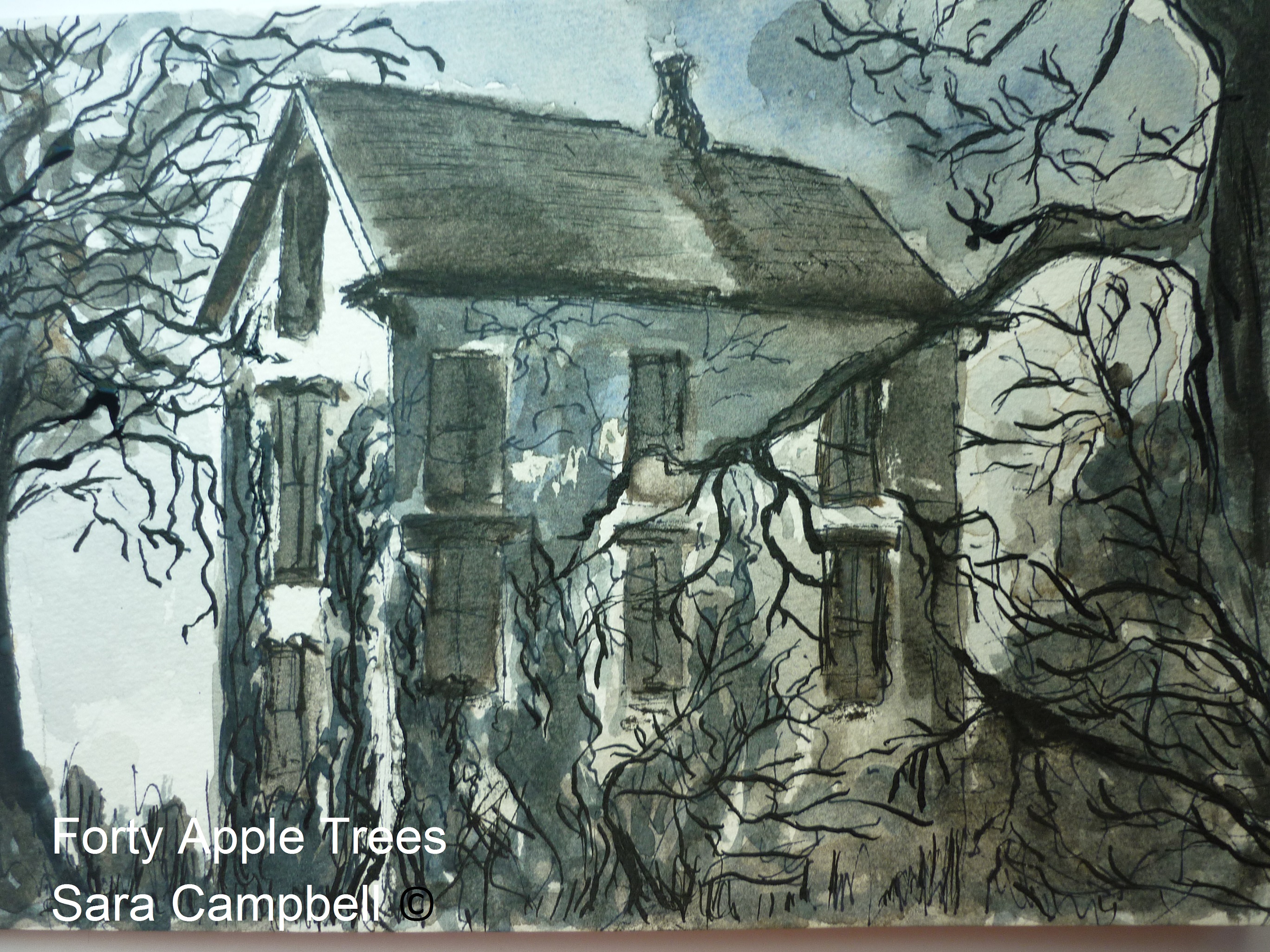
My working title for the book was Forty Apple Trees, the name of the house in the West of England where most of the third part takes place. The nameForty Apple Trees small hung around for so long that it stuck, and I asked my wife to paint the imagined cottage to incorporate into the cover. The version on the left was my favourite.

But some of my beta readers and writing friends thought the title was meaningless. I had to agree, and I spent a month throwing ideas around until I settled on Magenta Falling. They threw this one out too.  An Englishman’s Guide to Infidelity hit me like a brick when I was out walking one day. It references a book written by one of my characters, An Englishman’s Guide to Fidelity. He’s a complete swine, by the way.

Being an expert on everything, I roughed up a sketch and asked my cover designer to see what she could do. Here’s the before and after:

original infidelity coverInfidelity website cover


But I’d miscalculated. First, the cuckold hand gesture seemed unknown to most people. I was asked a few times if the book was about heavy metal . Secondly, the subtitle a novel was a wasted opportunity to add a hook; it obviously wasn’t a cookbook! And despite it being a lovely cover, it lacked impact compared to others in the marketplace.

AEGTI 2016 coverA year or so later I went back to my designer and asked for the blockbuster treatment. She gave me two bits of advice: (1) Don’t try to tell the story on the cover, (2) Leave everything to me this time.

So here it is, and I think it’s brilliant. I love the way the title punches out of the centre, and I love the sense of anticipation as the figure walks into a landscape that is both bright and forbidding.  And best of all, the cottage is back!

###

Find out more about my books here.

My covers are designed by Rachel Ainge at Tribe Creative Co.


New scholarly book evokes warm memories

New-Insights-into-Arabic-Translation-and-InterpretingI took time out from writing fiction last year to contribute the introduction to this new book, edited by Associate Professor Mustafa Taibi from Western Sydney University. In writing the introduction I took the opportunity to honour the memory of the Iraqi scholar Dr. Safa Khulusi, whose  Arabic classes I attended at the Polytechnic of Central London in the seventies.

The invitation to write the introduction evoked warm memories of academic colleagues, teachers, and students from the Arab World.

You can read a sample of the book by clicking the  Look Inside button here.

###

Learn about Stuart Campbell’s novels here.

Great read from Kerry J Donovan even with the American coffee

On Lucky Shores - Cover

What does a Sydneysider do when they get back from the US? Get a cup of decent coffee, what else? No, I shouldn’t be so cruel – I’ve had espresso in New York and San Francisco that approaches the refined drop we enjoy in Sydney, city of a million coffee snobs. But spare me the  warmed-up filtered stuff they serve in US diners! Kerry J Donovan serves gallons of it in this lively novel about Chet Walker, a young itinerant musician whose past is tantalisingly hinted at. Finding himself in the lakeside town of Lucky Shores, he is quickly embroiled in a festering scandal and instantly attracted to Josie, the minx in the diner with the coffee pot and an interesting past of her own. I loved the whole thing, even the sweet ending (I would have preferred a bit of angst, but that’s the kind of writer I am). Chet’s music and lyrics  are woven into the plot, but because they are original I couldn’t play them in my head: Hey, Kerry, what’s the chance of getting them recorded on Youtube and embedding the links in the e-book?

I had some questions for Kerry:

Q – I think that On Lucky Shores was your first novel set in the US. What sort of reaction have you had, especially from American readers? After all, you’re an Irishman living in France!

Kerry_J_Donovan
Kerry J Donovan

A – Agreed, OLS is my first US-set novel and will come as a bit of a change of pace for my readers. I mostly write UK-based police procedurals, although in one of my books, I did send my hero, DCI David Jones to France to catch a paedophile killer.

Setting OLS in the Colorado Rockies was a bit of a gamble for me and required a heck of a lot of research. Although the resort town of Lucky Shores is totally fictitious, I did want the setting to feel authentic. As for dialogue, narration, and ‘feel’, that was equally as tricky. I considered making my leading man, traveling musician Chet Walker, a British ex-pat, a sort of Crocodile Dundee character, but that would have been a bit of a cheat and I didn’t want to write a ‘fish out of water’ comedy. Instead, I tried hard to find a realistic American voice for the narrator and the characters, and hired an editor from Colorado, PC Zick, to help me with the settings, US grammar, and colloquialisms. She did a wonderful job and so far, reader responses have been incredibly supportive.

Basically, no one’s called me out on my misuse of the lingo. Not yet, anyway.

Q – If you found yourself in the diner in Lucky Shores, who would you most want to have lunch with?

A – Great question and a difficult one. The easy answer would be Chet, or Josephine (the diner’s owner and female lead character), but they’d be pretty much lost in each other and I wouldn’t have much of a chance in the conversation. Young love, eh?

Apart from the two leads, my favourite character is ‘The Ghost’, Sheriff Casper Boyd. He has his own agenda and, like Chet, is a recent addition to the Lucky Shores community. As an outsider, he has a different perspective from Lucky Shores’ other residents. Apart from everything else, he’s more my age than the youngsters, and we’d have slightly more in common. One question I’d like to ask him is why he’s being so tough on Chet. After all, the poor guy only wants to find a gig, earn some money, and move on with his life. Yeah. “What’s your game, Sheriff? Why are you being such a hard-ass?”

Q – People drink an awful lot of coffee in Lucky Shores. Are you willing to share your true feelings about the coffee they serve in US diners?

A – Couldn’t possibly comment. I don’t drink coffee. Never have, never will. I’m old school, a tea drinker through and through. I’m sure all US diners serve delicious coffee all the time, but I’m not an expert and will leave that discussion to others. And by the way, in Chet’s defense, he’d been out in the cold and the rain most of the night and needed the coffee as much for its warmth as its caffeine.  And anyway, he’s a big guy and the coffee cups are small. Give the guy a break, will ya?

###

Find out about Stuart Campbell’s novels here.