I’ll Choose My Own Books, Thanks Very Much

Once every few months I head for Elizabeth’s Bookshop in Newtown, a daggy-chic inner Sydney suburb where hard-up students rub along with social housing tenants and real estate investors. Elizabeth’s isn’t just a second-hand book paradise, it’s my antidote to the enshittification of culture; because when I buy old books I am completely immune to marketing, reviews, and algorithms. I cruise the shelves on autopilot, selecting books according to some mysterious internal instinct. Here are some of my latest haul:
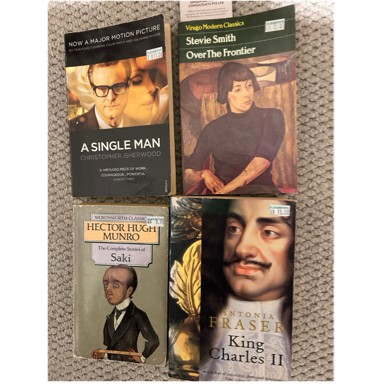
Stevie Smith, Over the Border

Antonia Fraser, King Charles II

Christopher Isherwood, A Single Man

Hector Hugh Munro, The Complete Stories of Saki

In the case of Stevie Smith, I know her poetry but not her novels. Antonia Fraser is super famous but I’ve never read her – and I have a soft spot for Charles II. I’ve been an Isherwood fan for decades, but I’ve never read A Single Man. And as for Saki, he’s so famous that I felt embarrassed that I didn’t have a clue who he was. More on my haul in a moment.

I read voraciously as a child in England. My mum signed me up for the public library: I can still feel the comfort of fat hardbacks wrapped in soft polythene dust covers. My dad had a little collection of highbrow books I read as a teenager. I remember stories by Somerset Maugham and the E.V. Rieu translations of The Iliad and The Odyssey. On reflection, it was escapism that drew me to books. I wanted to be anywhere but the dreary suburbs where we lived.

But I also became hooked on words. The first book I bought with my own money was Kit and the Mystery Man by Mollie Chappell, in which someone found themself in imminent jeopardy. I was desperate to know what it meant, and when I found out I shoehorned it into my school compositions. I’ve recently been chewing over Stevie Smith’s description of a freshly tidied garden as like a child with a washed face and a clean pinafore. I’m hooked on beautifully arranged words.

And I think it is escapism that has driven a lifetime of eclectic reading: Escaping into other times and places; escaping into a writer’s consciousness; escaping into other spiritualities; nowadays escaping from algorithms and grim headlines. When I began to write fiction seriously fifteen years ago, I carried back fragments of those other worlds and minds, using them to shape the new worlds and minds I created in my own novels and stories. Thus a perfect circular feedback mechanism developed: Reading and writing became two sides of a coin, input and output fused.

So here’s my take on the four books I mentioned:

Stevie Smith, Over the Border

Those new to Stevie Smith may at least know the title of her 1957 poem Not Waving but Drowning, which you can listen to here. She’s known principally as a poet but wrote three novels. Over the Border, set in 1936follows Smith’s peculiar alter ego Pompey Casmilus as she mopes after a romance breakup in London and somehow finds herself in the midst of an opaque espionage adventure in WWI Germany. Pompey’s narration meanders through style shifts, syntactic recursions, and odd frenchified vocabulary. I read it very slowly, stopping from time to time to gaze at a paragraph and wonder where it was going. What to make of this for example?

Why now certainly this Pompey is becoming very sad-case and dippy, for see now I am crying …

Over the Border somehow reminds me of a weird buffet restaurant in Japan where I filled all the bento box compartments with unrecognisable foods, then grazed around it discovering that many of the items were Yōshoku – adaptations of western food, e.g. cold mashed potato topped with pink fish mousse, oddly spiced bolognese sauce. With Over the Border, you graze among the sentences savouring tasty tidpits and ending up feeling quite sated without knowing quite why.

Antonia Fraser, King Charles II

This book is – like those massive fridges you can buy these days – a big unit. It’s huge, it’s detailed, it’s a magnificent work of scholarship, but written with such a deft hand that after 670 pages you don’t realise a fortnight has gone by. Notably, Charles II emerges from the pages as a great guy you’d love to have a goblet of Sack with.

Christopher Isherwood, A Single Man

I’ve probably read Isherwood’s Mr Norris Changes Trains a dozen times, and even used it as a device to bring two lovers together in my novel An Englishman’s Guide to Infidelity. How on earth did I miss A Single Man? It was worth the wait: Isherwood embeds us deep in the mind of bereaved British professor George Falconer as he spends his last day on earth in a US university. The writing is silky and sly, infused with suppressed irony and black humour. It’s 1962, and Falconer’s students are gauche and gawky; the barrier between him and them is like those invisible and impenetrable force fields in sci-fi movies. Delighted with the book, I streamed the movie. Twenty minutes in (in defiance of the critics) I was wondering why I bothered. There’s no denying that Colin Firth acts well (he did get an Oscar) but I felt that (a) all the principal characters were hopelessly miscast, and (b) the internal monologue of the novel seemed to have been replaced by gay sex scenes laid on with a sweaty shovel. Sure, Falconer’s gay but he is so much more.

Hector Hugh Munro, The Complete Stories of Saki

This is a one-off. Hundreds of quirky stories by an English toff with British India connections crammed into 700 pages of microscopic text. Under the pen name Saki (from the Arabic saaqii water bearer), Munro created a world of Edwardian house parties peopled by blowhard dowagers and crusty retired colonels. His most famous protagonist is Clovis Sangrail, a posh young fellow who pokes fun at Edwardian manners through pranks and veiled slights. Clovis, who is sometimes described as epicene (what a delicious word), is devilishly witty and mature well beyond his years (he seems to be about seventeen). Some of the stories are hilarious, some fall flat, most are very short. Poor Saki’s life was complicated, as was his background. Contemporary portraits show a man bearing a burden. He enlisted at the age of 43 and was killed by a sniper in France in 1916. He is best enjoyed in small bites; I estimate I’ll have got through The Complete Stories of Saki in about five years.

###
AI voiced novel misses the mark.

I grit my teeth and pressed the button, brushing aside my ethical misgivings about depriving a voice actor of a fee. I’d accepted an invitation from my publishing platform to turn one of my novels into an audiobook using their AI voice program. The truth is that my fiction ‘business’ runs at a loss, and I had no plans to invest in a voice actor; I was motivated more by curiosity, especially since the company wasn’t charging me a cent.

Their audiobook building process is dead simple: They put your ebook version up on screen. You choose your voices from a selection of American and British examples (I chose three – one for each character) and hit the narration button.

My baby began to speak! The narration was startlingly realistic; I was in awe of the technical virtuosity of the AI engine under the hood – and I still am despite my later reservations.

My job as author was to tune the engine as it hummed along – principally by repairing pronunciation errors. The toolkit is pretty simple: You respell the incorrect word to achieve the right pronunciation, e.g. respelling row as roe to block it rhyming with how. But a good handful of errors were resistant to my efforts, despite some ingenious tactics based on my expertise in phonetics.

The audio conversion runs in real time, but it took me several hours to stop and fix errors. While the voices in the audio version sounded sort of authentic, something was slightly off. All the major phonetic elements were well executed: Properly pronounced vowels and consonants, word stresses on the right syllables, sentence stresses mostly correct, longer segments like phrases, clauses and sentences overlaid with intonation contours to signal when they began and ended.

So what was slightly off? I think the problem lay in the way that the AI engine tackles intonation, a speech mechanism that conveys all kinds of meanings. You can test the magic of intonation by reading aloud “I love you” in ten different ways: You might find yourself conveying passion, regret, sadness, anger, desperation, or even sarcasm – each rendition depending on the context. And it’s likely that the intonation pattern you use is motivated by clues that go back over several sentences or even paragraphs. But while the AI gizmo uses intonation patterns that sound human in isolation, they don’t seem to reflect emotional cues beyond the current sentence. I didn’t see evidence that it ‘remembers’ elements of the text that would motivate subtle intonation patterns.

Don’t get me wrong: We’ve come an unbelievably long way since the first Dalek croaked EXTERMINATE, EXTERMINATE. There are vast numbers of applications for AI voicing where authentic human affect is irrelevant. But my novel sounded emotionally insincere and – dare I say it? – robotic, despite the dazzling technical feat behind its production.

Midway through writing this piece, I jumped onto the audiobook catalogue to listen to the free sample of the book. This time it wasn’t so dazzling. The rendition had an odd, jumpy singsong quality that I attribute mostly to intonation problems. And one sentence slipped disastrously from fruity Midsomer Murders British into a variety of American.

The customers evidently didn’t like it. The ebook has racked up about 2000 sales over the years, was an online bestseller for a day in 2016, and has a ranking of 3.6 stars and 73 genuine reviews. I still get a dribble of ebook sales without doing any serious promotion.

How did the audio book go? Zero sales.

EXTERMINATE, EXTERMINATE.

Check out my books here.

The Death of Truth Revisited

The current deluge of alternate facts on social media has resurrected debate in our household about which apps we should ditch.

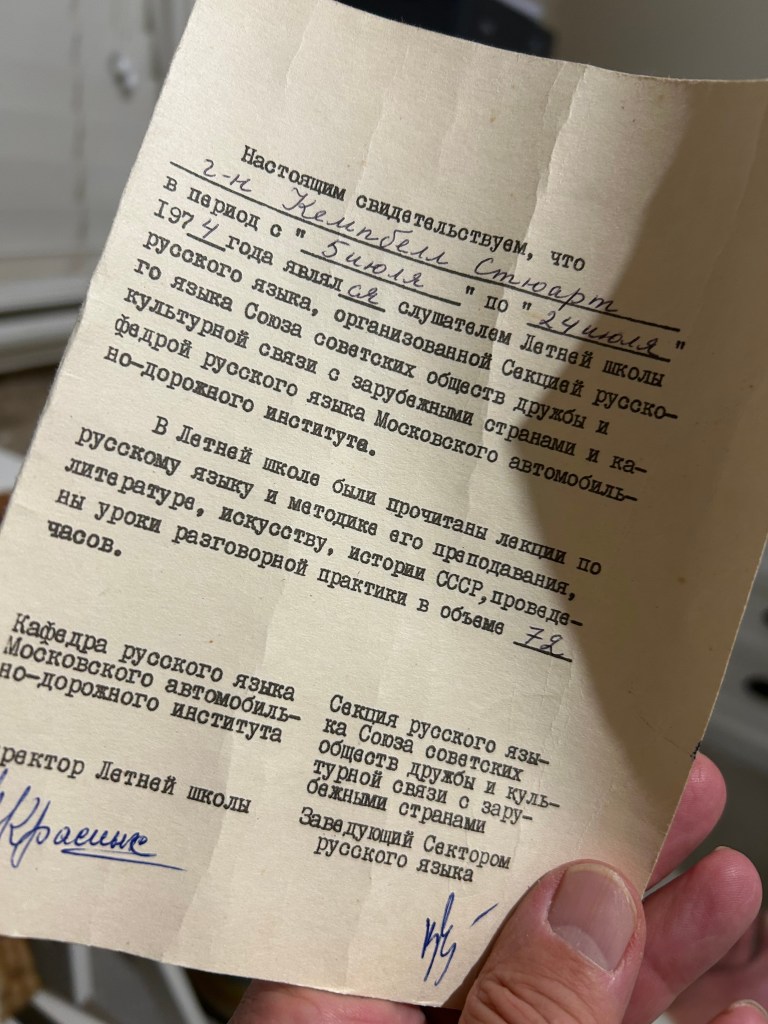
This preoccupation with truth revived memories of June 1974, when I’d completed two years of a four-year bachelor course in Russian and Arabic at the Polytechnic of Central London. Back from six months at Cairo University, which happened to overlap with the Yom Kippur War, I was signed up for an intensive month of advanced Russian at the Poly before our class was sent off to Moscow .

Our lecturer’s (self-appointed?) job was to teach us how to read a Soviet newspaper, i.e. to read between the lines. We spent the month burrowing in the innards of Pravda (‘Truth’) and Izvestia (‘News’).

When I arrived in Moscow, I was surprised to know that I was a delegate to the Union of Soviet Associations of Friendship and Cultural Links with Foreign Countries. That was a surprise, but I supposed it must be true.

At any rate, I attended Russian classes at the Moscow Highways Institute in the mornings (see my certificate above) and knocked around the city in the sunny afternoons, sometimes stopping to drink a glass of kvas and read Pravda; the day’s edition was mounted in glass display frames in the streets.

On my last day I read in Pravda about something serious that had happened in Cyprus. I roughly understood that Turkey was involved, but the long news article was so convoluted – perhaps to disguise the fact that the USSR hadn’t yet established a stance on the matter – that I spent the day mystified. I arrived home to read in The Guardian that Turkey had invaded the north of Cyprus.

In today’s world of alternative facts, I’m reminded of a Soviet joke that our mysterious lecturer passed on to us fifty years ago: ‘There’s no truth in Pravda, and no news in Izvestia‘.

***

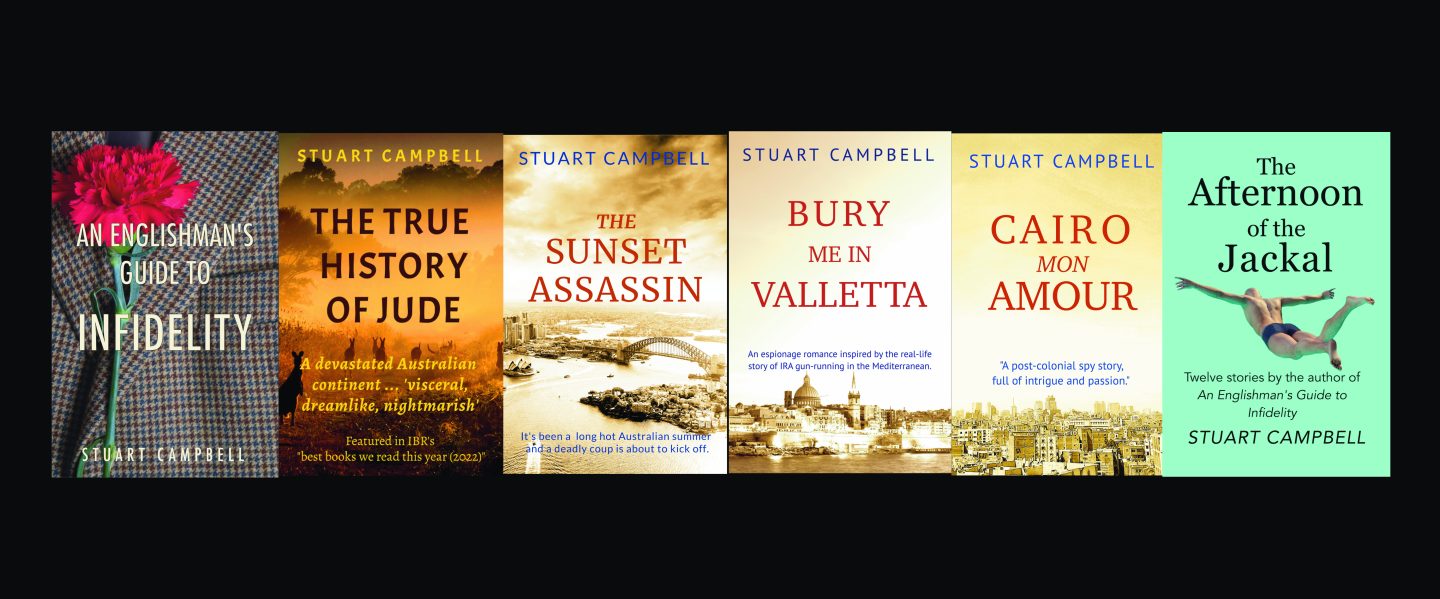
If you’re interested in a dystopian read, have a look at my novel The True History of Jude, (featured in Best Reads of 2022 by Independent Book Review in the US) where I project forward to a time when truth is trash, when generative AI has turned on itself, when every warship is sponsored by one of the three mega consulting companies to which governments outsource their functions, and … when Australia has excised its own territory from itself and established itself as a virtual monarchy operating from the Bodleian Function Centre in Oxford. Think this is bizarre? Watch this space over the next four years.

Featured

New Short Story Collection by Stuart Campbell

These twelve stories, set mostly in Australia and Britain, lead the reader through irony, black comedy and the weirdly unexpected towards truths at the very heart of humanity.

You may know me as an author of novels like The Siranoush Trilogy and An Englishman’s Guide to Infidelity . With this new book, I’ve now turned to the short story genre:
A defeated man stows away on a cruise ship. A woman prefers to be a bird than a human. A nineteenth century scholar discovers a deadly Nirvana. A wife decides to redesign her brain damaged husband. A school reunion revives an unlikely friendship.

The story behind the stories

In 2023, I challenged myself to unbung the writer’s block that struck me during COVID: I would learn to write short stories. I spent much of 2023 reading short story authors in order to crack the code. As I drafted stories, I emailed one a month to a group of about thirty readers and friends during 2024. I called this the Free Shorts project. I used reader feedback to fine-tune the twelve stories, which are now published as this collection. Along the way, three of the stories were recognised in writing competitions in Australia and the UK.

I hope you enjoy these stories, which you can find in ebook and paperback on Amazon here.

And don’t forget to check out my other books here. Happy reading!

Free Shorts project – a year of stories and friendships

I’ve almost made it – just one more story to send out in December. My aim was to email a free short story each month to a select group of my readers during 2024.

I want to send a huge thank you to all those who sent me comments and told me how they’d enjoyed my work.

Also a big thank you to my readers for renewing old friendships and making some new ones during our email exchanges. Two weeks ago I had a wonderful surprise when I got an email from a friend I hadn’t seen for decades. She’d read some of my books and contacted me via the QR code in the back of my paperbacks. Naturally, I put her on the Free Shorts list, and we’re having lunch in a few weeks to catch up on several decades of news!

I’m working on the book of the twelve stories, which will be in ebook and paperback. I thought a lot about the title. Should I use the Free Shorts theme? Nah – I was sick of looking at those droopy shorts. Instead I followed the lead of Hilary Mantel, who used the title of one of her stories – The Assassination of Margaret Thatcher – as the title of the collection.

So let me unveil the title and draft cover of the Free Shorts book*, which will be out early 2025:

One of my aims was to get some recognition through entering short story competitions. I’m delighted to say that three of the twelve were recognised:

My short story Happy Days was longlisted in Creative Writing Ink (UK) competition, 2023. Read more here.

My short story Birdbrain was  Highly Commended in Stories Unlimited Rural Themed Competition, 2023. Read more here.

My short story I Thought I Knew Something about This Place was shortlisted for the 2024 EM Fletcher Writing Award. Read more here.

*swimmer image licensed by Shutterstock

Next steps: Well, I’m cutting back my literary output over the next year or so while I dive into a new and completely unrelated project that is already consuming a lot of my time and brainpower (a few of you know what this nutty plan is). I haven’t got the time or mental energy to commit to writing another novel, but I do plan to write four short stories this year and send them out to the Free Shorts gang. I won’t be entering any for competitions because I’m not crazy about writing to prescribed word limits and weird themes.

I’ll also be publishing each the Free Shorts stories monthly through 2025 on my blog (and reposted on FB, LinkedIn and Bluesky) to help promote my novels. I’m too busy to do marketing, so I sell just a dribble of books each month. If I can slightly increase the dribble to a steady drip I’ll be happy!

http://www.stuartcampbellauthor.com