These twelve stories, set mostly in Australia and Britain, lead the reader through irony, black comedy and the weirdly unexpected towards truths at the very heart of humanity.
You may know me as an author of novels like The Siranoush Trilogy and An Englishman’s Guide to Infidelity . With this new book, I’ve now turned to the short story genre: A defeated man stows away on a cruise ship. A woman prefers to be a bird than a human. A nineteenth century scholar discovers a deadly Nirvana. A wife decides to redesign her brain damaged husband. A school reunion revives an unlikely friendship.
The story behind the stories
In 2023, I challenged myself to unbung the writer’s block that struck me during COVID: I would learn to write short stories. I spent much of 2023 reading short story authors in order to crack the code. As I drafted stories, I emailed one a month to a group of about thirty readers and friends during 2024. I called this the Free Shorts project. I used reader feedback to fine-tune the twelve stories, which are now published as this collection. Along the way, three of the stories were recognised in writing competitions in Australia and the UK.
I hope you enjoy these stories, which you can find in ebook and paperback on Amazon here.
And don’t forget to check out my other books here. Happy reading!
You may know me as the author of novels like Cairo Mon Amour, Bury me in Valletta, The Sunset Assassin, An Englishman’s Guide to Infidelity, and The True History of Jude.
For the last year I’ve been writing short stories. I’m working hard to master the form, but I’m especially interested to hear your views on what works and what doesn’t – and to use this feedback to make improvements to my stories.
The short story scene thrives on competitions run by libraries, municipal councils, bookshops and other bodies that support writers. I’ve been submitting stories in in recent times and I have my fingers crossed!
I’d gladly post samples of my stories free on my website but for one thing: Most competitions won’t accept stories that have been published – and that usually includes publication on a blog or website.
That’s why I’m offering free email access to one of my stories each month for a year starting in January 2024. You can see the list of stories below.
At the end of the year I’ll publish an anthology of the stories on Amazon, Kobo and Apple, hopefully with one or two competition plaudits under my belt.
Look out for my January story announcement later in the year. All you’ll need to do is email me at stuartcampbellauthor@gmail.com to request the January story. Even better, email me today and I’ll put you on my list.
I’m sure you hate spam as much as I do, so I won’t put your email into a mailout program without your consent.
A year of stories:
January 2024
Your Own Luck: A man with a past stows away on a cruise ship to Brisbane.
February 2024
An Afternoon under the Paperbark: A hidden observer witnesses a family drama on a hot afternoon in Sydney.
March 2024
The Unmasking of Mr French: A new neighbour in a luxury apartment block is not what he seems.
April 2024
Ninety-nine Names for Rain: A nineteenth century scholar discovers a deadly Shangri-La.
May 2024
The Afternoon of the Jackal: Uncle Christopher’s Boxing Day BBQ doesn’t go to plan.
June 2024
Birdbrain: A lonely woman prefers to be a bird.
July 2024
Thanks Dad: The Vice Chancellor of a university struggles with Imposter Syndrome.
August 2024
Belfast: When an Australian searches for his roots in Belfast, things get complicated.
September 2024
Fireworks: A man loses his memory in an accident, so his wife tries to redesign him.
October 2024
Lawrence of Arabia’s Box: An update on the fate of the lost manuscript of The Seven Pillars of Wisdom.
November 2024
Happy Days: History is rewritten at a school reunion.
December 2024
Balti Lamb: A dinner date at a Heathrow Airport restaurant goes pear-shaped.
In July 2025, my friend and fellow linguist Professor Basil Hatim set up his soapbox on LinkedIn. He promised that he would be “sharing … thoughts, opinions, and maybe even a few rants on the issues that get me thinking.” Ten months on, we are blessed with an impressive suite of more than thirty essays ranging from the first, which calls for a new text-linguistics approach to translating the Holy Qurān, to a recent one on the text-linguistics concept of informativity. This particular essay is built around the notion of divine provision, incidentally bringing into play a Blind Snake and a Devoted Cat.
Along the way we have seen the development of the concept of rhetorical intelligence, a desperately needed glossary of rhetorical and text-linguistic terms, and the launch of the ship nūn: a joyful graphic rendering of the Arabic letter ن (n) metaphorically carrying us along our journey of intellectual discovery. Colleagues have contributed comments and sometimes essay of their own in response. Prof Hatim has humbly taken these on board, issuing clarifications and explanations. For example, I had some misgivings about the early definition of rhetorical competence; a much more elaborated version soon appeared (which I’m sure was already in the pipeline).
The ship nūn is a good reminder that many of Prof Hatim’s essays are all built on the notion that the Holy Qurān (and the Arabic it was revealed in) provides unique examples of the workings of rhetorical and text-linguistic devices. The Arabic letter nūn for example isn’t marshalled as transport because it looks like a boat; rather, Prof Hatim extracts layers of signification for nūn from the Holy Qurān itself: It is linked to ‘the act of recording destinies and truths’ and ‘the act of creation, bringing words/worlds into being’. nūn is the first letter of Surah 68, which is concerned with oath and inscription.
As I watched the ship nūn sail through 2025 into 2026, I reflected on why my friend’s work left such a positive impression on me. On the surface, the writing – in Prof Hatim’s stately English prose – is joyful, reverent, crisp, and deeply insightful. What struck me more deeply through was its creative character and its liberation from academic convention*. I was struck by the parallel with my own post-retirement journey from Professor of Linguistics to a writer of fiction, the joy of being my own literary boss, along with the discovery that my literary creativity in later life has been a powerful impetus to self-discovery and, as Jung would have put it, individuation. More of Jung later.
In Prof Hatim’s work I have seen that same joy in creating not just new work but a new kind of work. In my view these essays represent a unique genre of writing located at the intersection of linguistics, theology and a third point that lies somewhere between oratory and dialectic. Let me go back to the Blind Snake and the Devoted Cat to illustrate my point.
Prof Hatim’s recent essay Informativity: A Frequently Misunderstood Concept is structured roughly as follows:
1. Informativity is defined with reference to Beaugrande and Dressler’s seminal text.
2. We are told that Sacred Hadith on divine provision (al-arzāq) will be used to exemplify informativity.
3. We learn that a discussion on divine provision by the Sheikh Abdal-Hamid Kishk employs a fable on the Blind Snake and a Devoted Cat. A translation of the fable is provided.
4. A beautifully written section follows, in which Prof Hatim argues that God deploys his ‘unseen agents’ (e.g. the snake and the cat) to make visible the ‘divine signature’. The entire fable challenges ‘reductive paradigms’ like Darwinism. The cat ‘is nothing more than a soldier of God’.
5. We return to the Sacred Hadith referred to by Kishk and its ‘moral force’ and its value in illustrating informativity.
6. The definition of informativity is mentioned again, along with the comment that the conditional consequence (jawāb ash-sharț) will be the focus of the argument.
7. The Hadith is provided in English translation with the final sentence suppressed.
8. The final sentence is revealed. While the text has guided us towards an expected conclusion – that God will disapprove if we do not meet his demands (loosely interpreted), the actual conclusion ‘overturns this expectation with disarming grace’ by revealing God as merciful.
9. The essay concludes with a reminder that ‘God’s dealings with his servants exceed the logic by which we deal with one another’.
This essay breaks all the genre rules of academic writing, and in this rupture lies its magic, its force and its call to action.
My actions were: To check the definition of informativity; to look up Robert de Beaugrande’s unusual (to say the least) biography; to check some Arabic terms in my battered Hans Wehr dictionary; to look up Sheikh Kishk; to look up and read a commentary on Surah 68. Then, in the early hours of the morning to lose sleep thinking about the fable and the parallels with Jung’s archetypes; to think about a story I might write; to think about a story I wrote about a man condemned to solitary confinement who is visited in his dreams by a green bird and an eyeless girl; to spend fifteen minutes on the cross-trainer in the gym listening to a podcast on Jungian analysis and thinking how this might influence how I might write a response to Prof Hatim’s essay.
A final word about informativity: I recently read George Saunders’ A Swim in a Pond in the Rain where the renowned author analyses short stories by four Russian authors and (to my mind) demonstrates that writing fiction is all about informativity, ‘the strategic orchestration of expectation and its deliberate violation’, as Prof Hatim puts it in this essay. For a writer of fiction, informativity is seen in such things as subverting a stale metaphor, the use of bathos, and betting how long you can string out the reveal. How we writers strive to achieve the ‘minimal linguistic shift that yields maximal ethical insight’!
I thought I’d celebrate the tenth anniversary of the passing of Raymond Saucisson by reposting this tribute from 2015:
Raymond Saucisson, the noted gourmand and long-time editor of Charcuterie Monthly, passed away unexpectedly yesterday. His close friend Stuart Campbell said that Saucisson’s death comes just a week after the publication of the anthology With Gusto!, for which the charcuterie supremo wrote an introduction. “I’m devastated,” said Campbell. “He was always at the cutting edge, as an editor and as a small goods expert; he was a man who took on life one huge slice at a time”. Saucisson was born into poverty in Marseilles in 1945. He learned the art of sausage making from his mother, who sold her wares in the alleyways off Le Canebière. As a child Saucisson listened to the stories of the sailors who haunted the area, and in 1960 took a job as a ship’s cook. After ten years at sea he jumped ship at London, eventually obtaining residence papers and gaining employment as a bus conductor with London Transport. Stuart Campbell remarks on the formidable standard of his English, considering he had virtually no formal education. “During his fifteen years on the buses he read voraciously: Georgette Heyer, The Times, Charles Dickens, The Beano, Thomas Hardy. He consumed everything that was left behind on a bus seat. The 142 to Watford Junction was his university, he once told me.” In 1985 he was offered the editorship of Charcuterie Monthly. In a recent article he reflected on the magazine’s success: “A piece of writing is like a sausage. It has form, content, texture. And in the same fashion, what turns a quotidian article into an exceptional article is that inexpressible je ne sais quoi, the literary counterpart of a bead of glistening pork fat or a perfect balance of herbs.” With his trademark cravat, four-day stubble and haughty stare, Raymond Saucisson will be missed around the French markets that have become de rigueur among Sunday bruncheurs (a neologism of his own invention) from Aylesbury to Auckland. Raymond Saucisson is survived by his wife Solange, an author of vegan cookbooks. “While our dietary tastes differed, we complemented one other perfectly like ham and peas. If he was my bubble, I was his squeak,” she said yesterday.
***
You can find books by Raymond Saucisson’s alter ego Stuart Campbell here.
I grit my teeth and pressed the button, brushing aside my ethical misgivings about depriving a voice actor of a fee. I’d accepted an invitation from my publishing platform to turn one of my novels into an audiobook using their AI voice program. The truth is that my fiction ‘business’ runs at a loss, and I had no plans to invest in a voice actor; I was motivated more by curiosity, especially since the company wasn’t charging me a cent.
Their audiobook building process is dead simple: They put your ebook version up on screen. You choose your voices from a selection of American and British examples (I chose three – one for each character) and hit the narration button.
My baby began to speak! The narration was startlingly realistic; I was in awe of the technical virtuosity of the AI engine under the hood – and I still am despite my later reservations.
My job as author was to tune the engine as it hummed along – principally by repairing pronunciation errors. The toolkit is pretty simple: You respell the incorrect word to achieve the right pronunciation, e.g. respelling row as roe to block it rhyming with how. But a good handful of errors were resistant to my efforts, despite some ingenious tactics based on my expertise in phonetics.
The audio conversion runs in real time, but it took me several hours to stop and fix errors. While the voices in the audio version sounded sort of authentic, something was slightly off. All the major phonetic elements were well executed: Properly pronounced vowels and consonants, word stresses on the right syllables, sentence stresses mostly correct, longer segments like phrases, clauses and sentences overlaid with intonation contours to signal when they began and ended.
So what was slightly off? I think the problem lay in the way that the AI engine tackles intonation, a speech mechanism that conveys all kinds of meanings. You can test the magic of intonation by reading aloud “I love you” in ten different ways: You might find yourself conveying passion, regret, sadness, anger, desperation, or even sarcasm – each rendition depending on the context. And it’s likely that the intonation pattern you use is motivated by clues that go back over several sentences or even paragraphs. But while the AI gizmo uses intonation patterns that sound human in isolation, they don’t seem to reflect emotional cues beyond the current sentence. I didn’t see evidence that it ‘remembers’ elements of the text that would motivate subtle intonation patterns.
Don’t get me wrong: We’ve come an unbelievably long way since the first Dalek croaked EXTERMINATE, EXTERMINATE. There are vast numbers of applications for AI voicing where authentic human affect is irrelevant. But my novel sounded emotionally insincere and – dare I say it? – robotic, despite the dazzling technical feat behind its production.
Midway through writing this piece, I jumped onto the audiobook catalogue to listen to the free sample of the book. This time it wasn’t so dazzling. The rendition had an odd, jumpy singsong quality that I attribute mostly to intonation problems. And one sentence slipped disastrously from fruity Midsomer Murders British into a variety of American.
The customers evidently didn’t like it. The ebook has racked up about 2000 sales over the years, was an online bestseller for a day in 2016, and has a ranking of 3.6 stars and 73 genuine reviews. I still get a dribble of ebook sales without doing any serious promotion.
When a slick email arrived congratulating me on my ‘literary achievements’, some pleasure centre in my brain briefly glowed. Reading on, I found the standard list of offerings: Enhanced SEO, exposure on Goodreads, engagement with influencers, etc. I’m sure most fiction authors endure a similar blizzard of unsolicited offers to help sell books; in fact I suspect that more money is made in the author support business than the author business.
When a second email arrived the next day, I took a good look at both communications: They both referenced a number of my titles, threw in key plot motifs, mentioned main characters, and wrapped up the whole piece with lavish praise. ‘Wow’, I (momentarily) thought, ‘someone’s put some effort into writing this’.
The someone was apparently an opaque email address and bland name – no other details. The actual someone was clearly a Generative AI setup that has scraped my book blurbs off the internet and tipped them into a copywriting blender. A similar non-human email arrived two days later, this time from a company with a website and the street address of a seedy premises on the fringes of a major US city that looked as if it might double up as a swingers club.
These emails could have been the reason the term ‘bottom feeding’ was coined: Fiction writing is so poorly remunerated that – from the author’s point of view – the writing industry barely deserves the term ‘industry’ at all. It staggers me that somebody can find a business niche that depends on scraping thousands and thousands of book blurbs in the hope of hitting authors willing to cough up good money for services that in my experience yield a negative ROI.
My other Generative AI encounter arose from a professional postgraduate course I recently enrolled in – fourteen years after I retired as a Pro Vice Chancellor and forty years since I was last a uni student. I was intrigued to learn that the university’s obligatory unit on academic integrity was much preoccupied with the hazards of dealing with AI in academic writing
So far, so good. Except that my second study unit entailed (a) researching a topic using a Generative AI tool, (b) researching it with my human brain, and (c) comparing the results. A quick check showed that this assessment item fulfilled a graduate attribute on understanding AI.
My human brain research wiped the floor with the GenAI version, and I managed to gleefully use the term ‘stochastic parrot’ (properly referenced) in the closing paragraph of the paper.
It’s a huge thrill for my short story Naming Rights to be longlisted for the Furphy Open Short Story Award, and a further confirmation that I seem to have made the transition from novels to short stories.
Thanks to my many readers and supporters! I’ll make Naming Rights available soon.
In 2017 I visited my mate Paul in Rhodes. I wrote a short post about how disappointed I was to find that there had been no guns at Navarone Bay. It’s been my most visited post, but I don’t really know why. I can only think that when someone remembers the film The Guns of Navarone and Googles it, my post comes up. Here’s the link if you’d like to join the crowd.
On the other hand, if you’d like to read something more informative and edifying, check out my books here.
Some people plan their life trajectory. For me, serendipity has often trumped planning. How else did I find myself unexpectedly signing up to an Arabic degree more than fifty years ago? Recently I began to ask myself how half a century of knowing Arabic has shaped the way I think and feel. How different has it made me from the person I might have been if I’d never taken this path?
It was 1971, and I’d applied for a languages degree at the Polytechnic of Central London (now the University of Westminster). The Russian interview went well; I could only offer a GCE ‘O’ Level, but Russian wasn’t widely studied in the secondary education system at that time. I had a GCE ‘A’ Level in French, but they were two a penny in the UK. Sorry, the French lecturer sniffed, your grammar’s not good enough; try the Arabic room down the corridor, they start from scratch.
The Head of Arabic sat in an empty classroom staring out over the roofs of Bloomsbury: I was signed up in minutes for a journey that would shape the rest of my life. For most of my adult years, Arabic and Arab culture have been embedded in my mind, helping to shape my world view, my scholarship, my values. In signing up on that day in 1971, I joined an exclusive club of English speakers who know something about the world of the Arabs from the inside, rather than through the smeared lens of ignorance, prejudice and habituated racism. I find it impossible to imagine a me who didn’t wander into that classroom in 1971.
I’d had a messy flirtation with Arabic in 1969. After leaving school at sixteen, I stumbled into a civil engineering traineeship which ended with me failing my maths exams three years in a row. Freshly unemployed, I headed for Gibraltar and picked up a job driving a grocery van with a crew of Moroccans. I spoke schoolboy French with them, but I was fascinated by their throaty Arabic. I bought a copy of Teach Yourself Arabic and slogged through the chapters for a couple of weeks, but there was no connection between what the book said and what my Moroccan buddies said. Much later I learned that the Moroccan Arabic dialect is pretty well incomprehensible to anyone but Moroccans, and that the high-flown language of Teach Yourself Arabic isn’t used by van drivers.
Arabic installed itself in my mind quite differently from the way that French or Russian did. I learned French at school between the ages of 11 and 15. As soon as I arrive in France or New Caledonia, I open my mouth and bad French pours out based on prepubscent rote learning.
I studied Russian alongside Arabic from age 20 to 25, but while Arabic dazzled me, learning Russian was like pouring grey sand into a holey bucket. It seemed to need ten times more effort to find places in my head where it would stick. Cyrillic script looked like a row of Soviet era radiators, unlike the dramatic flourish of Arabic. Beyond the teaching staff you never met a Russian in the Polytechnic cafeteria. Poor, unattractive Russian was trapped inside cheap Soviet textbooks. But in 70’s London you met with a whole stream of Arabs – Lebanese communists, Yemeni poets, Libyans on Gaddafi’s big oil scholarships. You went to parties with Arabs in their expensive flats on the Edgware Road. Russian didn’t stand a chance.
And unlike Russian, Arabic words entered my brain dressed up in their own colourful costumes, where they had a jolly time mixing with new friends – words like Al-Urwah Al-Wuthqa, ‘The Firmest Bond’, the title of a short-lived Egyptian revolutionary journal that was key in initiating the Arab revival of the late nineteenth century. My teacher mistranslated it as ‘the reliable handle’ and I have used it for decades to describe useful household items like spanners (Wow, I bought a real Urwah Wuthqa at the hardware store today). A Libyan taught me a filthy poem in high-flown Classical Arabic that I can still reel off. I knew a Tunisian girl called Buthaina, and learned that her name is a slang word for pussy cat. I have a habit of commenting on Arab names when I watch TV. That guy’s name means ‘glory of the religion’, I might mutter. Then I remember the Arabic saying al-asmaa’ laa tu’allal, ‘names are not to be explained’, told to me by a man whose name meant ‘war sparrow’.
Thus Arabic poured into me, along with a jumble of memories, associations, emotions, stories, relationships, people, and images.
The aesthetic of the east was part of the attraction of Arabic: In my mind, the Arab World belonged to the exotic and sensual Orient – alongside India, joss sticks, flowing robes and sitar music – that coloured my generation in the late sixties. If I’d been offered a course in Hindi or Bengali that day at the Poly, I’d probably have taken it. It would be eight years until Edward Said would challenge the West to examine the underbelly of its relationship with the East and to frame a postcolonial conception of East-West relations. Not even the Beatles were spared postcolonial scrutiny; was their appropriation of Indian culture imperialistic, just dressed in psychedelic garb? I unconsciously modelled this worn-out worldview: I was doing the Arabs a favour by learning their language. In 1973, I was proud when an Egyptian journalist gave me a book of his inscribed in Arabic ‘to the orientalist Stuart Campbell’. I groan at my naivete now.
The inner workings of an immature psyche aside, it was the sheer alien complexity of Arabic that got me hooked, from the sweeping right-to-left script, the mad plug-in word-building system, and the pharynx-bending phonetics. Our Egyptian lecturers utilised a traditional classroom method of slog, repetition and memorisation with minimal use of English. The core materials were a kind of cultural studies curriculum strongly infused with the long-forgotten creed of Arab Socialism, handwritten and printed on a Roneo machine. The early texts had two sentences per page in big handwriting, the fourth year ones were on a par with newspaper Arabic. Our job was to memorise it all – hundreds of word roots, jagged morphological patterns, unpredictable plurals, alien sentence constructions, unexpected semantic frameworks, none of it remotely like the European languages we had learned at school. It was pure slog, every spare moment with nose in notebook memorising, self-testing, silently chanting like an acolyte in an occult sect.
I quickly cracked the Arabic dictionary code: You don’t look words up alphabetically by the first letter; you search the word for its three-consonant root and look up the root, under which the whole word family is listed. I’m on my second Hans WehrArabic-English Dictionary, the first of which ended up stuck together with gaffer tape until it disintegrated after twenty years of look-ups. The Arabic dictionary is as much a learning tool as a reference tool; it’s impossible to look up a word without mentally evoking – and reinforcing – the grammatical rules needed to search for it. I didn’t realise how the Hans Wehr had become almost an extension of my psyche until I opened it last year and found that my eyesight had deteriorated so badly that I couldn’t read the tiny text; I was so distraught that I brought forward my cataract surgery.
Writing Arabic entailed less mental rewiring than I expected. I dimly recall copying loops and lines from right to left, but I must have learned so quickly that few traces remain. I have a completely unscientific intuition that there is something more ‘natural’ about writing in Arabic. Writing in English entails a contradictory ergonomics: Maintaining a horizontal progress using an up and down sawtooth motion. Arabic entails a horizontal sweep interrupted with loops and ticks. It feels fluid, liquid, relaxed to write – as you might expect from a script that was traditionally written with a reed pen rather than chiselled into stone.
There are delicious stylistic features such as kashida, a kind of kerning that emphasises the horizontal sweep of Arabic: A word can be stretched across the page as in Figure 1, where both words contain a kashida, indicated by the curved sweeps.
Fig 1.
The elegance and ease of writing Arabic is, however, contradicted by the difficulty of reading aloud: Arabic script mostly omits short vowels, leaving it up to the reader to work out the pronunciation. The exceptions include the Qur’an and some language learning materials, where short vowels are indicated. But as you steadily absorb word patterns and grammatical rules, the opacity of vowelless script clears. Nevertheless, reading errors abound even for native speakers, and purists delight in spotting mistakes. A Lebanese friend who used to read the evening news on a Sydney Arabic radio station always received corrections from indignant listeners the next morning.
The challenge of reading aloud leads to the broader topic of learning to speak Arabic. For me there were two salient issues: The phonetics of Arabic and the dialect problem. Foreigners often describe Arabic as ‘throaty’. The phonetics component of the Polytechnic’s mandatory linguistics strand explained in scientific terms what ‘throaty’ meant. In no time I revelled in being able to produce pharyngeal fricatives and uvular stops. There was an immense satisfaction in performing these phonetic tricks, especially executing tongue twisters, or more accurately throat twisters.
But even with authentic pronunciation, gaining fluency was a challenge. The speaking part of our course focussed on reading aloud, and our model was the oratorical style of our male teachers. Amazingly, it is only at my keyboard today that I realise that no woman ever spoke to us in Arabic at the Poly. I based my speaking style on the Egyptian chaps so that I sounded like those newsreaders with moustaches who pump out the party line on TV in dictatorships.
I had anticipated the dialect issue. In fact, some months before our class went off to study in Cairo, I led a delegation of students to request that the Poly offer some teaching of Egyptian dialect before we departed. We were assured that we would ‘pick it up’, but the staff were uncomfortable with the idea that a low status dialect might have grammatical rules.
After two years at the Poly, we were sent off to Egypt with vague instructions to report to a certain Professor at Cairo University (in contrast to modern study abroad programs that entail detailed risk analysis and in-country fixers). My wife and I arrived at her Armenian grandmother’s boarding house in central Cairo to find that the lady had gone shopping. The gentleman boarders were amused and intrigued at meeting an Englishman who knew Arabic. They called in a student who lived in the block; he would take us out to look for Madame. Here, I quote from my memoir Cairo Rations:
We went from shop to shop while the student practised his English on us. I was expecting him to be interested and flattered … that a British student had gone to the trouble of studying his language and his culture. Instead, he questioned me brusquely about why I was in Egypt, eventually becoming quite sarcastic and tossing in terms like ‘imperialist’ and ‘invader’.
Madame was eventually found. She didn’t speak English, so I barked at her in my Egyptian lecturer fashion but immediately sensed a horrible dissonance. This weird alpha male persona wasn’t me! And Madame spoke back in Egyptian dialect, not newsreader Arabic!
My dialect fluency peaked in 1974 due to the demands of living in a country at war – queuing for ration cards, being chased in the street as a suspected Israeli spy, being detained and questioned by police.
This incident with the angry student was an epiphany, a signal that there was a fatal crack in my thinking and that of my generation. When Edward Said blew the lid off Orientalism five years later, I’d already gained a deep understanding of anti-Arab racism in its many forms, both subtle and explicit. But Said’s writings helped me recognise that in 1973 I had stood at the confluence of two intellectual streams – the old Orientalism that infantilised the Arabs, and the postcolonial era that exposed the West’s racist condescension. In later years I did research on anti-Arab attitudes in the Australian press, and wrote the Siranoush Trilogy of espionage novels that challenged the ‘bad Arab’ trope that infests popular literature and film.
While studying Arabic helped form my worldview, it also opened unexpected doors to academic research – serendipity again. A relative gave me an archaic-looking illustrated manuscript in Arabic script: “I got this in Saudi Arabia. You might find it interesting.” It was actually in Persian, replete with Arabic loanwords, but I noticed an anomaly in the spelling of some of the nouns. By chance, I was doing some work on Indonesian at the time and was surprised to find the same Persian spelling anomaly in the borrowed Arabic words in Indonesian and Malay. According to indigenous scholars, the Arabs who brought Islam to the Malay world sailed straight from Arabia. Then how did the Arabic words acquire Persian spellings? Over the next few years, I developed and published an account showing that Arabic words entered the Malay world in three historical layers, one of which was Persianised. This work was a major historiographic advance that is unchallenged to this day.
Today, the impact of Arabic on my life is evident from my curriculum vitae: A career in teaching and researching Arabic linguistics and Arabic translation; senior university roles; a string of PhD students, most of Arab background; books and refereed journals. But how has Arabic contributed to my worldview? How am I different from a Stuart Campbell who might never have taken those few steps down the corridor?
I’m fairly sure that the political and social consciousness of my alter ego would have aligned with the real me: The Cold War, Vietnam and the Palestine conflict shaped the foundational thinking of many of my generation. But the extra element conferred by Arabic is an enhanced insight into the Arab world. It’s the ability to look behind the English language news media about the Middle East because you can read the Arabic press; it’s the ability to bypass the slipshod and stereotyped characterisation of the Arabs because you’ve known and worked with so many of them; it’s the ability to watch a TV interview with an Arab politician or a Syrian refugee or a Dubai Bling star, and decode the signals that the translation won’t give you: What does the accent tell you about the speaker’s origins and class? How is the level of language formality shaping the message? What does the person’s name tell you about their background? How do they address the other speakers and why do they use this or that form? How often is God evoked, and what does that tell you about the speaker’s emotional state? What does that place name mean, and what glories and tragedies are infused in it? What does that graffiti mean?
I was always intrigued in Cairo by the way that people in the street addressed me. My favourite was bash muhandis, ‘chief engineer’. For me, this evokes a whole set of questions – what sort of person would address me thus, why is there a Turkish element in the expression? And how I would address the person back?
That’s the kind of thing that sticks in your head after you wander into a room and sign for a fifty year stretch.
###
If you want to read more of my writing check here to find out about my short stories and novels.
This short story was written for my Free Shorts project, which culminated in a twelve-story collection , which is itself entitled The Afternoon of the Jackal. In 2025, I’m releasing one of the stories each month free on my website. Happy reading, and please leave a comment to let me know if you enjoy my work.
***
“Those jeans look bloomin’ ridiculous,” Dad said. This from an overweight middle-aged man in a Santa hat and a yellow T-shirt with PROUDLY MADE IN THE UK on it. Okay, so maybe that extra rip around the butt was a bit too revealing. I offered to carry the wine when we got out of the Kluger, and let the two-bottle cooler hang over the gash in the denim. Mum went ahead bearing the bowl of home-made tabbouleh she brought every year, great-granny’s special Armenian recipe of course.
“And don’t curl that lip, Missy,” Mum said without even looking back to see my expression. Sure, I’d made a slight fuss about going to Uncle Gary’s Boxing Day barbecue. I mean, I’m sixteen next month, I’ve got a life of my own, things to do, stuff Mum and Dad wouldn’t have a clue about. And it’s so far, way up on the Northern Beaches on the other side of Sydney.
We go to our uncle’s place every Boxing Day. He’s actually called Garo, but Dad is genetically incapable of pronouncing foreign names, so he relabelled Mum and her brother years ago. Mum’s really called Serpouhi, which isn’t exactly hard to say, but Dad can only manage Sophie.
Anyway, every December 26, me and my cousins have to sit around the patio table in the heat drinking soft drinks while the adults get jolly and bang on about mortgages and TV programs and real estate prices and cholesterol and Jimmy Barnes. I’d planned to go to a party with my friends, but Dad said Uncle Gary would be hurt if I didn’t come this year, especially since his partner Derek had passed away last January.
So I did come after all, which was why I didn’t appreciate Mum’s comment because I was definitely not curling my lip. What changed my mind was the news that Uncle Gary had got married to a guy from Scotland.
Yes, married.
My cousin Ruby phoned me the week before and told me about it and how the husband was young and hot. But Uncle Gary’s old and fat, I said. Yeah, weird, Ruby said, but can we just say he’s got a larger build, you know, not f-a-t. Ruby’s studying psych at uni, and she’s always banging on about triggering words as if I’ve never heard of it.
I asked Mum and Dad about Uncle Gary over breakfast, and they said oh didn’t we mention it? No, I said with maximum offended dignity. Anyway, I said, curiosity winning over dignity, what do you guys think about it? Then they went all ‘each to his own,’ and ‘it’s not for us to judge’ but I knew they were busting to see the new crush.
Uncle Gary and Derek had been a family fixture since before I was born, and the story behind the Boxing Day barbecue (also a fixture since before I was born) was that since Mum’s brother was a bachelor and didn’t have any kids to spend the day with, we were ‘good company’ for him. Mum said ‘bachelor’ as if it was a box with a ghastly secret inside, like when people say ‘cancer’ and you have the horrors imagining tumours on their eyeballs or wherever. I remember Dad talking to a friend about Uncle Gary and them both sniggering when the friend asked if he was a confirmed bachelor. As the years went on, it gradually dawned on us kids that Gary and Derek were more than bachelors, but woe betide anyone who mentioned the ‘gay’ word to Mum. One year, my cousin Jackson – he would have been eight – asked out loud if Uncle Gary was a poof, and everyone suddenly found something loud to say: More of that lamb? Pass the Cab Sav. Goodness, it’s thirty-two degrees, usually rains over Christmas.
So this Boxing Day barbecue doubled up as the regular gathering plus the Scottish husband’s debut, not that anyone actually said that he’d be presented to the family; we just all knew. The honeymoon, we heard, had been in Goa, which was doubly weird since Uncle Gary and Derek used to drive to Noosa for their holidays, although Derek travelled overseas a lot for his work.
As we walked up the path to the front door, Mum was all fake brightness and Dad had huge armpit sweat stains. It struck me that the garden looked a bit tatty. Uncle Gary’s place was nestled in a subtropical suntrap on a cliff overlooking the beach. Derek used to keep the lush plants immaculately pruned, but now there were fat spiders hanging on webs between the yellowing leaves and gone-to-seed blooms.
The rest of the clan were there – about fifteen now that we three had arrived. I spotted Ruby chugging a beer on the back patio. She waved and nodded at the beer bottle; she’d sneak one out for me later. A stranger was turning kebabs on the barbecue – it must be a caterer, although Uncle Gary usually did the cooking himself on Boxing Day. When the guy turned and waved, I realised it was my uncle, not in his usual billowing kaftan, but shorts and a T-shirt. He must have lost thirty kilos.
Everyone seemed to be busy setting the table and avoiding looking at Uncle Gary or the back garden. So where was the Scottish hottie? Uncle Gary gave me a skinny hug while I did a recce over his shoulder – no sign.
“You’ve grown, let me see you, so beautiful.”
I did a cute pose. “And you, Uncle Gary, you’ve …”
“Shrunk,” he said, and we both laughed.
“That lamb smells good,” I said.
“I’ve done some of those English pork sausages for your dad.” We laughed again.
Ruby popped out from behind a gazebo. She flipped the tops off two beers and beckoned me onto the terrace leading to the pool on the next level.
“Look.”
We sat under the palms to watch the man sunning himself prone by the pool.
“That’s Romeo,” Ruby whispered.
“Is that his name, Romeo?”
“No, you dill. He’s Edward. Romeo’s like in Shakespeare.”
“Right, so Uncle Gary’s Juliet?”
“Shut up. He can hear us.”
The man was in perfect shape – muscular but not pumped, smooth golden skin, close, wiry black hair. He wore tiny red bathing shorts – hardly more than a G-string.
“Oh my God. What a waste.” Ruby swigged on the beer. I’d drunk half of mine too fast and was feeling slightly woozy on an empty stomach.
“Fuck, yeah,” I said, and then felt a bit stupid because Ruby had a thing about not using the f-word casually: It’s a weapon. Use it sparingly. Make it fucking count.
Uncle Gary’s Chinese lunch gong rang – another annual fixture.
Romeo stirred, turned on his back. He was brutally handsome, in his late twenties maybe.
“Don’t stare,” I whispered.
“I’m appraising.”
He looked at us both with a glassy expression and slipped into the pool, swimming rapid laps, smoothly and effortlessly like a dolphin.
We ran up the steps to the long table on the vine-covered terrace. A sea breeze took the edge off the noon heat. Mum was freshening up the tabbouleh, which was looking limp after an hour and a half on the back seat of the car.
An empty chair highlighted the new husband’s absence.
“Will I fetch Edward from the pool?” Mum asked. “I expect he’s hungry.”
Uncle Gary looked up from serving the kebabs. “He’ll be up in a minute. Just getting dressed I should say.” Ruby frowned at me. I shrugged my shoulders.
But Romeo didn’t come. The atmosphere was fragile. Mum kept looking towards the pool area. Dad attacked his British sausages and launched into a long story about the warranty on his new mower.
Gone was the jocular banter of past years. Uncle Gary used to be an architect and Derek had been a professional violinist, and they would entertain us with a ping-pong of affectionate digs and well-rehearsed anecdotes throughout the meal, with Dad trying to outdo them with lead balloon rejoinders that were so bad you wouldn’t waste breath groaning at them. The couple had been complete opposites: Derek small and dapper in crisply pressed whites and tinted glasses, Uncle Gary portly and dishevelled. They used to play really cool old school music over the outdoor sound system – jazz, I suppose. But this year it was just the clink of cutlery mixed up with people saying jeez and wow at Dad’s mower warranty story.
On the way home last year, Mum, a bit relaxed after too much prosecco, had said to Dad, “Do you think they, you know, do it?” Dad laughed: “I doubt if Gary can locate the wherewithal.” I just pretended I hadn’t heard. It’s so embarrassing when they talk about that kind of stuff. What I did know was that Derek and Uncle Gary loved each other, not like Mum and Dad, who just seem to put up with each other.
Dad’s story ended at last, and everyone stared at their plates while Mum tried to drag information out of her brother.
“Where did you and Edward meet?”
“Oh, it would have been online as far as I remember.”
Dad put on his ‘how interesting, tell us more’ face, but Mum jumped in with, “And Goa for the honeymoon? It sounds so exotic.”
“A bit more spicey than Noosa,” Dad chipped in and winked at Mum. I hate winking. It’s so gauche. Mum says Dad can’t help it because he’s English, and nobody on her side of the family ever winked because in the Armenian community they have better manners.
Uncle Gary mumbled something about having a good travel agent.
“Oh, absolutely, a good travel agent’s an absolute essential,” Mum forged on, swerving into another conversational lane. “And what does Edward do?”
“Do?”
“For a living, you know?”
“He’s looking around for an opportunity, maybe taking a course or something.”
“But did he have a job before?”
“Oh yes, definitely.”
“What job was that, darling?”
I cringed. Mum saying ‘darling’ means the thumbscrews are coming out.
“He was a dancer.”
“Did you say dancer?” Mum asked, omitting ‘not a doctor or a pharmacist?’
“Yes, a dancer?”
“What kind of dancer, Garo?”
“On cruise ships.”
Mum froze while she processed this bit of information that had no known geolocation in her world view. That’s a big difference between her generation and mine – cognitive flexibility, adaptability to new ideas.
As Mum opened her mouth, Dad jumped in. “Come on Sophie, that’s enough of the third degree. Give poor old Gary a minute to eat his lunch.”
Ruby got us back on track by telling the younger kids to sing a Christmas song, and the adults munched in gratitude. When the brats finished the first song, Ruby started them on another and the atmosphere relaxed because the adults didn’t have to talk. Then it was time for dessert and more fussing with dishes and spoons to cover up the unmentionable absence.
“Oh, here he is at last,” Uncle Gary said with a chuckle I’d never heard before, a bit like when a cute puppy jumps onto the couch. Edward appeared under the entrance to the gazebo, shiny with lotion and almost naked. Dad, who was nearest to him, jerked out of his chair, toppling it into a display of potted orchids. He scrabbled in the pots, righted them, straightened himself up, and thrust his hand out with a booming “How d’you do, Edward”. Mum’s jaw hung open. Ruby peeped at me and smirked. The kids looked up from their ice cream.
Edward ignored Dad, who looked around at us in bafflement, retrieved his chair and topped up his wineglass.
The near-naked man sat down in the empty seat, filled a bowl with pav and ice cream, and hunched over it, slurping with a fist-gripped spoon.
“Haha,” Uncle Gary said, “My diamond in the rough,” at which Mum spluttered something through her ice cream that might have had the word ‘manners’ in it.
Ruby stood up and told the little kids it was swim time and the last one in the pool was a squashed banana. She led the giggling herd out of the gazebo leaving me, Mum, Dad, Uncle Gary, and Edward behind, as well as two sets of uncles and aunts who, sensing trouble, said they were desperate for a ciggie.
With the smokers puffing away in the driveway, Edward scraped his bowl clean and burped. My phone vibrated. I peeped down. Ruby: Keep me posted.
“Well, this is a bit different,” Dad said. We all looked at Uncle Gary.
“I need to explain one or two things,” he said. “Edward, sweetheart, come over here.”
Dad made a choking noise and blew his nose.
Romeo slipped into the seat vacated by one of the smokers. He held Uncle Gary’s hand.
“You see,” my uncle went on, “Things aren’t always what they seem. I know you’re thinking about those lovely Boxing Day parties, and how Derek and I were so smart and funny and happy.”
“You were smart and funny and happy. Weren’t they?” Mum said, looking at me and Dad for agreement. I shrugged. Dad frowned.
“It was all an act.”
Romeo produced some words that sounded like “Ball make widna fract,” and Uncle Gary said, “Yes, sweet boy”.
Dad spluttered, “How was it an act?”
“I hated him. I detested Derek.”
Dad chewed a fingernail. I looked at the baba ghanoush.
“No,” Mum spluttered like a goldfish flipped out of its bowl.
Dad squared his shoulders but Uncle Gary waved his hand before he could say any more.
“Derek was cruel and controlling. He treated me like a slave. Worse than a slave.”
My parents goggled at him, making vague lip movements as if words were trying to come out but hadn’t made their minds up what they should sound like.
“But why didn’t you …”
“Why didn’t I leave, Sophie? He was clever. He made me believe my inadequacies were my fault and that without him I’d be useless and lonely. He used to bring his sleek friends here and flaunt them at me. He was always taunting me for being fat, and the more he did it, the more I ate. I was so ashamed. The kaftan was his idea. The sack of shame, he called it.”
“Well, I’ll be buggered,” Dad muttered, never lost for the wrong word. “Are you sure about all this, Gary?”
Mum waved me down to the pool, evidently fearing I was in acute moral peril. I ignored her. Another text from Ruby: He’s straight. Has to be. Just wants a spouse visa. What’s going on?
I texted under the table: It’s getting weird here.
Ruby replied: Be there in a sec.
Edward now had his arm around my uncle’s shoulder. His glassy expression had turned to deep concern and sorrow. He said something in an accent like chunks of words mixed up with garden pebbles.
Dad stood up and crossed his arms. “Sorry Gary. This isn’t making sense. You’re telling us the bloke you lived with for decades, the bloke you made a big sobbing speech about at the funeral … I mean, we knew him, he was like … y’know, someone we … “
“… liked, trusted,” Mum chipped in.
“… respected,” Dad added.
I stood up and crossed my arms. “It’s called coercive control, Dad. These people can be very manipulative.” This from the girl domestic violence expert who, half an hour ago, was emoting over Derek and Gary’s love and devotion. I’m a fast learner, you have to be in this world, and anyway we’re doing a project on domestic violence in social studies at school right now. Judging from Dad’s angry glare, I should have shut up, but I was saved by Ruby, who glided into the gazebo wearing – but only just – the tiniest bikini in Sydney.
“Edward, we didn’t get introduced properly.” She knelt next to the new hubby with face tilted to receive a social kiss, which was rewarded with the icy stare. Edward muttered more pebbly Scottish words and went back to consoling my uncle. Ruby stood up, stared around at us all completely affronted; nobody ignores Ruby. We looked back, bewildered.
“Well,” Mum said, looking at her watch.
***
On the way home in the Kluger, I put on my headphones and pretended to listen to music while Mum and Dad thrashed out a story to fit the evidence: Maybe Derek hadn’t been quite the angel they thought he was, but Gary was probably exaggerating, after all grief did strange things. Yes, they remembered that Derek could be a bit sarcastic, but then Gary gave as good as he got, well not always, there was that time he walked out on the Boxing Day lunch and didn’t come back, and Derek sniggered that he was having his period. And the kaftan and the weight, who’s to know what goes on in other people’s relationships? And especially homosexuals – after all, it can’t be the same as a woman and a man, can it? (Mum looked back to check I had the headphones on.) As for Edward, he was odd but seemed sincere, although you couldn’t understand a word he said. Takes all sorts to make a world, and it’s a fact that some Scottish people can be surly, but time would tell. If he’d got Gary to lose thirty kilos, he was worth his weight in gold for that alone. Dad thought he’d probably located his wherewithal at last, but it was so weird that a handsome chap like Edward can go off and play with the other team. Still, look at poor Ruby and the deadheads she finds on her apps, like that artsy fartsy one she’s living with, all Ned Kelly beard and quinoa and almond lattes. Mind you, it wasn’t exactly fun this year. Maybe now that Gary has Edward, they’ll go away next Boxing Day and we can do something different.
When we got home I went to my room. Ruby called.
“Did you see the look on his face when I bent over?”
“What look?” I asked.
“Male gaze on steroids. When I dropped my bag. The hungry jackal look. I tell you, he’s a fake. The evidence is in.” She made a growling noise.
“Evidence? What evidence?”
“It was an experiment, to see how he’d react. You saw his face.”
“Yeah, I suppose,” I said. An experiment? A girl dropping her bag in front of a guy?
Ruby went on, all fired up. “Maybe someone should tell Uncle Gary. He deserves to know, doesn’t he?”
I wasn’t quite sure about this, even though Ruby’s knows a lot of psych. I also felt slightly uncomfortable about the way she bent over when she pretended to drop her bag. I mean there are times when it’s OK to be a bit over the top, but the way she did it was just embarrassing with Mum and Dad and Uncle Gary all there. And then twisting around and looking straight at Edward.
Ruby’s embarrassing performance wouldn’t shake itself from my thoughts. I lay awake that night replaying in my mind what I’d seen as we were leaving: Edward hanging back while we farewelled Uncle Gary. Dad giving Uncle Gary a giant handshake, Mum hugging her brother. Dad launching in Edward’s direction with an outstretched hand and changing his mind and retreating at the last moment. The more I replayed it, the clearer it became. They all stood around for half a minute saying, “Well, then,” and “That was lovely,” until Mum said to Dad, “Hit the road, Jack.” We all laughed, and that’s when Ruby did her thing. I remember looking towards Edward at that moment; he frowned at Ruby bent double, looked up at me and gave me a really nice wink. I felt this connection, like he was an older brother.
The bit about Ruby’s experiment was bugging me too. I mean, you might do something like that as a sort of test, but calling it an experiment seemed over the top. So I did a search and came up with Single Subject Experiments in psychology, which had nothing to do with what Ruby did, and I came to the conclusion that just because she’s doing psych at uni, she’s actually a bullshitter.
###
If you enjoyed this story, you can find details of my books here.
This short story was written for my Free Shorts project, which culminated in a twelve-story collection entitled The Afternoon of the Jackal. In 2025, I’m releasing one of the stories each month free on my website. Happy reading, and please leave a comment to let me know if you enjoy my work.
***
A man in his sixties was found wandering the docks last night in a confused state, apparently having suffered excision of the tongue. Authorities are urging members of the public to come forward if they have information about the individual’s identity.
The island grew from a smudge on the horizon to a green hump crowned by low cloud. Within an hour the steamer was standing a hundred yards off, and the island revealed itself as a broad escarpment perhaps twenty miles long, carpeted with terraced fields. The crew lowered a rowboat and passed down boxes of medicines, mail, paraffin, and various tools. Before climbing down the rope ladder, I took my leave of the captain.
“Until the autumn, then,” he said. “I hope you complete your work successfully.”
And I pray my real mission is not discovered, I silently told myself.
Out on the open water I hitched my greatcoat tighter against a light drizzle while the crewmen puffed over the oars. I steadied my leather trunk as a wave lifted the boat and dropped it with a smack. A figure on the jetty in a squat top hat raised a hand: The mayor of the principal village, no doubt.
The crewmen offloaded me and took on board a cargo of cheeses and preserved meats. The steamer would return in six months.
“Mr Rose, welcome.” The mayor had a rustic, windblown complexion; the top hat was perhaps enjoying its twice-yearly outing. We had corresponded via the six-monthly mail deliveries, agreeing after several exchanges that Mr Albert Rose of the Royal Office of Works would visit the island in the spring to ‘conduct a geographical survey of the island.’
Mr Albert Rose existed, however, only in my imagination and in the forged letters I had sent the mayor.
The mayor hoisted my luggage onto his trap, and we set off at a steady trot to his cottage, where I was installed in an attic room with the afternoon rain tapping on the glass and misting the green slopes outside. I checked that the door locked from the inside before unpacking my notebooks, drawing instruments, tape measures, and a surveyor’s theodolite I had taught myself to use for measuring elevations and angles.
Concealed under a panel in the trunk’s floor was my copy of Jessop’s Field Guide to Practical Lexicography, with the notation inside the front cover Property of Professor P. Grammaticus. I slipped the book back under the panel, covering it with a pile of shirts. I had told my fellow scholars that I was sailing to New York City to study – incognito – the criminal cant of the street gangs, and had my landlady lock my rooms for six months, rent paid in advance.
Three years before, a conversation with a sailor in a portside tavern had provoked my interest in the island. Disguised as a sweeper, I was collecting secret words used by longshoremen to conceal their talk of pilfering from ships’ cargoes. The sailor told me in a gin-soaked whisper about an island where the people spoke a ‘diabolical tongue’ that ‘addled the senses’ and ‘drove men half demented’. I questioned him for more details without success, but as a discerning judge of character I was largely convinced that his account was authentic. I immersed myself in the university and government archives, discovering that the island had somehow avoided official scrutiny for many decades. The dusty volumes yielded up a further hint in the records of the city jail: A woman who had fled the island by ship had been arrested for using ‘satanic speech’. The opportunity was too tempting to miss for Professor Paul Grammaticus, Fellow of the Royal Society of Lexicographers, editor of The Encyclopaedia of Esoteric Tongues, and pioneer of clandestine scholarly investigation methods.
The imposter enjoyed a solid dinner that night with the mayor’s family – four polite ruddy-faced teenaged children and a handsome wife with blonde hair and strong hands. The family spoke fluently in my language, even if their speech had an old-fashioned lilt in tune with the rural caps and smocks they wore. I held no qualms of conscience about posing as a surveyor; my calling as a student of the human condition outweighed such considerations. My sole worry was to be found out.
As the meal ended, I enquired after tomorrow’s weather: Would there be rain?
“There is rain every afternoon,” the eldest son said.
The youngest daughter added, “And sun every morning. But tomorrow we will have …”
I felt momentarily faint. No, not faint, but something more complex, troubling and profound, accompanied perhaps by a strain of distant celestial music. I must be tired from the journey.
***
My bogus work adapted itself to the rhythms of the island weather: Sunny mornings in some hillside hamlet surveying the contours of the land, measuring the fields, noting the crop varieties, and interviewing rustic families; rainy afternoons when I made fair copies of my maps and tables in the attic room. All activities beyond noon were suffused with rain, something that bothered the islanders not one whit.
Besides studying the physical dimensions of the island, I learned that they bartered goods on fair grounds of exchange, with all receiving sufficient for their needs. Brides from the mainland bolstered the strength of the islanders’ breeding stock. A wholesome recreation of dances and country sports seemed to sustain social needs. I was intrigued by the absence of churches or indeed any evidence of religion. My own religious instincts had long ago yielded to the rational principles that governed my life; but was it possible that simple rural folk could be similarly liberated?
Among their talk of animal litters, irrigation, and family ancestors, there was no hint of the ‘diabolical tongue’. Had it been the gin talking three years ago? Or were the islanders hiding something?
***
The faintness I had experienced at the first meal with the mayor’s family recurred. Almost every day I would suddenly be overcome – just for a few seconds – by a certain wooziness and faint strains of heavenly music that dissolved as I strained to hear them. Had I acquired a cerebral disorder – a tumour, a haemorrhage, a brain microbe? The medical services on the island were sparse, no more than an extension of the veterinary skills the farmers practised to keep the livestock healthy. Following my habit of systematic observation, I took to noting the dates and times of the fainting spells.
One rainy afternoon I donned stout boots and an oilskin to tramp to the top of the long escarpment dividing the island into the bleak windward side and the fertile leeward side. The vista from the peak evoked a pellucid calmness of mind. The patchwork of serene fields and the boundless vigour of the sea expelled all workaday thoughts. But this day a nagging idea disturbed the calm. As the rain shifted with the wind, the idea emerged clear into the light. I clapped hand to brow and strode home in the drizzle, arriving in a state of agitation. I drew a grid on a large sheet of paper, combed each of my notebooks, and cross-referenced my survey work with the dates of the fainting episodes. Soon a hypothesis emerged. Within a short while it was confirmed: Each spell occurred while I was conversing with the local folk. A further hypothesis suggested itself and with some effort solidified into a speculative finding. I stared at the grid shaking my head: Could it be that the fainting happened when people were talking about rainfall?
At dinner that night I steered the conversation to the weather, skilfully drawing from the farmer’s children’s anecdotes about working the fields in wet weather. They responded with a faint orchestra of heavenly sounds. I brought all my forces of perception to bear as I questioned the children more, until a glorious chorus began to ring in my ears. A flood of joy fogged my mind. I struggled to focus my senses on each celestial utterance, desperate to preserve the memory of its sound and meaning. When the conversation faltered, I excused himself. Lying on the bed in a state of equal parts enervation and exhaustion, I formulated my revelation: Like the tribes that have forty-two words for maize or sixty words for snow, the villagers had numerous words for rain. But wait, didn’t my own language have drizzle, spitting, pouring, precipitation, shower, downpour? No, these islander words belonged to another dimension in their meanings and their unworldly musico-phonetic forms.
I snatched a notebook and quill pen to scribble in plain letters the meanings of some of the throat melodies (a term I coined in mid-thought) I had heard during the meal:
rain that brings happiness
rain that brings false hope
***
In the privacy of the attic room I devised a diabolically complex system of symbols to represent the sounds of the throat melodies. Such was my fervour that I neglected the surveying work. Instead of recording the banal details of fields and cowsheds, I began to spend most mornings conversing with villagers about the weather, carefully transcribing the throat melodies I heard. In the rainy afternoons when the mayor’s family worked outside, I practised saying the ethereal words aloud. The first time I said aloud rain that brings happiness, I was startled to hear from my own throat its celestial peals, and to be immersed in a maelstrom of joy in which I spied flashes of memories—my dear mother, my first puppy, a child’s birthday party.
One afternoon I was practising rain that lessens melancholy when there was a creak on the stair.
“Who’s there?” I called out. The stair creaked again and a door closed downstairs. Through the window one of the ruddy-faced sons could be seen loping away from the cottage.
It was a month until the steamer returned, and I must avoid discovery; perhaps the boy had heard nothing.
My notes – safely concealed in a cavity in the wall – confirmed ninety-nine words (or throat melodies) for rain, and I had begun to draft the paper I would read at the Royal Society to crown my reputation as the world’s foremost expert on esoteric languages. I had even dared to hypothesise a spiritual dimension to the matter – that the islanders’ minds were collectively connected to Mother Nature, or even (I once mused) to Pythagoras’s music of the heavens, although I squashed these absurdly irrational notions whenever they crept into my mind.
The last month of my sojourn on the island passed without any hint that I was under suspicion. But as the day of my departure approached, I was troubled by a bluntness of intellect and a growing unease about the future. When I read through the draft of my Royal Society paper, it was if another Paul Grammaticus had written it – a cynical, vain version of myself, devoid of compassion or empathy.
A communal supper was to take place the day before the steamer was due. I polished my boots with duck fat and attached my only shirt collar with a pearl stud. Stepping out into the lane I joined the throng strolling to the barn in a vigorous downpour. The jolly islanders jostled and laughed as they squeezed through the barn door and took their places at long tables.
Before the food was served, the mayor made a speech praising the islanders for the harvest, mentioning the rain that caresses the leaves and half a dozen other throat melodies. I was suddenly taken with an irresistible urge to speak up. I stood – uninvited – and launched into an unrestrained lexical romp, showering the diners with lilting, warbling, fluting rain melodies. The audience were momentarily stunned, then threw away all caution, cheering and singing out in answer. And as their rain words mingled with mine, my mind – or perhaps spirit – entered a new realm of perception where we all shared the rapture of rain, swirling in emotions of unimaginable profundity and serenity. I was at one with the island and its inhabitants for eternity.
***
The mayor took me aside when the supper ended. “Walk with me, Sir, whoever you might be.”
A passer-by said goodnight and the mayor replied, using the word rain that portends sorrow.
“We trusted you, and you stole from us,” he told me. The rain fell more heavily, its intensity swelling so that I could hardly see or hear amid its gushing roar. The mayor guided me to a barn used for veterinary procedures. I stumbled through the door to face half a dozen sad-faced islanders.
My mind raced. How could I outwit these simple folk and return to the mainland tomorrow with my notebooks? But I faltered. I had passed through the austere deserts of rationality into a lush, magical paradise. Return to what? To the acclaim of my peers for stealing the keys to heaven and reducing them to inked letters for the sake of my own vanity?
“Let me stay, I beg you. I have seen eternity here.”
Two men gripped my arms and forced me onto a cart. Another thrust a pair of tongs into my mouth and drew my tongue out. I glimpsed a gleaming knife to one side of my head and a red poker to the other.
###
If you enjoyed this story, you can find details of my books here.
This short story was written for my Free Shorts project, which culminated in a twelve-story collection entitled The Afternoon of the Jackal. In 2025, I’m releasing one of the stories each month free on my website. Happy reading, and please leave a comment to let me know if you enjoy my work.
***
Vernon the concierge opened the glass entrance doors from the street into the marble foyer. “Good evening, Ma’am. It’s a warm one.”
I asked after his daughter – she’d been unwell – and turned into the mail room.
There was a man with his back to me, busy with his letters. My phone beeped. I looked down to check a message I’d been expecting. When I looked up, the man was leaving. He glanced back briefly and nodded. Elegant, good-looking, around my age.
But there was a letter on the floor. He must have dropped it. I picked it up and read the return address: J. P. French, Apartment 22W1. My new neighbour. The return address was a fine art dealer. I slipped the letter into J. P. French’s mailbox and took the lift to Level 22. I needed to say hello to my cat, get out of my dress and office shoes, and pour myself a cold prosecco.
In the apartment, all signs of Martin were gone: The jacket on the hallstand, the leather one he’d bought when we went to Marseille; his books, toothbrush and after-shave, clothes. And his presence was gone – always bigger than his person, a Martin who filled the room with his pacing, his intricately expressive hand gestures, and the constant cross-currents of opinions and proposals: An exhausting man, who sucked everybody into his orbit until they spun like tiny moons around his radiance.
Of course, the students adored him: A professor and department head, still bookishly good-looking at fifty, a virtuoso of the enigmatic smile. He’d been my partner for the past six years, during which time he’d apparently screwed half the Political Science department. Gone three days now, on extended leave after an enquiry into his conduct. I’d kicked him out on my fortieth birthday.
And I’d kicked myself out of his orbit.
I took the glass of prosecco onto the balcony. A cruise ship in the harbour glowed bone-white, and the ferries bobbed and twinkled in the dusk. A clinking sound made me look around: A pair of hands resting on the rail of the next balcony holding a glass of red wine, the fingers of one delicately caressing the stem of the glass in the other. A man’s hands.
My new neighbour, J.P. French. What are you like, I wondered? I thought back to the mail room encounter. Had I sensed a diffidence – or perhaps vulnerability – in that quick nod?
I fetched the prosecco and poured myself another glass.
James Patrick French stood on the balcony and read the letter again. He’d accept the invitation of course, but fretted about how he’d get through the evening. He’d never been good at socialising. Clubs, groups, societies, dinner parties, gallery cocktail parties like this one – he’d never felt right making small talk with strangers. And it was worse when the people you met at such places were so effortlessly gregarious. It wasn’t as if he were short of ideas or things to chat about. He had subscriptions to the opera and to a couple of theatres, read The Guardian online, travelled to Europe for a month each year. He could ‘work a room’ as his fellow art dealers put it, as long as the conversation was about provenance, Chinese porcelain, or the Heidelberg school of painting. But put him at a dinner table with a stranger on each side, and James French was as much company as an Art Deco vase.
These social events had been tolerable when his wife was still with him. She’d cajole him to the point where he could stitch on a smile and embroider some clever remarks to keep the chitchat going. But there were so many ways in which they were incompatible. “You’re a good man, James,” she’d said on the day he moved out. “There’s a woman out there somewhere who’ll chime with you. I can’t picture her, to be honest, but it surely isn’t me.”
With these thoughts in mind, he poured himself another glass of Shiraz and stood gazing at the stream of cars crossing the harbour twenty stories below. He didn’t miss his ex-wife, but after two years on his own he still missed the presence of another human being in his home. His new apartment building, he’d been told before he bought it, was ‘sociable but not too chummy’. The residents all knew each other. There were social activities, but ‘no pressure to join in’. It had sounded like an improvement on the inner-city terrace where, for two years, he’d spied his neighbours three or four times without exchanging a word.
This was the time of day – six or seven in the evening – when his social predicament turned to a nagging ache, the time of day when he sought company, but not too much.
He picked up a paperback, took the lift to the marble lobby and nodded to the concierge.
“Out for dinner, Sir?”
“Yes, I am. It’s Vernon, isn’t it? Any suggestions?”
“Well, Sir. If you’re happy with something casual, there’s the Casa Venezia just along to the left. Then there’s the pub on the corner.”
“How’s the food at the Casa Venezia?”
“Very good, I’m told. Actually, if you prefer not to dine alone, a group of our gentlemen have just headed there. If you tell them you’re new to the building, they’ll be very welcoming. They’re always looking for tennis partners, by the way.”
“Really?” James suppressed a squirm of mental discomfort at the thought of coping with a group of strangers. But it had to be faced. It was that or share dinner with his paperback.
The evening air was warm, heavy with an impending summer storm. James walked past the Casa Venezia and made for the pub. It was a gastro-type establishment selling craft beers, but there wasn’t a square foot of space among the yelling office workers letting off corporate steam.
Back at the Casa Venezia, he peered inside without crossing the threshold. There was nobody he recognised except a couple in their sixties who he vaguely recalled from the apartment building. They almost certainly spotted him but made a show of being exclusively engrossed in their conversation. In the far corner, five or six professional-looking men were studying the menu. James went through a mental calming exercise he had read about on the internet. He rehearsed his opening gambit: Something on the lines of, “Hello, Vernon said you might be looking for a tennis partner.” No, that was senseless. You didn’t walk up to a bunch of strangers in a restaurant and propose a sporting rendezvous. What about, “Evening, gents. I’m new to the building. Mind if I join you?” But ‘gents’ – too jaunty, too casually ironic? Perhaps ‘Hi’. Yes, ‘Hi’, the universal conversation opener. But wait: One of the professional men had given him a casual wave. He’d been recognised. The man with the wave leaned in to make a remark, and his fellows looked up at James with welcoming smiles. He raised his hand to acknowledge them, but hesitated at the sound of a voice behind him.
“Aren’t you my new neighbour?”
He turned. It was a woman. Smart, pretty, around his age. “I’m sorry,” James said. “Have we met?”
“Not exactly, unless you include under water.” He looked at her. Nothing registered.
“Butterfly,” she said. She was attractive, not unlike his ex-wife.
He remembered: The lap swimmers in the pool in the morning. For the last week there had been a lithe woman performing professional-looking butterfly stroke and elegant tumble turns. He’d quickly learned that pool etiquette demanded that unacquainted swimmers acknowledge each other only faintly through their goggles – a nod if two swimmers happened to stop for a rest, a faraway look in the opposite direction when the stranger stepped out of the pool. He hadn’t managed to see her face – just glimpsed the trim body as he turned to breathe between strokes, stole a glance at her when she climbed out of the water.
“Butterfly,” James said. “Of course.” He was trapped between the woman and the expectant faces of the professional men.
“I’m in apartment 22W2. I’m Jane,” she said, offering her hand. She wasn’t like his ex-wife, after all. There seemed to be a depth of warmth and complexity in her expression, and something else that he couldn’t put his finger on.
As he searched for some appropriate words, the street was lit up with a flash of white light followed by a crash of thunder and a sudden blanket of rain. He looked down at the outstretched hand, gently took the fingers in his. He felt a rare confidence.
“James French. Will you join me for dinner, Jane?”
PART II
I laid my business clothes on the bed and put on a kimono. The sky was darkening above the harbour. I massaged my toes on the cool tiles of the balcony. There was a discrete cough from my neighbour. The man’s hands rested on the balustrade, the fingers interlaced but tightening and loosening. A phone rang and the hands were gone. If not a diffident art specialist, then …
John Phillip French was sick of divorce lawyers. He flung the phone onto the sofa.
“Cheapskates!” The letter lay scrunched on the carpet. He’d paid a fortune for the painting by one of the ’emerging artists’ his ex-wife patronised, but the young genius had receded along with his market value before completely emerging. He’d never liked the ugly abstract picture anyway. Proper paintings had things in them you could recognise – horses, women, mountains. He’d call the bastards in the morning and insist he got half of the purchase price in the divorce settlement.
The phone rang again. He ignored it. Let them stew.
A bank of three laptops glowed in the third bedroom, the screens flickering with updates from the markets. A backdrop of office lights filled the vista from the window. There was a cruise ship on the water with a deck full of boneheads waving at bloody nobody.
He needed to focus. London would be opening soon, New York four hours later. A night’s work to do. He needed sustenance, brain food, protein, no alcohol.
Phone. Where’s the house phone? After a week in the building, he still hadn’t located the basics. There it was. Square thing, two buttons.
“Front desk, Vernon speaking. How may I help you, Mr. French?”
“I need to have a quick dinner, something decent.”
“If you like Italian, can I suggest the Casa Venezia? It’s just down the street.”
” Make me a reservation for half an hour from now.”
There was a moment’s hesitation, and then, “Of course, Sir”.
John French bit his lip; a please always helps, his ex-wife was always telling him. Actually, the only sensible thing she’d ever said.
He blasted himself in the shower, first scalding hot, then heart-shocking cold. Towelling himself in front of the mirror, he appraised his body: Still taut, no flab. A woman would be lucky …
The image of the woman in the pool intruded, and he felt a stirring between his thighs. Attractive. The wrong side of thirty but the right bloody side of forty. He refocussed on his immediate needs. She’d keep for now.
Shave. Splash of something – who cared what, but it was expensive. Rip linen shirt from laundry wrapping, choose from six pairs of chinos. Gel hair.
He exited the lobby lift and turned into the mail room, where a woman was shuffling her letters. Quick appraisal: Hot. No, very hot. The pool woman. No question about that rear end. She brushed past him and he caught a draught of something sexy and expensive. She’d dropped a letter. Name: Jane Lestrange. No sender. Apartment next to his. He put it in her box. He followed her out but the guy on the front desk was already closing the glass door as she turned into the street.
The concierge returned to his desk. John French raised an eyebrow and waited. The guy stepped out and swung the glass door, not for him but to admit an elderly lady coming in. Remember your manners, John. The stock market’s not the centre of the universe. Bloody hard to remember, though.
“Good evening, Vincent.”
“It’s Vernon, Sir.” The concierge held the door open for John French. “The Casa Venezia’s just a few steps along the street, Sir.”
It was hot, sweaty hot. He could smell his fresh man smell in the linen shirt mingling with whatever he’d splashed on. Powerful. Bloody intoxicating for a woman.
She was ten metres ahead of him, slowing by the Casa Venezia. She was inside now, and he was almost behind her. The sky cracked and raindrops like hot jellyfish slapped the pavement. The maître was shaking his head. John French heard him say, “Every table is booked, Ma’am”. The woman turned away. John French said, “I’ve got a table. The lady can share with me. Find an extra chair”.
Christ, she was a stunner. He glanced at his watch. An hour and a half before London opened. You could do a lot in an hour and a half.
“Thanks,” she said. “My name’s Jane.”
“Tarzan,” he said, “but you can call me John.”
PART III
Damn Martin. He’d phoned, begging to meet me for lunch. I told him to call up one of his students if he wanted a screw. He left messages in the afternoon. When I got home, I switched my phone to silent. I needed a drink – a big drink. There was no prosecco, but Martin had left half a bottle of Scotch in the pantry. I filled half a tumbler and stepped outside. Nobody next door. I clinked my glass on the balustrade.
The hands appeared, loosely linked at the fingertips. I leaned over the balcony to see better. One of the fingers was stained – blue, black? Or was it just a shadow? If not a frantic stockbroker, perhaps …
Jeremy Preston French stood before the picture window and drank in the view. No, he gulped it, slurped it, savoured its whole and its parts. Toy cars in their thousands in a stream of light and sparkle swept over the harbour. A bone-white cruise ship crouched against a darkening sky of inky greens and burnt apricot.
He’d painted the harbour many times, but this was a new angle. The gravid storm clouds to the north merged into the dusk, and a single dash of tropical rain flicked across the window. Slitting his eyes, Jeremy French considered how he might represent the streaked drops in paint.
He turned away and scanned the instructions his brother had left. Typical of Ken to compile an instruction manual: Lights, heating, air con, kitchen gadgets, carpet spot cleaner, kitty litter … it went on for five pages. The straight-down-the-middle brother, the careful one.
“I’ll see you in three months”, Ken had said with a final worried look at the plush cream carpet.
“Don’t worry. I’ll just be sleeping here. No painting.”
“And looking after Ludwig.”
“Relax, Ken. Cat food in, cat poo out, once a day.”
“You forgot water. When they eat dry food …”
“Enjoy Japan, Ken.”
Three months out of the studio: A holiday from his stale couch and the take-away containers and empties, and an exploratory journey into the world of the people who bought his work. It would be a chance to get under their skins, feel what they felt, understand why everybody wanted a Jeremy French on their wall.
Or used to want a Jeremy French on their wall.
The scrunched letter was in his pocket. The gallery wanted the wall space. Words honed and honeyed: ‘… despite your established reputation … increasing demand for emerging talents … need to curtail your exhibition … regretfully … ‘
He pondered his dilemma: Face the facts, French. You’ve got to find a new direction before you drop off the market altogether. Your work is dated. Derivative, some are saying: A retreat to a comfortable and undemanding abstract expressionism, a vacuous homage to Jules Olitski, the smug reviewer had written. Jeremy French’s face flushed at the memory of the coffee shop interview with the twenty two-year old media studies graduate. “Well, let’s move on, will we?” the primping pipsqueak sneered as Jeremy struggled to recall what an Olitski might look like.
Over the creative hill at forty-five. He cringed. But if he couldn’t fire up the crucible of his youth, he’d put his energy into being entrepreneurial, analytic. Work out what the punters wanted on the walls of their lounge rooms and their corporate HQ foyers. Work it out and paint it.
He poured a glass of Ken’s pricey-looking cabernet sauvignon and took it onto the balcony. There was a sharp smack as something hit the picture window beside him. It was a bird, a black and white thing, dazed on the tiles and gazing up with an unfocussed eye. One scaly foot jerked spastically. Jeremy crouched over the animal, transfixed by the tiny theatre before him: The backdrop of city lights, the leaden air, the struggling bird, Ludwig the cat frozen in orb-eyed alarm.
He was seized by a moment of exquisite connection with his soul, a spiritual charge, a sensual urge, a raw need to hold this moment in his senses. To paint it.
But the bird hopped to its feet and flew into the apartment, hitting an open cabinet of their late mother’s porcelain miniatures that scattered in broken pieces on a glass table. Ludwig leapt at the creature, which released a stream of shit on the carpet and flew out of the window. Jeremy jerked to avoid the bird and toppled over, spilling the wine in a star-shaped splash on top of the ash-coloured shit.
He surveyed the mess: Stuff, objects, things. All cleanable, replaceable. He surveyed the paintings on Ken’s walls: Safe, investment grade, boring. And there! There, nestled beside a picture of rustic farmers, was one of his smaller works: Safe, boring, and probably dropping in value.
No, bollocks to the punters. He was an artist, not a paint-to-order picture maker. He’d do what his heart had been telling him these last few months: Buy a one-way ticket. Go and paint in Turkey or Cambodia or Morocco, far from the café and film festival set who the galleries pandered to. Do something impulsive. Give his unsold works to charity. Learn to swim butterfly. Ask the first good-looking woman he met to come away with him.
But in the meantime, he was famished. There was a place down the street that Ken had taken him to. Italian, Spanish?
In the lobby, a woman was chatting to the concierge. Jeremy took in the scene: The woman gesticulating with long fingers, giving the old man an ironic grin as if they had shared an old joke one time too many. And the concierge, leaning back with his belly straining under the uniform waistcoat, artless wisdom in his crinkled smile.
The woman turned to face Jeremy.
“Aren’t you my new neighbour?” Her expression was a meld of humour, intelligence and daring. She was what? Thirty-five, forty? A woman who’d seen a thing or two and was ready for a tad more.
“Jeremy French. Good to meet you.”
“Jeremy French the painter. Yes, of course. I’m Jane Lestrange. I bought one of your pieces for our chambers. “
“You’re a lawyer?”
“Ex-lawyer. I told them where to stick their job today.”
“Well, good on you, Jane Lestrange,” Jeremy said. “Look, are you heading out for dinner? I’ve got a proposition for you.”
PART IV
I had an arrangement on Thursday evenings to meet a group of friends at a tapas bar nearby. A couple of them were lawyers like me, one was in commercial real estate, another in media. It was a low-key place where a quintet of professional women could take a booth and chat without having to shout over a roomful of men downing beers. I might entertain them with my musings about the mysterious J.P. French.
Our usual spot was empty, and I slid onto the bench seat to wait. The waiter brought a bottle of sauvignon blanc and five glasses.
After ten minutes there was no sign of my friends. I began to message one of them, but then remembered – we’d arranged to meet on Friday this week. Not like me at all: Perhaps I’d spent too much time thinking about my neighbour.
I was immediately self-conscious: A lone woman with a bottle of wine in front of her. I topped myself up and struck an ‘I’m waiting for friends’ attitude; five minutes, and I’d go to the ladies and quietly leave on the way out.
A couple had taken the booth behind me and began whispering hoarsely. I bent over and fiddled with my phone. Their voices became louder and more urgent, the whispering abandoned, their words just audible above the mood music in the background. Almost against my will, my attention was drawn to the unseen drama, and I stared harder at the phone.
“I want you back,” the man was saying.
“What right do you have to follow me here?”
“I’m your husband, that’s what right I have.”
“I want you to keep away. Just go. Now.”
“Not until you say you’ll come back, Miriam.”
Silence.
“It won’t happen again, Miriam.”
“You’re not supposed to come near me.”
“I’m just looking for a last chance. I’m telling you, it won’t happen again.”
“Really? You’ve changed, have you? You’re scaring me. Don’t make me call for help.”
“I can change. I know I can. I’m getting advice. I’ve joined a group. Other men.”
“Please just go or I’ll phone the police.”
Silence.
“Are you listening, Jack? You broke two of my fingers last time.”
Silence.
“I’m getting up now. If you move, I’ll call for help. Don’t follow me.”
“Miriam, I love you.”
“I’m going.”
“I know where you live, Miriam.”
I sensed shuffling behind me, and then saw a woman walk swiftly past and out of the door. I leaned deeper over my phone and stabbed nonsense into the buttons. His presence in the booth behind was solid, palpable. Then he was walking past me, leaving a wake of cologne with a sharp edge of perspiration. I looked up. He turned, stopped, took a step towards my booth, thrust out his hand, and said, “I think we’re neighbours. I’m Jack French.”
If you enjoyed this story, you can find details of my books here.



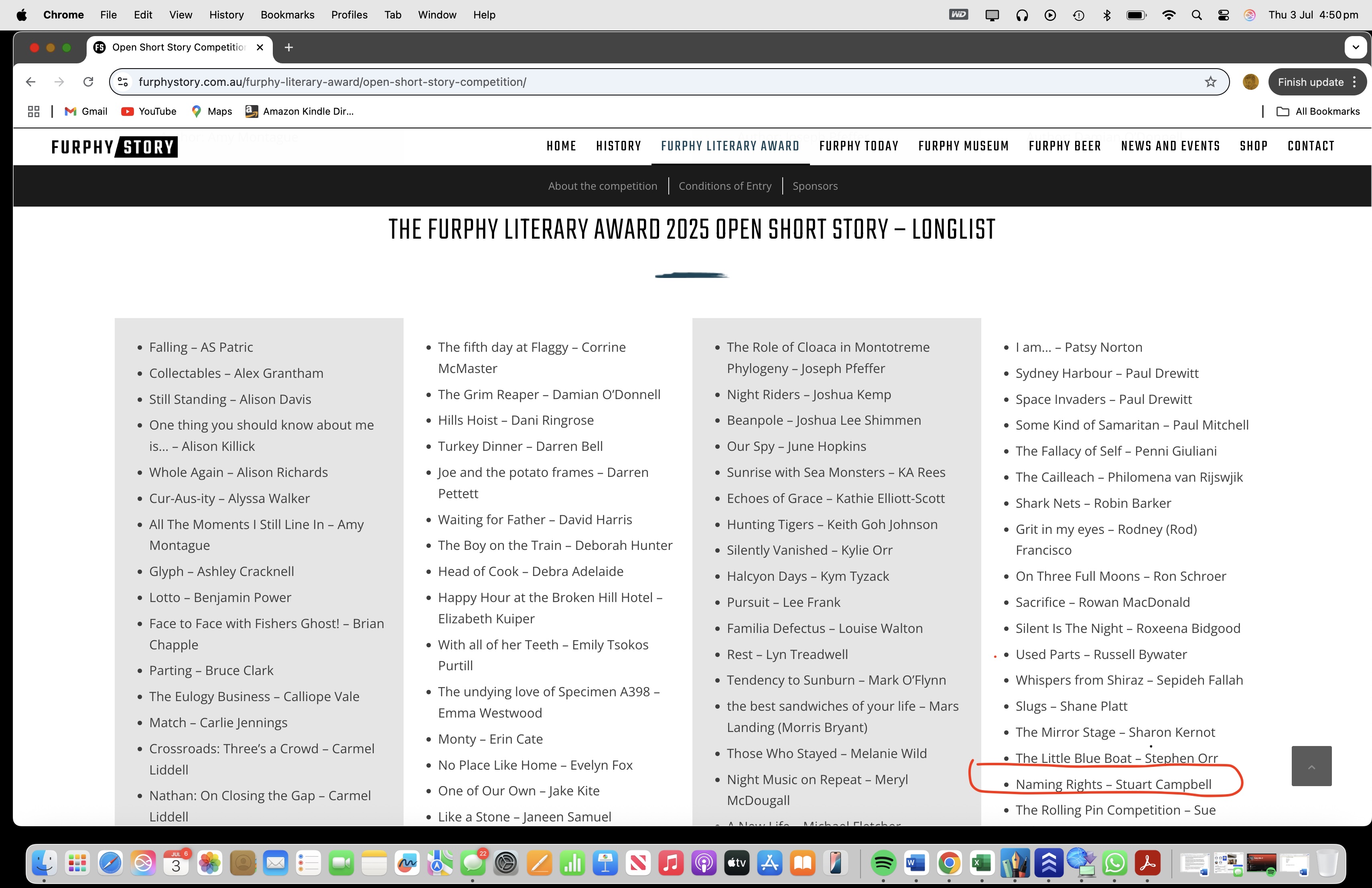

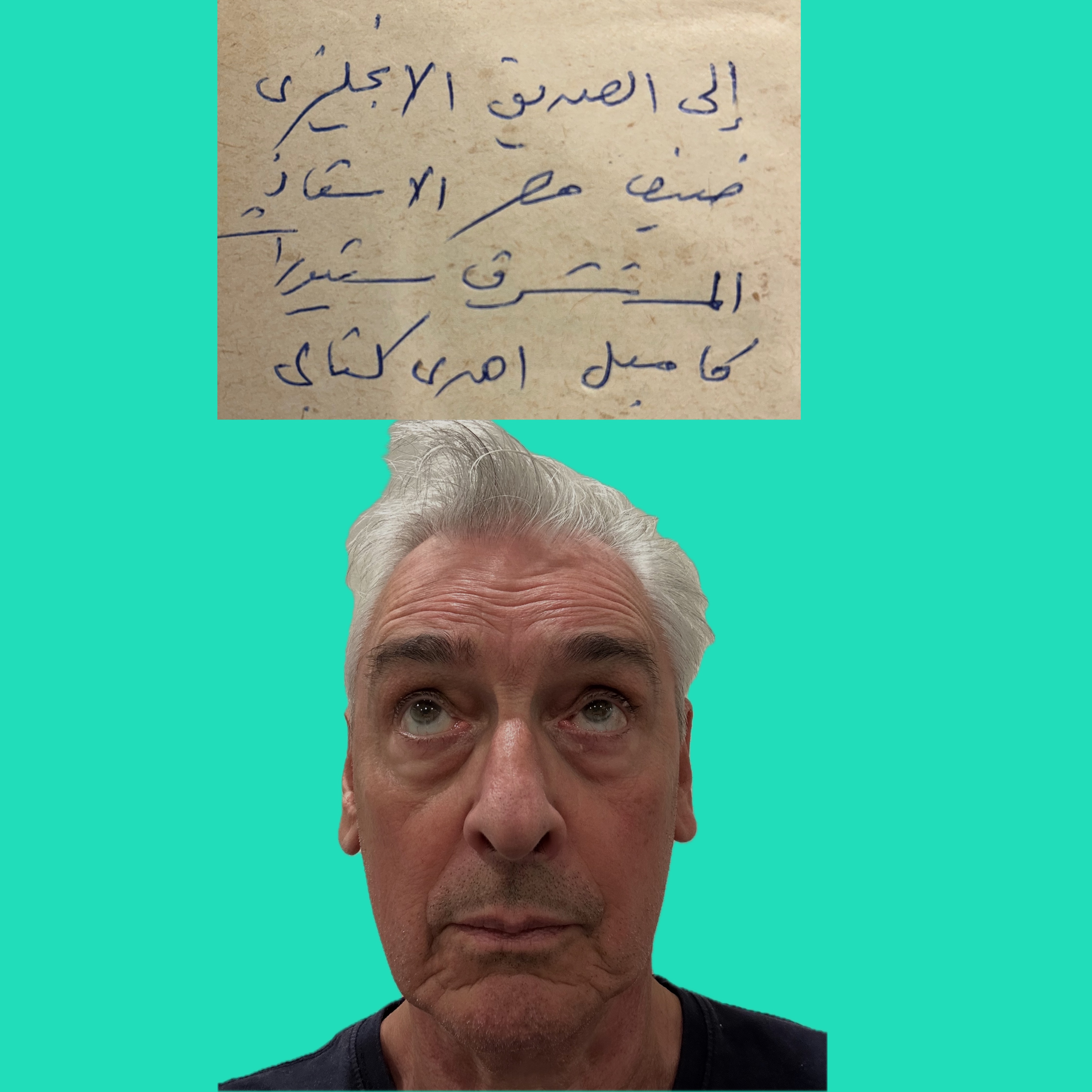

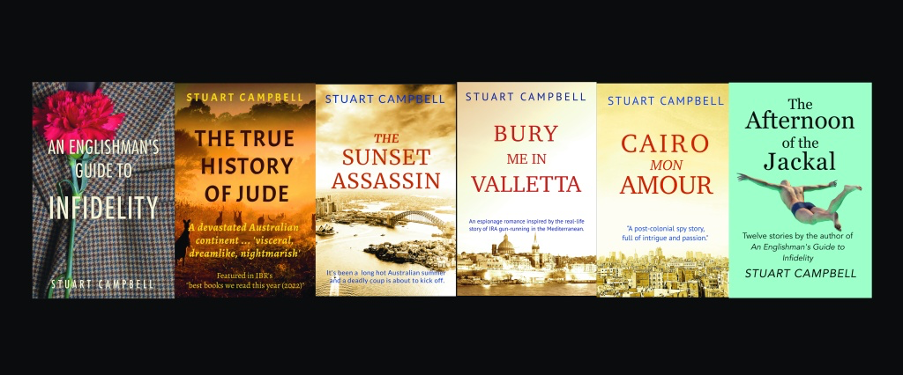
 Stuart Campbell author