“Are your family Lebanese?” I asked the young glazier working in my house. “Yeah, I’m second generation,” he said.
I told him I’d been in Beirut in 1973.
“Ah, the good old days,” he replied.
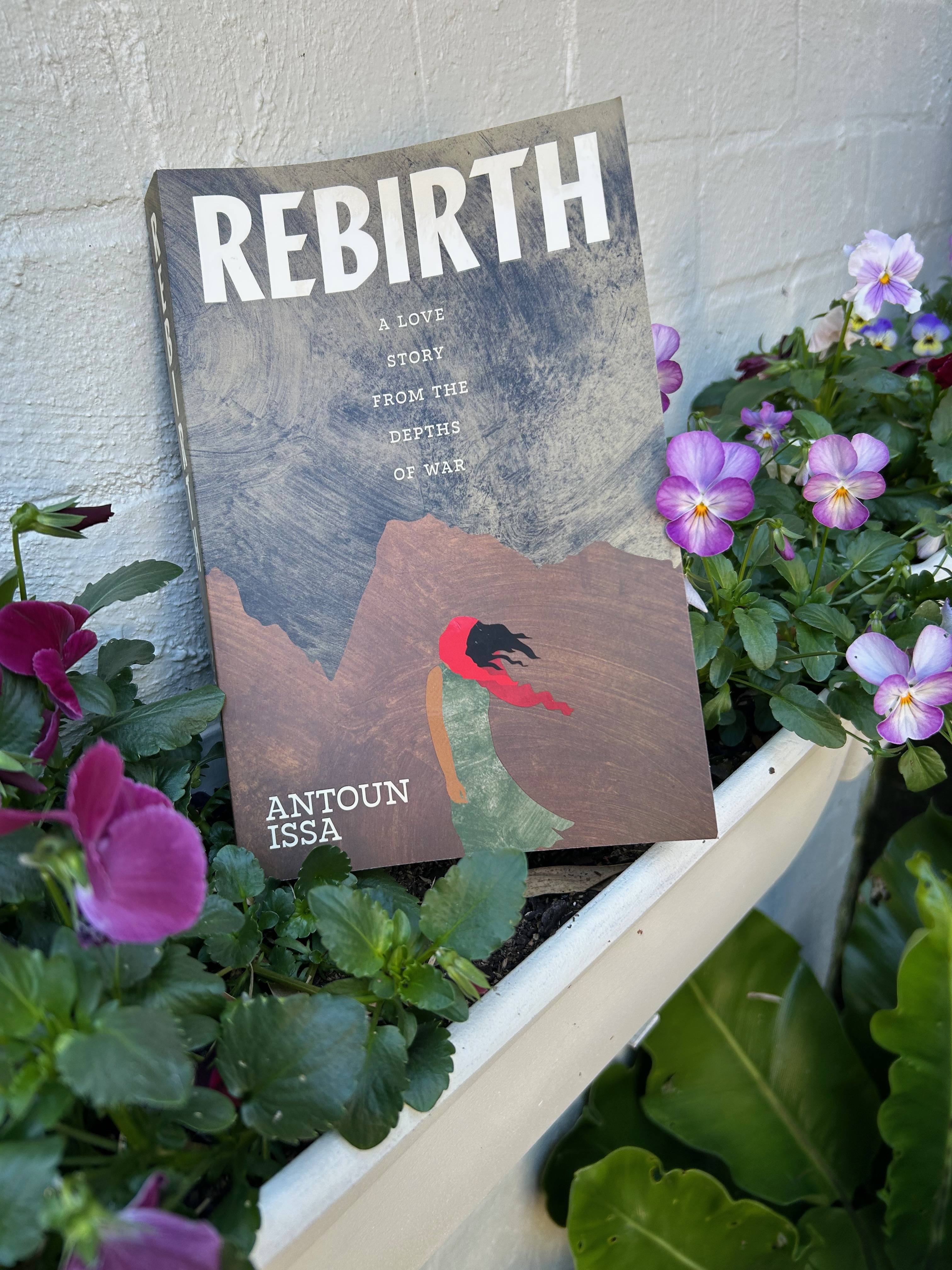
In the Epilogue to Rebirth, Lebanese-Australian journalist Antoun Issa notes the yearning among many Lebanese for a Lebanon ‘untainted by war’. My glazier had clearly inherited this yearning from his parents.
Rebirth tells the story of a poor Beirut family torn apart by the 1975 civil war, who eventually migrate to the inhospitable northern suburbs of Melbourne. The story is told through Antoun Issa’s mother’s eyes in a remarkable feat of fictionalised biography. Laila’s family live in dire poverty in Jisr El Bacha, a Maronite Christian suburb squeezed up against two Palestinian refugee camps. Her father Fares struggles to provide for the family, but Laila has to leave school at fourteen to work as a tailor. As the civil war erupts, Fares insists that the family remain isolated from politics, but the vicious conflict between the PLO and the Phalangists shatters their home, their family and their friendships.
In the late seventies I taught many adult migrant Lebanese in Sydney who’d fled the aftermath of the civil war. With Egypt as my own point of reference for the Arab World, I was intrigued by these people with their curious Arabic dialects, French given names, and fiercely protective attitude to their culture. I met students from Christian villages whose families had spoken Aramaic a few generations past, others from Sunni towns. I met refined intellectuals, poets, preachers, schoolteachers. Cognisant of their confessional government system and clan loyalties, I trod carefully. They formed a cultural kaleidoscope whose colours I could barely distinguish. The students never spoke of the war. I never asked.
Antoun Issa’s Rebirth lays bare the reality of the shootings, the betrayals, the checkpoints, the revenge, the hunger. The emotional impact is supercharged through the family’s fierce instinct to maintain their values despite the vileness of their circumstances. Food – or the lack of it – is a central concern as Laila’s mother makes scraps into meals during the long siege as shells and bullets fly around their house. In the latter part of the book Laila is astonished by the huge quantities of food served in Australia; when in Jisr El Bacha a few pine nuts were a treat, here they were piled on in pointless abundance.
Rebirth gave me a clue about the lives of those students in the faraway seventies, and I thank Antoun Issa for filling this gap.
The author does a skilful job of creating a voice for Laila – rich in noble sentiment, heavily larded with metaphor, and drenched in pathos. I found this approach entirely appropriate for a story that conveys the tragic history of a family, a culture and a country. There is the deft hand of the journalist in this work, especially in Antoun Issa’s handling of politics in a text driven by voices that claim to be apolitical; when necessary, he discreetly stands back from the action to seamlessly explain a point about who is slaughtering who and why.
I was interested to observe how he peppers the dialogue with Arabic to convey the foreignness of the setting and characters (a special interest of mine). In much the same fashion as Michael Mohammed Ahmad’s The Tribe, we see find untranslated easy to guess words like finjen ‘cup’; others like tfaddal, untranslated but clearly a welcoming utterance from the context; and expressions with translations such as Leik ya hala – welcome! Overall the foreignisms do their job of exoticising the setting without clogging the text.
Alf shukr (a thousand thank yous) to Antoun Issa for this deeply affecting and intellectually satisfying novel.