Gay love, snappy fantasy, and missing the point

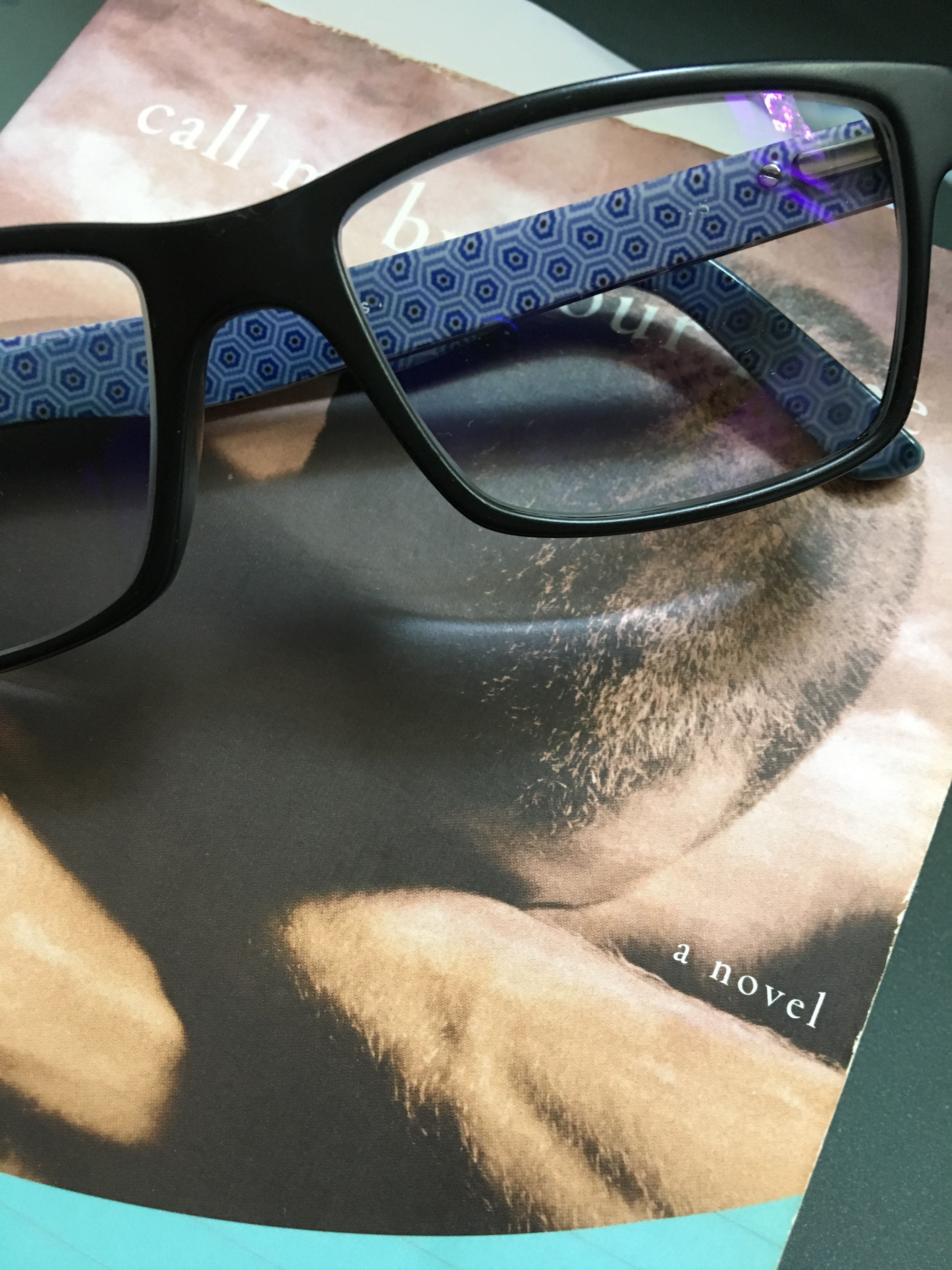
img_0863Somehow I missed André Aciman’s Call Me By Your Name in 2007, but a friend kindly lent me a paperback copy (there doesn’t seem to be an ebook edition, and so I spent a few days with the unfamiliar feel of paper between my fingers). I’ve bundled Aciman in this post with two quite different works: A short story by indie author Jack Binding, and the dance piece Spectra, which just opened at the Sydney Festival.

Let me start with Spectra, a collaboration between artists from Tokyo and Townsville, that “explores the interconnectedness of the universe – illuminating the potency of intentional actions and their inherent power to bear fruit in the future”. I had difficulty in finding points of connection between the dance and the theme, and in turn between the music and the light sculpture. At the same time, the athleticism of the dancers was stunning, and there were some highly original components, such as the line of arms that took on a snake-like life of its own. While I left the theatre feeling slightly dissatisfied, the performance stuck in my mind the next day, especially the exhaustion and elation of the young dancers in the curtain call, for whom the emotional force of the piece was obviously authentic and drenched with meaning. I spent the rest of the next day reflecting on why I hadn’t engaged with the piece, concluding that I’d failed to remember that every generation rediscovers the art forms of the previous one, and that perhaps I’d left my empathy at home. The review of Spectra by Deborah Jones filled in the gaps for me.

Jack Binding, an English writer living in Sydney, followed my blog recently, so I returned the favour by downloading his short story Dot Matrix. I’m envious of anyone, Jack Binding included, who can write a short story. All of mine have been overwrought flops. Dot Matrix is a smart, short and snappy fantasy of workplace revenge with a technological quirk that floats somewhere between the paranormal and the paranoid. Check out Jack’s well-groomed website here.

Call Me By Your Name passed me by in 2007. My reading experience of gay literary fiction (is that a genre?) is pretty well limited to Alan Hollingsworth’s The Line of Beauty* and Sarah Waters’ Fingersmith, so I dived into Aciman’s novel without much of a frame of reference. It’s a love story on the familiar theme of self-doubt and unrequited desire, but with two male protagonists – a brilliant student summering at his parents’ Italian villa, and a slightly older house guest who is spending the season working on the translation of a scholarly manuscript. Call Me By Your Name is a skilled depiction of emotional and erotic tension, with the pair warily circling the possibility of a relationship, until the inevitable happens. The striking thing about the book is the psychological particularity of this (or any?) same-sex relationship, which is enshrined in the title. There’s inevitably an element of prurience in reading this kind of work; let me say that the sex is handled tactically, as it should be: In good writing, sex scenes have a job to do, other than to provide entertainment. I wasn’t sure of the need for the final chapters. Did it really matter how our men felt two decades later? Did I really need a cup of cocoa after the degustation?

A movie based on the book is to be released in 2017.

*I found the BBC mini-series of The Line of Beauty thin and wan, on a par with the superficial and rushed mini-series of Anthony Powell’s A Dance to the Music of Time. Why do they bother? Just read the bloody books!

I write quirky novels about love, betrayal and redemption. Find out more about my books here.

An offbeat mix in my New Year book review round-up

img_0837Having just read two most unlikely companions in Harriet Beecher Stowe’s Uncle Tom’s Cabin and Pamela Crane’s The Scream of Silence, I stumbled across two reads from earlier in the year – Jenny Diski’s The Sixties and C.S. Lewis’s autobiographical Surprised by Joy: The Shape of My Early Life.

Diski, who died in 2016 tweeting to her last days, describes in her 2009 book a decade much more colourful that mine. Her sixties was the real thing, not the toned-down version of the outlying suburbs of London where I grew up. But then, who’s to say what was and wasn’t real? Written more than three decades after the events with the hindsight of a dazzling literary mind, The Sixties is the sixties that I wish I’d had, but perhaps nobody had.

I don’t have much to say about Surprised by Joy. I gulped Lewis’s fiction as a teenager, but decades later he comes across as finicky and laboured. I found this book worthy but not especially convincing in the writer’s explanation of the discovery of his faith. The account of his sadistic boarding school was the high point. I learnt recently that the school, carefully disguised as ‘Belsen’, was located in my home town in England on a road I have walked hundreds of times, probably more than once with one of his novels in my pocket.

Now when it comes to worthy, it takes a lot to beat Harriet Beecher Stowe. Somehow, I’d missed Uncle Tom’s Cabin in my reading career, so I downloaded a free copy and braced myself. I won’t comment on the theme of the book, other than to say that Stowe was a fierce critic of slavery, and that her novel sold many thousands of copies when it was published in 1852. What interested me as a writer was the difference in literary technique in the ensuing one and half centuries. Three aspects stood out: One was the manner in which the author intersperses the narrative with her own critique of slavery, addressing the reader directly before hopping back into the action; the second was the unfashionable treatment of point of view, with Stowe directing proceedings from on high and dropping into the consciousnesses of her characters at will; the third was the sometimes impenetrable rendition of slave speech, which fogs the page and invites the eye to skip down. Nevertheless, I found Uncle Tom’s Cabin greatly moving, even though I suspect that Stowe would have got a C-minus in a modern creative writing  course.

Let me finish with something quite different in Pamela Crane’s short story The Scream of Silence. Crane writes psychological thrillers of terrific quality, and this short story – a taster of a longer work that is under way -is no exception. I loved the sense of place – the grittier side of Raleigh and Durham in North Carolina, as well as the desperate whackiness of the first-person narrator. I also admire Crane’s professional and entrepreneurial approach to the difficult business of being a writer. Look her up.


Learn more about my books here.

Martin F. Mooney – your perfect literary companion in the Trump-Brexit era.

MMFM 2016 coverProfessor Martin F. Mooney is a fading poster boy of the inner-city elites: Left-leaning, middle-aged and too frisky with his female students, he’s looking for a way out of the university before he’s pushed. Politics seems the obvious next step. This contemporary satire set in Sydney, Australia is your perfect literary companion in the Trump-Brexit era.

Now available at iBooks, Amazon, Kobo, Barnes & Noble, and Smashwords.

Find out more about Stuart Campbell’s books here.


Requiem for scholarship in a world of designer barbarism

Three pieces of news in recent weeks convince me that scholarship is being devalued faster than last year’s smart phone. The first was the fullsizeoutput_cd0claim that hate sites are gaming Google so that mundane searches return results that reflect right-wing extremist views. The second was that the Australian senator who flabbergasted the noted physicist Professor Brian Cox with his climate change denialism is to travel to the US to confer with President-Elect Trump’s advisors. And the third was an Australian cabinet minister who declined to express confidence in the government’s own Chief Scientist.

Perhaps the news about Google is the most distressing. Forget the extremist views: The crucial point is that the more we click on a specific topic, the more our supposedly neutral social media tools will feed similar stuff back at us until we are drowning in a pool of our own distilled personal opinion. Worse still, despite the teaching of critical literacy in our schools, the internet seems to have gained the authority of the encyclopedias we used to have on our shelves.

Remember that encyclopedias contained curated knowledge based on scholarship; social media contain knowledge curated by popular opinion and algorithms. I am constantly staggered by the recycling of discredited pseudo-knowledge through sharing, tagging, liking, and emoticonning. This way lies designer barbarism.

My career as academic was based on the notion that knowledge was built on the foundations laid down by the scholars who preceded me. The crucial tool was falsificationism – the technique by which you stress-test existing knowledge with the aim of disproving its validity or improving on it. You gather evidence. You evaluate it. You weigh up competing models. You make the best-informed conclusion that you can. That’s why we have cancer drugs, mass transport, clean water, and of course the internet.

And that’s why stunts like sideswiping our top scientist and claiming that NASA is faking climate data devalue the scholarship that separates us from the barbarians.


Emeritus Professor Stuart Campbell is a novelist and higher education governance expert.

What if Julius Caesar could read your blog?

You can now read my website in Latin, and for that matter a few dozen other languages. Should we be excited? Yes and no.

screen-shot-2016-12-05-at-11-06-01-pm
My website in Latin!

This new capability came as the result of an email from WordPress, my website platform, telling me that the Google Translate widget was now available. In minutes, it was installed and I picked Latin from the drop-down menu. Why Latin? Because I could!

I confess to a professional interest here: I taught Arabic-English translation for some years, and spent half a career researching what might go on in translator’s brains.

But for those with only a passing acquaintance with translating, a caveat or two might be in order. Firstly, the ‘translate’ button on my site is not necessarily the same thing as the alternative language versions (sometimes indicated with little flags) on the websites of big institutions. For example, the content on non-English websites of a university will usually by pre-authored in French, Chinese, etc., and not translated on the spot.

So how good are web-based translation tools? Well, it depends on what you’re translating and between which languages. The reason for the variation is to do with the process behind web-based tools.

In the pre-internet days, automatic translation (then known as ‘machine translation’) worked on the same principle employed by Miss Bollard, my terrifying Latin teacher in pre-Beatles England. The machine translation technique is to analyse the input text into word meanings and grammatical rules, and then reassemble those meanings and rules into another language. The computer’s real task is to attempt to replicate what went on in Miss Bollard’s classically trained brain. The advantage of the computer is that it doesn’t have to be sent snivelling to the headmaster’s study to be punished if it makes too many mistakes. If you’re interested in a beautifully drawn picture of early machine translation, check this excellent article by John Hutchins.

Web-based translation tools use a quite different process: They read the input text, and then scour the internet to match it with similar texts that have existing translations. The output text is then compiled from those translations. The system learns from new translations appearing on the web, and from improvements posted by users.

Which brings me to Julius Caesar. I suspect that the internet is not exactly bursting with English-Latin translations, which will explain why French web-based translations are better than Latin ones. But how can you check the quality if you don’t know the language? The quick and dirty way is to ‘back-translate’, i.e. use the tool to translate a chunk from English to, e.g. Welsh, and then translate the Welsh back into English.

Here is the first line of Pride and Prejudice back-translated through several languages using a web-based translation tool:

English-French-English: It is a universally recognized truth that only one man in possession of good fortune must be in need of a woman.

English-Welsh-English: It is truth universally acknowledged, that a single man must possess good fortune to be in want of a wife.

English-Latin-English: This is of a truth recognized as such, known, and will have the same good fortune to be his wife.

The differences are striking, and the quality seems to be in approximate proportion to the quantity of bilingual content likely to be available for the tool to work with: The French version has one serious error, confusing Austin’s single (unmarried) man for a unique man. The Welsh version is logically incorrect, and the Latin version is nonsense.

But before we send this web-based tool snivelling to the headmaster’s study, we should realise that we have unrealistic expectations for the Latin version. In fact the web-based tool is a bit like me in 1961 – too little material to work with! Come back, Miss Bollard. All is forgiven.

Find out about Stuart Campbell’s books here.


November books: Four novels, four good reads, and four stars each

stuart-head1-bw-hires-portraitOne of the oddest novels I’ve read in recent times is Himmler’s Cook by Franz-Olivier Giesbert. I was swept along by this off-key tale of Rose, the Armenian centenarian, reminiscing about her life from the haven of her Marseille restaurant. She survives the Armenian genocide, suffers multiple sexual predators, becomes great friends with Himmler, and makes plenty of tasty dishes along the way. It’s a clever story and a smart retelling of bits of twentieth century history, but in the end, not entirely satisfying. The difficulty I had was conceptualising Rose as a person rather than a literary device. Perhaps I was looking for too much.

Francis Guenette’s The Light Never Lies took me to British Columbia. This sequel to Guenette’s Disappearing in Plain Sight preserves the central device of the void left by the death of Caleb, husband of Izzy, the glamorous youth counsellor in the remote settlement of Crater Lake. While Guenette’s work is heavy on social issues – mental health, marriage equality, youth suicide, Indigenous rights – it presents a very persuasive reality of fraught relationships, emotional pinch points, gorgeous scenery, and wholesome food you can almost eat off the page. There are a lot of characters to get to know in this longish book, but perseverance pays off.

I read Peter Hobbs’s In the Orchard, the Swallows around the time that the progressive press was fulminating over Lionel Shriver’s remarks about cultural appropriation. I sit on the fence with this topic, having done plenty of cultural appropriation in my own writing. But I felt uncomfortable with Hobbs’s first-person story of a man in the remote border regions of Pakistan recalling his long imprisonment and banal, meaningless torture – the consequence of an innocent indiscretion with a would-be girlfriend in his adolescence. Yes, the text is poetic and lyrical, but I could not drive from my mind the thought, “How would the author know this boy’s experience?” The first-person technique is, I think, the difficulty: It eliminates the distance between the author and the narrator and leaves a taste of implausibility A fine read, nevertheless, if you can ignore the clamour about who’s allowed to write about what.

And this leads me to John M W Smith’s A Crazy Act in Uganda. Smith has solved the cultural appropriation problem in the first two of his Dictator Thriller Series (see also An Unlawful Act in Libya) by interposing himself (or someone like him) as the second-hand narrator of the story. Here, Smith’s literary avatar recounts a story told by an old man about a brutal episode in Idi Amin’s Uganda. Forty years previously the man, a disease epidemic expert, accepts a contract to work on a project to eliminate smallpox; but matters are more convoluted and evil than he expects, and some truly ghastly events ensue. I enjoyed this novella for the tension built into the plot and the cleverly calibrated balance between evil and expediency. There are no laughs to be had here, but I did wonder whether Smith could have injected some of the macabre humour of An Unlawful Act in Libya. But then Uganda’s history is perhaps just too dark for humour.

I write quirky novels about love, betrayal and redemption. You can read about my books here.

My eclectic holiday reads: Sydney-Singapore-Penang

img_0423
Eastern and Oriental Hotel, Penang

I left home with a packed Kindle last month for my first ever cruise. My eclectic reading tally was as follows:

Peter Ralph’s The CEO: White Collar Crime took me up the Eastern seaboard from Sydney to Cairns. Mr Ralph specialises in corporate thrillers that are apparently based on extensive experience of the business world. I’d read his Dirty Fracking Business previously and been struck by his profound knowledge of the fracking industry in Australia. The CEO: White Collar Crime is a madcap morality tale of how not to do business: Protagonist Douglas Aspine is a monster, intent on gobbling up profits, women, cars, and anything else that falls onto his plate in his quest to be a top CEO. Alas, the trail of damage lengthens until there is only one way out. In Australia, we have an old-fashioned expression ‘Ya wouldn’t read about it!’ as a reaction to something implausible. Alas, I have a horrible feeling that Australia has more than a few Douglas Aspines, and here’s where you’ll read about it.

After Cairns, we were solidly in the tropics and on course for Darwin. Our ship’s ultimate destination was Singapore, after which we were to fly to Penang, and then return to Sydney via Singapore. So what better book to read next, but Tan Twan Eng’s award-winning The Gift of Rain, set in George Town, Penang, a city I hadn’t visited in more than twenty years. This sinuous novel is the tale of a half-English and half-Chinese son of the powerful Hutton trading family during the Japanese occupation of Penang. It’s a big, ambitious novel that often veers towards the mystical. The star of the book was the Eastern and Oriental Hotel, where we were booked to stay, and I finished the book the day we checked into the

World class Armenian moustaches
Record-breaking Armenian moustaches

dear old thing, with its white shutters and lovely banquet rooms, and photographs of the Sarkies brothers. These gentlemen, bearing record-breaking moustaches, were the very same Armenian brothers who founded Raffles in Singapore.

I wandered George Town, summoning up Tan Twan Eng’s images of the Japanese occupation, but in the meantime I’d started on his The Garden of Evening Mists, an exquisite novel set in the years after WWII, and dealing with the pain of guilt and betrayal as a former prisoner of the Japanese in Malaya rebuilds a Japanese garden in memory of her dead sister. I finished it on the last night of a stopover in Singapore, and after a pre-departure dinner at the venerable Zam Zam Restaurant, I was ready for Kerry J. Donovan’s Cryer’s View, the latest in his The DCI Jones Casebook series.

I’m a big fan of Kerry Donovan, who matures as a writer with every book, and now works in a range of genres: Note his experimental The Transition of Johnny Swift, and his American small town debut On Lucky Shores. In Cryer’s View, we see a strengthening of Donovan’s skill in building complex characters, so that what is at face value a police procedural is a more profound piece of work. I knocked off Cryer’s View just before BA15 touched down at 6am in Sydney, well chuffed, as I think Detective Sergeant Phil Cryer might have put it.

Overall, a great reading experience, and the cruise wasn’t bad either. I’ll award 20 out of stars for the lot.

You can read about my books here.

Should I rewrite history to make it fit my novel?

Arthur or Martha? © Sara Campbell 2015
Arthur or Martha?
© Sara Campbell 2015

I’ve got a problem.

I’m writing a novel* that includes episodes set in London in 1975. I want one of my characters to go to a concert by Ravi Shankar and Yehudi Menuhin at Southwark Cathedral.  The concert actually took place – I was there, and I remember that it was very long and I was very uncomfortable on the cold stone floor.

Trouble is, that concert was in 1972, not 1975.

Or was it? According to a website that catalogues Ravi Shankar’s tours from 1964 to 2012, the maestro didn’t play any concerts in London at all in the seventies. But then I found a copy of the concert program for sale on Italian eBay, and it’s eerily there in black and purple – 1972.

Should I rewrite history? All my  instincts tell me ‘no’ – I was, after all an academic researcher for years of my life, and  fiddling with evidence was on a level with shoplifting.

Is that particular concert so important to the book? Well, yes, but I suppose there is some other emblematic event that I could replace it with.

I’ll keep you posted.

###

*The sequel to Cairo Mon Amour (to be published in London in 2017). The working title is Bury Me In Valletta.

Note on the portrait: I call this my querulous guinea pig picture, but somehow it acquired the title of Arthur or Martha?. For non-Australian readers, the origin of the phrase can be found here.

Five stars for Kerry Donovan’s ‘The Transition of Johnny Swift’

512plzra3dlI’m a fan of Kerry Donovan’s DCI Jones English police procedurals, and I particularly enjoyed his US debut On Lucky Shores.

The Transition of Johnny Swift is completely different. This time, the author throws us into a jangling world of motor racing, dire injury, psychological stress, simmering romance, and family loyalty. The spiralling plot has the reader on edge until a clever resolution in the last few pages. I was unclear about what genre I was in until the ending, but this added to the pleasure! The technical stuff – medicine, neuroscience and some weird physics – was convincing enought to keep me engaged. The style – an urgent, present tense meld of introspection, narrative and economic dialogue – pushes the pace.

Well done, Mr Donovan. More like this please!

###

Read about Stuart Campbell’s books here.

Australian Indigenous languages: A white linguist looks back.

Stan Grant’s account in The Guardian of his relationship with the Wiradjuri language jolted me back forty years to the language work I did as a Masters student at the Australian National University…

Source: Australian Indigenous languages: A white linguist looks back.