The Accidental Arabist

Some people plan their life trajectory. For me, serendipity has often trumped planning. How else did I find myself unexpectedly signing up to an Arabic degree more than fifty years ago? Recently I began to ask myself how half a century of knowing Arabic has shaped the way I think and feel. How different has it made me from the person I might have been if I’d never taken this path?

It was 1971, and I’d applied for a languages degree at the Polytechnic of Central London (now the University of Westminster). The Russian interview went well; I could only offer a GCE ‘O’ Level, but Russian wasn’t widely studied in the secondary education system at that time. I had a GCE ‘A’ Level in French, but they were two a penny in the UK. Sorry, the French lecturer sniffed, your grammar’s not good enough; try the Arabic room down the corridor, they start from scratch.

The Head of Arabic sat in an empty classroom staring out over the roofs of Bloomsbury: I was signed up in minutes for a journey that would shape the rest of my life. For most of my adult years, Arabic and Arab culture have been embedded in my mind, helping to shape my world view, my scholarship, my values. In signing up on that day in 1971, I joined an exclusive club of English speakers who know something about the world of the Arabs from the inside, rather than through the smeared lens of ignorance, prejudice and habituated racism.  I find it impossible to imagine a me who didn’t wander into that classroom in 1971.

I’d had a messy flirtation with Arabic in 1969. After leaving school at sixteen, I stumbled into a civil engineering traineeship which ended with me failing my maths exams three years in a row. Freshly unemployed, I headed for Gibraltar and picked up a job driving a grocery van with a crew of Moroccans. I spoke schoolboy French with them, but I was fascinated by their throaty Arabic. I bought a copy of Teach Yourself Arabic and slogged through the chapters for a couple of weeks, but there was no connection between what the book said and what my Moroccan buddies said. Much later I learned that the Moroccan Arabic dialect is pretty well incomprehensible to anyone but Moroccans, and that the high-flown language of Teach Yourself Arabic isn’t used by van drivers.

Arabic installed itself in my mind quite differently from the way that French or Russian did. I learned French at school between the ages of 11 and 15. As soon as I arrive in France or New Caledonia, I open my mouth and bad French pours out based on prepubscent rote learning.

I studied Russian alongside Arabic from age 20 to 25, but while Arabic dazzled me, learning Russian was like pouring grey sand into a holey bucket. It seemed to need ten times more effort to find places in my head where it would stick. Cyrillic script looked like a row of Soviet era radiators, unlike the dramatic flourish of Arabic.  Beyond the teaching staff you never met a Russian in the Polytechnic cafeteria. Poor, unattractive Russian was trapped inside cheap Soviet textbooks. But in 70’s London you met with a whole stream of Arabs – Lebanese communists, Yemeni poets, Libyans on Gaddafi’s big oil scholarships. You went to parties with Arabs in their expensive flats on the Edgware Road. Russian didn’t stand a chance.

And unlike Russian, Arabic words entered my brain dressed up in their own colourful costumes, where they had a jolly time mixing with new friends – words like Al-Urwah Al-Wuthqa, ‘The Firmest Bond’, the title of a short-lived Egyptian revolutionary journal that was key in initiating the Arab revival of the late nineteenth century. My teacher mistranslated it as ‘the reliable handle’ and I have used it for decades to describe useful household items like spanners (Wow, I bought a real Urwah Wuthqa at the hardware store today). A Libyan taught me a filthy poem in high-flown Classical Arabic that I can still reel off. I knew a Tunisian girl called Buthaina, and learned that her name is a slang word for pussy cat. I have a habit of commenting on Arab names when I watch TV. That guy’s name means ‘glory of the religion’, I might mutter. Then I remember the Arabic saying al-asmaa’ laa tu’allal, ‘names are not to be explained’, told to me by a man whose name meant ‘war sparrow’.

Thus Arabic poured into me, along with a jumble of memories, associations, emotions, stories, relationships, people, and images.

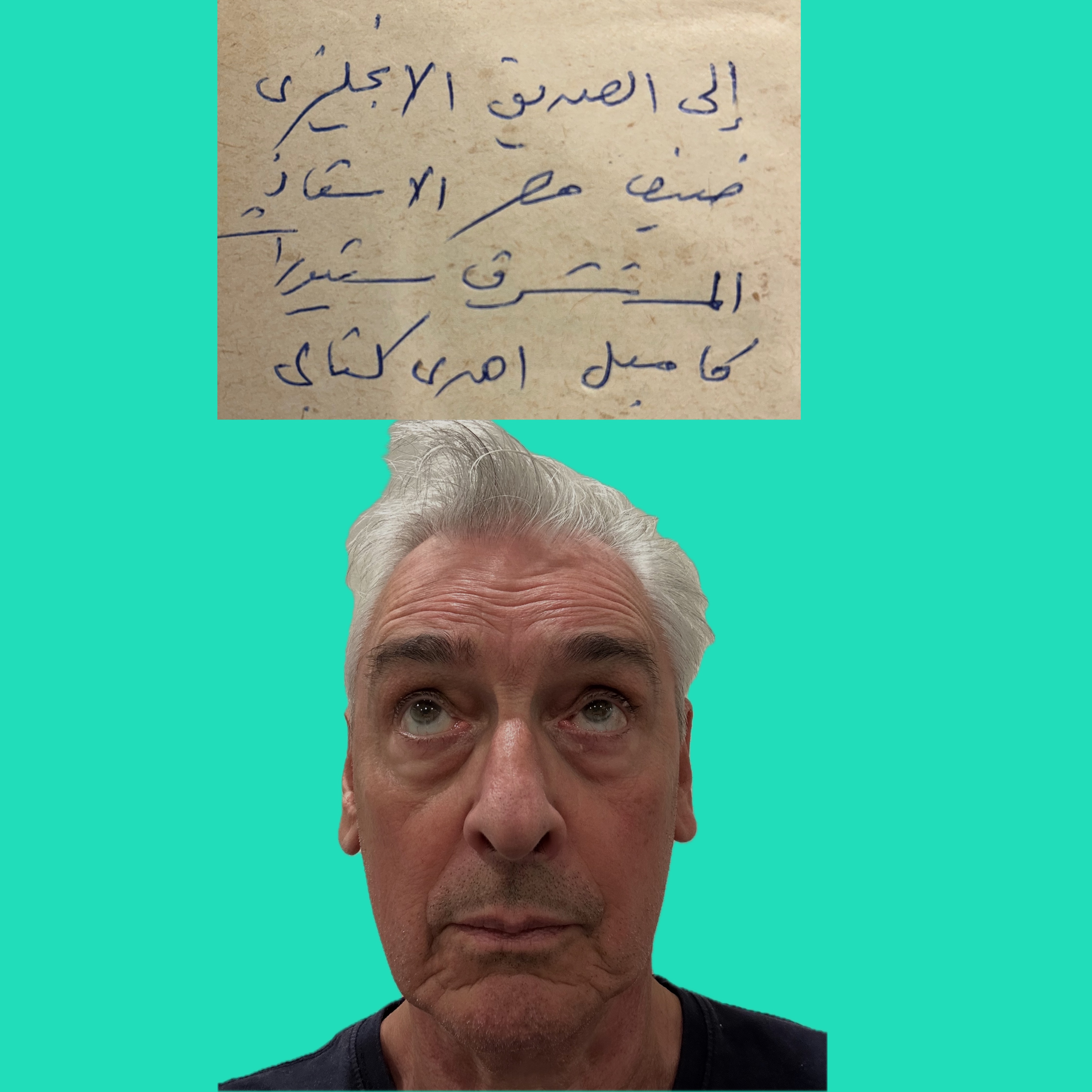
The aesthetic of the east was part of the attraction of Arabic: In my mind, the Arab World belonged to the exotic and sensual Orient – alongside India, joss sticks, flowing robes and sitar music – that coloured my generation in the late sixties. If I’d been offered a course in Hindi or Bengali that day at the Poly, I’d probably have taken it. It would be eight years until Edward Said would challenge the West to examine the underbelly of its relationship with the East and to frame a postcolonial conception of East-West relations. Not even the Beatles were spared postcolonial scrutiny; was their appropriation of Indian culture imperialistic,  just dressed in psychedelic garb? I unconsciously modelled this worn-out worldview: I was doing the Arabs a favour by learning their language. In 1973, I was proud when an Egyptian journalist gave me a book of his inscribed in Arabic ‘to the orientalist Stuart Campbell’. I groan at my naivete now.

The inner workings of an immature psyche aside, it was the sheer alien complexity of Arabic that got me hooked, from the sweeping right-to-left script, the mad plug-in word-building system, and the pharynx-bending phonetics. Our Egyptian lecturers utilised a traditional classroom method of slog, repetition and memorisation with minimal use of English. The core materials were a kind of cultural studies curriculum strongly infused with the long-forgotten creed of Arab Socialism, handwritten and printed on a Roneo machine. The early texts had two sentences per page in big handwriting, the fourth year ones were on a par with newspaper Arabic. Our job was to memorise it all – hundreds of word roots, jagged morphological patterns, unpredictable plurals, alien sentence constructions, unexpected semantic frameworks, none of it remotely like the European languages we had learned at school. It was pure slog, every spare moment with nose in notebook memorising, self-testing, silently chanting like an acolyte in an occult sect.

I quickly cracked the Arabic dictionary code: You don’t look words up alphabetically by the first letter; you search the word for its three-consonant root and look up the root, under which the whole word family is listed. I’m on my second Hans Wehr Arabic-English Dictionary, the first of which ended up stuck together with gaffer tape until it disintegrated after twenty years of look-ups. The Arabic dictionary is as much a learning tool as a reference tool; it’s impossible to look up a word without mentally evoking – and reinforcing – the grammatical rules needed to search for it. I didn’t realise how the Hans Wehr had become almost an extension of my psyche until I opened it last year and found that my eyesight had deteriorated so badly that I couldn’t read the tiny text; I was so distraught that I brought forward my cataract surgery.

Writing Arabic entailed less mental rewiring than I expected.  I dimly recall copying loops and lines from right to left, but I must have learned so quickly that few traces remain. I have a completely unscientific intuition that there is something more ‘natural’ about writing in Arabic. Writing in English entails a contradictory ergonomics: Maintaining a horizontal progress using an up and down sawtooth motion. Arabic entails a horizontal sweep interrupted with loops and ticks. It feels fluid, liquid, relaxed to write – as you might expect from a script that was traditionally written with a reed pen rather than chiselled into stone.

There are delicious stylistic features such as kashida, a kind of kerning that emphasises the horizontal sweep of Arabic: A word can be stretched across the page as in Figure 1, where both words contain a kashida, indicated by the curved sweeps.

Fig 1.

The elegance and ease of writing Arabic is, however, contradicted by the difficulty of reading aloud: Arabic script mostly omits short vowels, leaving it up to the reader to work out the pronunciation. The exceptions include the Qur’an and some language learning materials, where short vowels are indicated. But as you steadily absorb word patterns and grammatical rules, the opacity of vowelless script clears. Nevertheless, reading errors abound even for native speakers, and purists delight in spotting mistakes. A Lebanese friend who used to read the evening news on a Sydney Arabic radio station always received corrections from indignant listeners the next morning.

The challenge of reading aloud leads to the broader topic of learning to speak Arabic. For me there were two salient issues: The phonetics of Arabic and the dialect problem. Foreigners often describe Arabic as ‘throaty’. The phonetics component of the Polytechnic’s mandatory linguistics strand explained in scientific terms what ‘throaty’ meant. In no time I revelled in being able to produce pharyngeal fricatives and uvular stops. There was an immense satisfaction in performing these phonetic tricks, especially executing tongue twisters, or more accurately throat twisters.

But even with authentic pronunciation, gaining fluency was a challenge. The speaking part of our course focussed on reading aloud, and our model was the oratorical style of our male teachers. Amazingly, it is only at my keyboard today that I realise that no woman ever spoke to us in Arabic at the Poly. I based my speaking style on the Egyptian chaps so that I sounded like those newsreaders with moustaches who pump out the party line on TV in dictatorships.

I had anticipated the dialect issue. In fact, some months before our class went off to study in Cairo, I led a delegation of students to request that the Poly offer some teaching of Egyptian dialect before we departed. We were assured that we would ‘pick it up’, but the staff were uncomfortable with the idea that a low status dialect might have grammatical rules.

After two years at the Poly, we were sent off to Egypt with vague instructions to report to a certain Professor at Cairo University (in contrast to modern study abroad programs that entail detailed risk analysis and in-country fixers). My wife and I arrived at her Armenian grandmother’s boarding house in central Cairo to find that the lady had gone shopping. The gentleman boarders were amused and intrigued at meeting an Englishman who knew Arabic. They called in a student who lived in the block; he would take us out to look for Madame. Here, I quote from my memoir Cairo Rations:

We went from shop to shop while the student practised his English on us. I was expecting him to be interested and flattered … that a British student had gone to the trouble of studying his language and his culture. Instead, he questioned me brusquely about why I was in Egypt, eventually becoming quite sarcastic and tossing in terms like ‘imperialist’ and ‘invader’.

Madame was eventually found. She didn’t speak English, so I barked at her in my Egyptian lecturer fashion but immediately sensed a horrible dissonance. This weird alpha male persona wasn’t me! And Madame spoke back in Egyptian dialect, not newsreader Arabic!

My dialect fluency peaked in 1974 due to the demands of living in a country at war – queuing for ration cards, being chased in the street as a suspected Israeli spy, being detained and questioned by police.

This incident with the angry student was an epiphany, a signal that there was a fatal crack in my thinking and that of my generation. When Edward Said blew the lid off Orientalism five years later, I’d already gained a deep understanding of anti-Arab racism in its many forms, both subtle and explicit. But Said’s writings helped me recognise that in 1973 I had stood at the confluence of two intellectual streams – the old Orientalism that infantilised the Arabs, and the postcolonial era that exposed the West’s racist condescension. In later years I did research on anti-Arab attitudes in the Australian press, and wrote the Siranoush Trilogy of espionage novels that challenged the ‘bad Arab’ trope that infests popular literature and film.

While studying Arabic helped form my worldview, it also opened unexpected doors to academic research – serendipity again. A relative gave me an archaic-looking illustrated manuscript in Arabic script: “I got this in Saudi Arabia. You might find it interesting.” It was actually in Persian, replete with Arabic loanwords, but I noticed an anomaly in the spelling of some of the nouns. By chance, I was doing some work on Indonesian at the time and was surprised to find the same Persian spelling anomaly in the borrowed Arabic words in Indonesian and Malay. According to indigenous scholars, the Arabs who brought Islam to the Malay world sailed straight from Arabia. Then how did the Arabic words acquire Persian spellings? Over the next few years, I developed and published an account showing that Arabic words entered the Malay world in three historical layers, one of which was Persianised. This work was a major historiographic advance that is unchallenged to this day.

Today, the impact of Arabic on my life is evident from my curriculum vitae: A career in teaching and researching Arabic linguistics and Arabic translation; senior university roles; a string of PhD students, most of Arab background; books and refereed journals. But how has Arabic contributed to my worldview? How am I different from a Stuart Campbell who might never have taken those few steps down the corridor?

I’m fairly sure that the political and social consciousness of my alter ego would have aligned with the real me: The Cold War, Vietnam and the Palestine conflict shaped the foundational thinking of many of my generation. But the extra element conferred by Arabic is an enhanced insight into the Arab world. It’s the ability to look behind the English language news media about the Middle East because you can read the Arabic press; it’s the ability to bypass the slipshod and stereotyped characterisation of the Arabs because you’ve known and worked with so many of them; it’s the ability to watch a TV interview with an Arab politician or a Syrian refugee or a Dubai Bling star, and decode the signals that the translation won’t give you: What does the accent tell you about the speaker’s origins and class? How is the level of language formality shaping the message? What does the person’s name tell you about their background? How do they address the other speakers and why do they use this or that form? How often is God evoked, and what does that tell you about the speaker’s emotional state? What does that place name mean, and what glories and tragedies are infused in it? What does that graffiti mean?

I was always intrigued in Cairo by the way that people in the street addressed me. My favourite was bash muhandis, ‘chief engineer’. For me, this evokes a whole set of questions – what sort of person would address me thus, why is there a Turkish element in the expression? And how I would address the person back?

That’s the kind of thing that sticks in your head after you wander into a room and sign for a fifty year stretch.

###

If you want to read more of my writing check here to find out about my short stories and novels.
My new novel is set in Manly, Australia. Find out why.

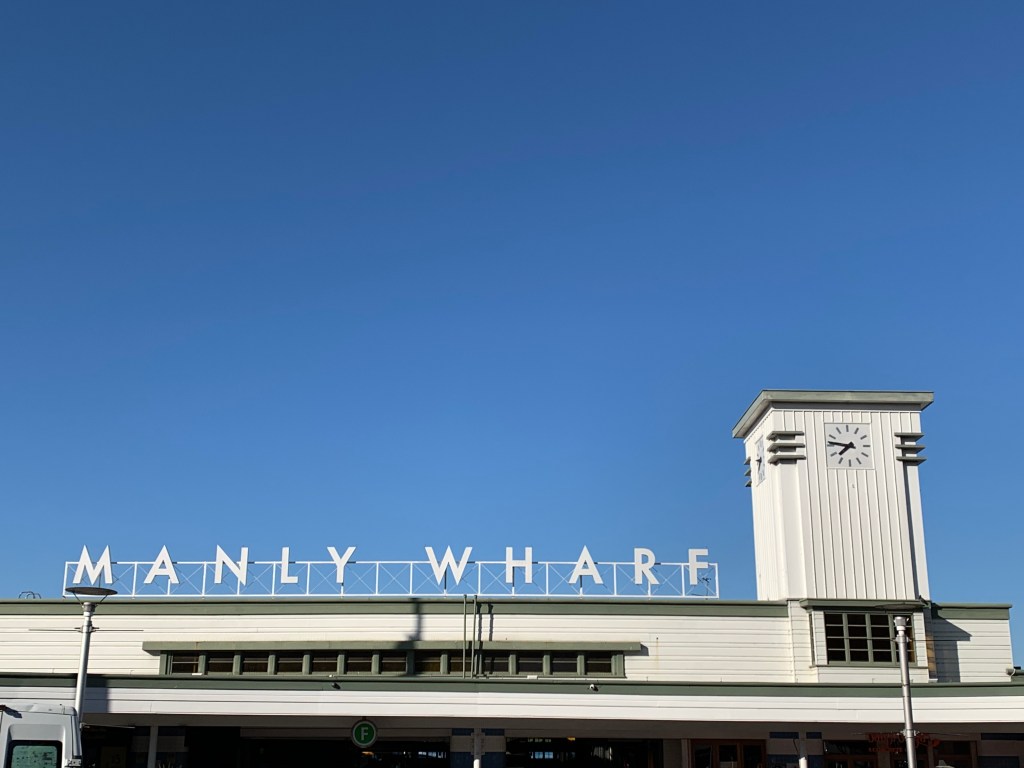
Manly, Australia’s favourite seaside town, is a location spotter’s treasure trove. Sitting on a peninsula overlooked by the neo-gothic pile of St Patricks, the town is an architectural mish-mash of Art Deco shopfronts, Federation era cottages, glitzy apartment blocks, and brown-brick walk-up flats. In normal times, thousands of tourist take the thirty-minute ferry ride from Sydney to Manly wharf and amble down the Corso, the street that bisects the peninsula and leads to the ocean beaches. But behind the beachwear shops and restaurants lies another Manly, unseen by the tourists, that offers an edgy fiction setting.

Australia’s COVID-19 lockdown in April 2020 forced me off the seafront promenade into the empty back streets to avoid hordes of gasping joggers deprived of their gyms. But my walks opened up corners of the town I’d barely noticed. Soon my meditative strolls turned into location spotting for the novel I’m currently writing.

The Impeccables is set in Manly in 1978. Why Manly and why 1978? Well, the previous book in the series ended with the main character Pierre Farag exiled to Australia in 1975. I needed somewhere to settle him down for a few years before he finds himself unwillingly involved with a clandestine right-wing group that aims to blow up the Opera House.

And I love a writing challenge: I couldn’t resist the idea of reconstructing the look and feel of the town where I came to live in 1978 — an era before iPhones and credit cards, when the seafront was lined with pre-war blocks of flats rather than glitzy apartments. I’ve spent hours studying the 1978 Sydney newspapers and browsing the brilliant Lost Manly FB group pages.

To recap the series, the novella Ash on the Tongue, set in 1972 in Cairo, introduces Armenian-Egyptian private eye Pierre Farag and his first incursion into the world of espionage. In the full-length novel Cairo Mon Amour, Pierre and his actress girlfriend Zouzou are drawn into a plot to conceal the launch of the 1973 Yom Kippur War. In Bury me inValletta, we meet Pierre and Zouzou in exile in London in 1975. As sleeper agents they are reactivated by the UK government to sabotage an IRA gun-running plot in Libya and Malta. My current novel in progress The Impeccables, finds Pierre and Zouzou exiled to Sydney, where they are drawn into a plan to stage a coup against the Australian government. The novel ends again in exile, but this time to a remote spot in tropical Far North Queensland. I haven’t decided whether there will be a fifth book in the series; it depends a bit on whether I can find a plausible way to get the pair out of exile. I may have painted myself into a plot corner! In addition, I regain the rights to Cairo Mon Amour from my publisher in August 2021, which will give me the option to publish the series as single edition.

All three novels are based on carefully researched historical scenarios, and each includes what I call a ‘moral core’ for want of a better term: Cairo Mon Amour is in part my personal tribute to the resilience of the Armenians in exile; Bury me in Valletta is about the collapse of the relationship between a father and daughter; The Impeccables deals with the far boundaries of betrayal.

But what has surprised me is the development of the relationship between Pierre and Zouzou as its power balance shifts and the couple find new ways to bridge the growing emotional gulf between each another. I never anticipated this when I first put finger to keyboard. This presents another challenge for a possible sequel; are they headed for the divorce courts, or will the balmy tropical climate of Queensland soothe their angst?

But back to Manly. For The Impeccables I installed Pierre and Zouzou in a run-down rented house. It’s in a made-up street called Rialto Close in a muddle of walk-up brick apartment buildings and the backs of dry cleaners and TV rental shops, four streets away from Manly Beach. The name Rialto harks back to a former cinema in the Corso. The site is now occupied by a small shopping arcade, commemorated by the unglamorous Rialto Lane. My Rialto Close could be in any of half a dozen locations around the town, but wherever it is you might spot a dumped sofa.

Meanwhile, I’ve been honing my skills in book design. Right now, you can get a paperback of Bury me in Valletta through Amazon in the US, but there’s a big freight charge and a long wait for Australian readers. So, I’ve produced an additional paperback version with Ingram Spark, which is now accessible through thousands of bookshops and libraries around the world. I was thrilled to receive the proof copy in November — excellent production values, and the interior all designed by me. I incorporated the lovely cover designed by Rachel Ainge for the ebook. This new print version is now available, and I was delighted to get some US and UK sales immediately after the release date on December 1 2020.

Here’s a great customer review of Bury me in Valletta from a reader in Scotland: ‘Gripping from beginning to the end. Brilliant book and great sequel to Cairo Mon Amour. When is the next book of Pierre Farag, Stuart?’ And for an excellent independent review from IBR, click here.

You can find vendor links for my books here, including for the novella Ash on the Tongue, which is permanently free on Smashwords. The Impeccables will be released some time in 2021.

Return of ‘Blue Murder’ evokes my dad’s book on police corruption.

I’m currently immersed in the history of Sydney in the late seventies as I work on my current novel The Impeccables, which touches on police corruption. What a treat, then, to get a second chance to see the 1995 ABC production Blue Murder last week (SBS OnDemand). Set in the 1970s and 1980s, the two-part mini-series follows the grisly careers of criminal Neddy Smith and corrupt cop Roger Rogerson, and the swag of gangsters who ran Sydney’s underworld. It’s totally gripping TV, delivered with a grittiness that we rarely see in the high-gloss era of Netflix.

Watching Blue Murder triggered a confluence of memories. My late father, detective-turned-barrister Donald Campbell, had a lifelong aversion to police corruption, dating back to his days as a young constable in London when stealing lead from roofs was in fashion. He was (like me) addicted to writing, and authored a three-part book on police corruption in the UK, New York, and New South Wales. The book Police Corruption, now out of print, was published by Barry Rose Law Publishers in 2002 about a year after his death, with the final editing tasks being shared by some of his sons.

I recall him writing to me in around 1998 to obtain a copy of the Wood Royal Commission report, which provided much of the background on the NSW section. I bought the CD of the report in a government office in George Street, and mailed it him in London. On a visit to my old family home not long after, I was woken by the fax machine in the early hours of the morning; it was from a very senior source in Sydney answering some point of detail.

I dipped into Police Corruption after watching Blue Murder to fill in the background to the mini-series, much of which I had forgotten. I hadn’t looked at my dad’s book for a few years, but the writing was as crisp and readable as I remembered it. In fact, I’m keen to make the book available to the public again, and I have the outline of a plan in mind.

So, back to The Impeccables, with a much sharper feel for my setting and a reminder of how rotten the state of NSW was in those days.

You can find out more about my novels here.

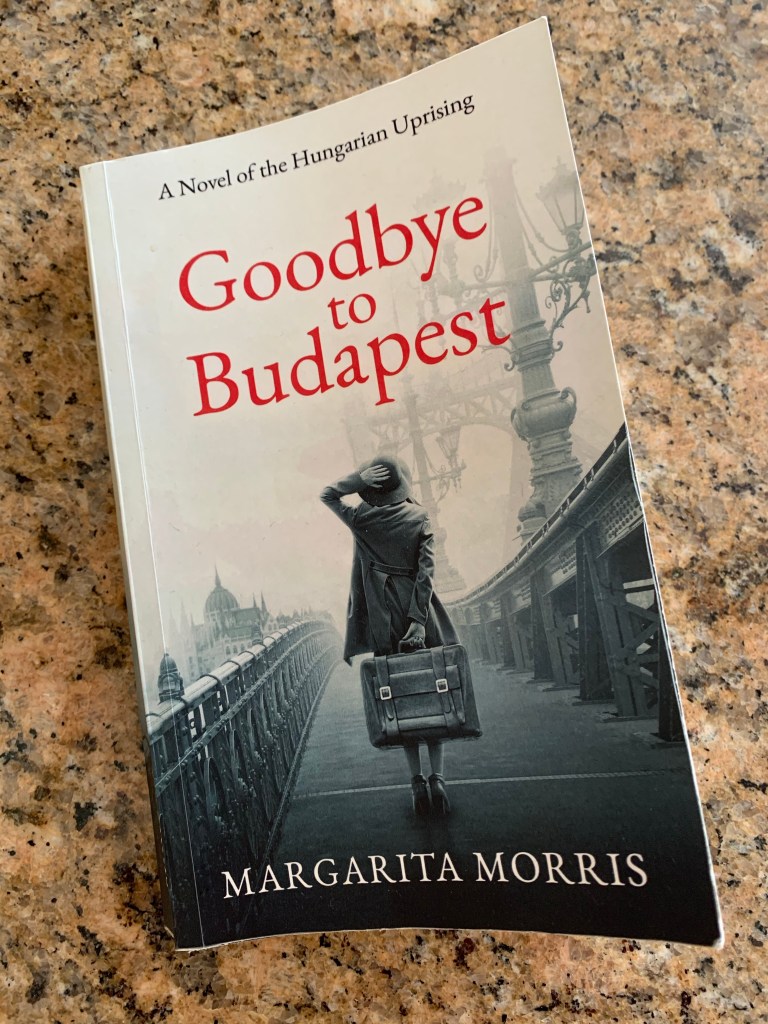
Fast-moving Hungarian uprising tale with a ring of authenticity

I was lent Margarita Morris’s Goodbye to Budapest by Hungarian friends here in Sydney, which seemed a convincing recommendation; I’d heard some of the stories about how they’d escaped Hungary during the communist era, and the paperback copy they lent me was inscribed with enthusiastic remarks. I’d also visited Budapest a year or two before, visiting 60 Andràssy Avenue, now the site of the House of Terror.

The secret police headquarters at 60 Andràssy Avenue is a central theme in Goodbye to Budapest. It’s where university don Màrton Bakos is imprisoned and tortured by the dreaded AVO secret police. The book is built around the fate of the Bakos family, with daughter Katalin pushing the narrative forward.

Goodbye to Budapest spans the period from October 1952 until November 1956, covering the uprising and its crushing by Soviet tanks. It’s fast-paced, and focuses on the fate of a handful of authentic characters struggling to survive awful oppression and betrayal.

I had a peep at Morris’s website, wondering whether she has Hungarian family connections. Apparently she hasn’t, which is a great credit to the research and empathy behind this book.

I should mention that the paperback is independently produced (I have form in this area), and is professionally put together with a clean design and attractive cover.

A great read!

Tense day working on my latest novel (weak joke alert)

Hard at work today revising my dystopian novel Patria Nullius. It’s a book within a book: The outside shell is in past tense and the kernel is in present tense. Yesterday I made the big decision to rewrite the kernel in past tense.

I’ve got Ladytron on the cans to help me along, so it’s all good so far.

Meanwhile, I’m grinding through the task of promoting my new book Bury me in Valletta. I’m given away some botched copies of the paperback (my botch-up, now fixed), and I’ve had great feedback. The ebook is discounted to 99c on Amazon and $1.99 on Apple. Do yourself a favour and download a copy. Even better, post a review if you like it!

The vendor links are here.

Thanks,

Stu

Picture gallery: Fading traces of the Soviet era

Aeroflot ticket, 1974. Lost aesthetic or Communist kitsch? (author’s collection)

When I was studying  Russian in Moscow in 1974, it was unthinkable that in  less that twenty years, the Soviet Union and the Warsaw Pact would be no more.

For my literary invention Ivan Zlotnik, the flawed Soviet diplomat in Cairo Mon Amour, the USSR was there to stay. Zlotnik gambled his freedom on the date of the outbreak of the Yom Kippur war. Did he win or lose? That’s for the reader to judge.

Forty-three years later, tourists buy up Communist kitsch in nostalgic homage to regimes whose harsh outlines soften over the decades. But more permanent traces of the Soviet era remain, as this small gallery shows:

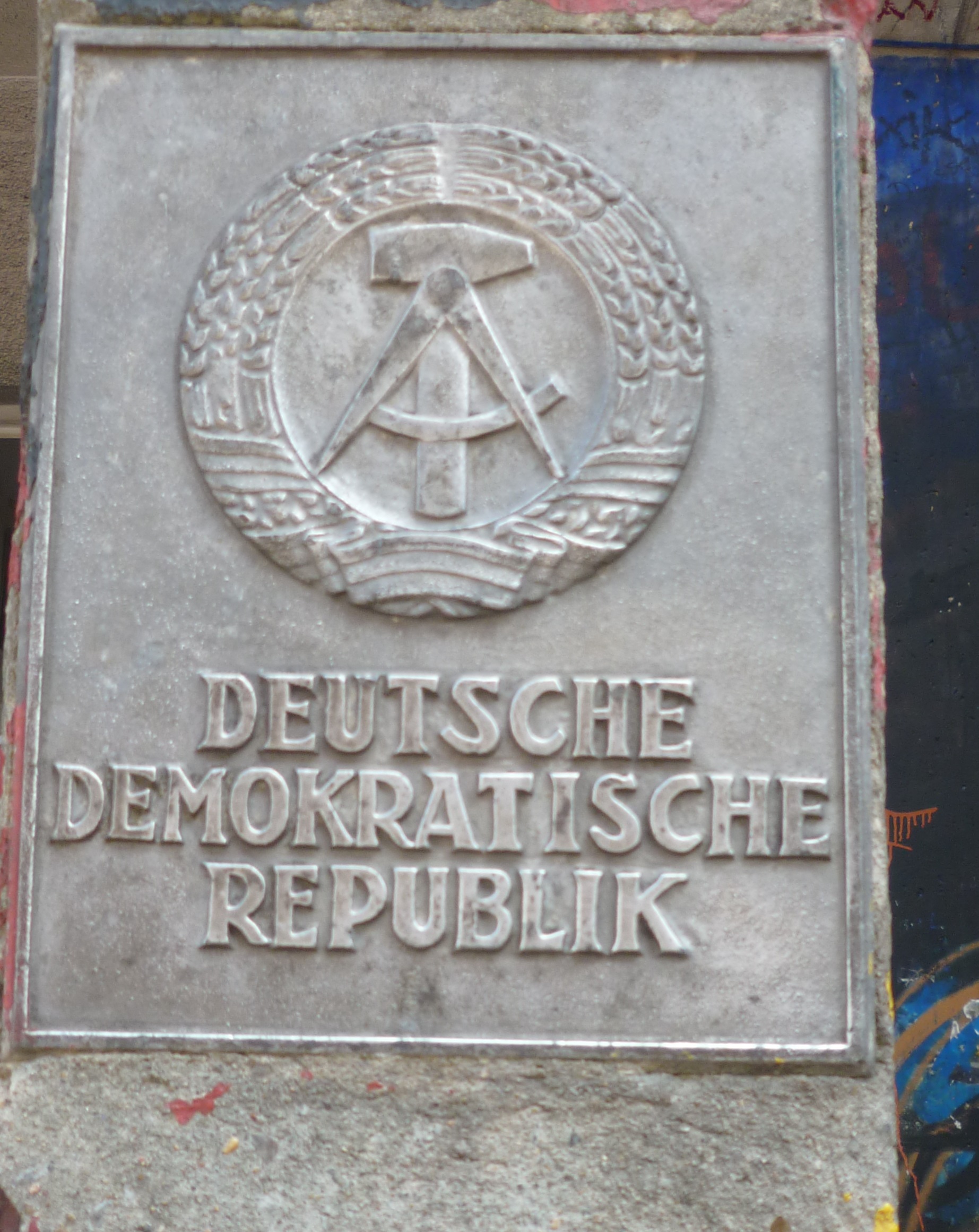
Remnant plaque, Berlin (photo: Stuart Campbell)

Symbols of communist industry and military power, Prague (photo: Stuart Campbell)

Vintage URAL motorcycle spotted in a Budapest street (photo: Stuart Campbell)

Soviet Memorial, Budapest. The Russian reads ‘In honour of the liberating Soviet heroes’. (photo: Stuart Campbell)

Should I rewrite history to make it fit my novel?

Arthur or Martha? © Sara Campbell 2015
Arthur or Martha?
© Sara Campbell 2015

I’ve got a problem.

I’m writing a novel* that includes episodes set in London in 1975. I want one of my characters to go to a concert by Ravi Shankar and Yehudi Menuhin at Southwark Cathedral.  The concert actually took place – I was there, and I remember that it was very long and I was very uncomfortable on the cold stone floor.

Trouble is, that concert was in 1972, not 1975.

Or was it? According to a website that catalogues Ravi Shankar’s tours from 1964 to 2012, the maestro didn’t play any concerts in London at all in the seventies. But then I found a copy of the concert program for sale on Italian eBay, and it’s eerily there in black and purple – 1972.

Should I rewrite history? All my  instincts tell me ‘no’ – I was, after all an academic researcher for years of my life, and  fiddling with evidence was on a level with shoplifting.

Is that particular concert so important to the book? Well, yes, but I suppose there is some other emblematic event that I could replace it with.

I’ll keep you posted.

###

*The sequel to Cairo Mon Amour (to be published in London in 2017). The working title is Bury Me In Valletta.

Note on the portrait: I call this my querulous guinea pig picture, but somehow it acquired the title of Arthur or Martha?. For non-Australian readers, the origin of the phrase can be found here.

‘Cairo Rations’ still #1 in its Amazon category!

graphic cover2Cairo Rations is still #1 in its Amazon category and still free! In fact, it’s permanently free on Amazon, Apple, Barnes & Noble and Kobo. Today’s stats:
Amazon Best Sellers Rank: #15,507 Free in Kindle Store (See Top 100 Free in Kindle Store)
#1 in Kindle Store > Kindle eBooks > Nonfiction > Travel > Africa > Egypt

Check here to see where to get it.


Australia and the plight of the Armenians

AAVicken Babkenian, co-author of Armenia, Australia and the Great War, gave an excellent presentation at the Sydney Institute this week on a new work that details the efforts of Australians to provide relief to the thousands of Armenian refugees following the massacres of 1915.

Even with a reasonably good knowledge of the plight of the Armenians, I was completely unaware of this Australian-Armenian connection. Babkenian and historian Peter Stanley have  done extraordinary work in uncovering this slice of social history, using a vast and comprehensive body of resources ranging from soldiers’ diaries, memoirs, parish newspapers and the archives of forgotten charities.

Highly recommended.

#

Click here to receive my newsletter.

Learn about Stuart Campbell’s novels here.


Escape from Egypt during the Yom Kippur War

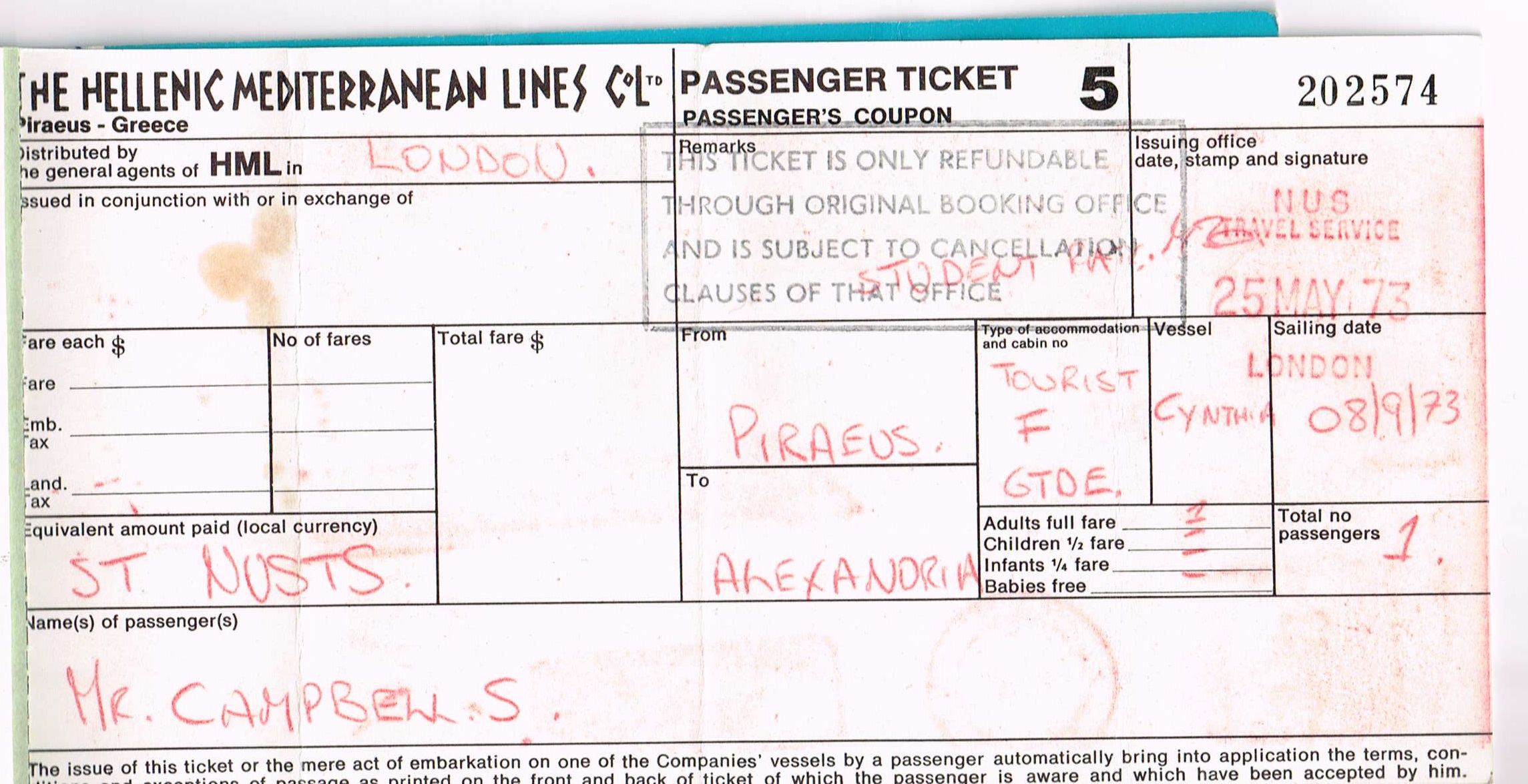
cynthia ticket 001My third novel Cairo Mon Amour (publication July 2016) is set in Egypt in 1973 during the Yom Kippur War. I happened to be a student in Cairo at that time, and as the borders closed, it became very difficult to leave Egypt. Several days into the war, we heard that a ship was to evacuate foreigners from Alexandria.

In the novel I have two of my characters, Pierre and Zouzou, flee the country on a ship around the same time. In my research among US diplomatic cables I discovered the actual ship was the Syria, and that it left Alex on  Thursday 11 October, five days after the war began. I could not find any contemporary descriptions of the Syria, except for an obscure article about the US diplomat Dean Dizikes*, who found the ship in Greece and organised the voyage. I drew on his description of the ship’s graceless departure in my story.

However, I was amazed to discover that US diplomats had tried unsuccessfully to requisition another ship,  the Cynthia, at Piraeus before obtaining the services of the Syria. Why amazed? Because I had sailed from Piraeus to Alexandria on the Cynthia just a month before. I have the ticket to prove it! So, in the interest of literary rather than historical integrity, I put Pierre and Zouzou on the Cynthia and wrote the Syria out of the Yom Kippur War.

The Cynthia was, by the way, a loathsome tub. I have written about my horrible voyage from Piraeus to Alex in my memoir Cairo Rations!, and I have included the relevant section at the foot of this post. If you would like to have a free copy of the entire 11,000-word memoir, email me at stuartcampbellauthorATgmailDOTcom (replace the AT and DOT with @ and . so that I know you are human) and I will send you a copy and add you to my email news list.

*The Yom Kippur War – an evacuation of the ungrateful

Read a free sample of An Englishman’s Guide to Infidelity  here. Buy Stuart Campbell’s books in paperback and ebook on Amazon by clicking on these title links:An Englishman’s Guide to Infidelity and The Play’s the Thing . Stuart Campbell’s covers are designed by Rachel Ainge .

EXTRACT FROM CAIRO RATIONS!

BY SCRAPHEAP FROM PIRAEUS TO ALEXANDRIA

We tried to catch a taxi at Piraeus station but couldn’t master the local technique of running alongside the moving vehicles, grabbing the door handles, and claiming possession. Instead I hefted our two heavy suitcases under a blinding September sun from the station to the dock. By the time we found the MV Cynthia my arms were as taut as fanbelts and my anaesthetized fingers looked like salami.

We had tickets to Alexandria for a double cabin, bought through the National Union of Students in London. The NUS wanted to sight our marriage certificate before they would sell us the tickets, and had thoughtfully franked the reverse of our Gibraltar Registry Office document with a big inky stamp.

When we arrived on the deck of the reeking Cynthia the purser shook his head in amazement that travellers with such cheap tickets could possibly believe they were entitled to a double cabin. My wife and I were separated and ordered to different parts of the stinking tub well below the waterline. I lugged the two huge suitcases to her cabin, dropped off the one we thought might contain her clothes, and then continued to drag the other one like a cockroach through the superheated rusting passageways. But I was spared: My assigned eight-berth cabin was festooned with frilly frocks – no place for a man. I used my last ounces of energy to drag the hated suitcase to the top deck. The grudging purser directed me to a double cabin above the waterline, and I threw myself onto the lower bunk and hung my throbbing hands over the side.

With the circulation to my fingers partly restored I went aloft, or perhaps abaft, and searched for my wife on the deck. The greenish tinge of her face augured badly; we were still tied up alongside the caisson wall, but the rocking of the ship, the stench of diesel, and the hot greasy miasma from the vents above the kitchens had started to do their work.

The MV Cynthia juddered out of the harbour at a funny angle like a water rat with a crushed leg. It was her last voyage before the scrapheap.

In the afternoon the ship’s swimming pool was filled up. It was barely big enough to fit six people standing but the weight of the water taken on board strained the heaving engines almost to a standstill. We hung around the canvas awning near the pool to escape the heat. An Egyptian man in swimming trunks did an elaborate callisthenic routine and introduced himself. He was captivated that I could pronounce his name properly, and asked me to repeat it over and over: “Please, what is my name?” We escaped to another part of the ship but wherever we went he seemed to be waiting in his trunks behind a lifeboat or a stanchion, and would pop out and inanely ask, “Please, what is my name?” I would repeat robotically,  “Mar’i Kamil S-“. I leave his last name incomplete in case he is still alive and wants to be my friend on Facebook.

In the evening the toilets overflowed and we had to hop through sewage to get to the hotbox  where dinner was served to the third class passengers. A waiter probably named Malvolio guarded the kitchen entrance with a filthy tea towel over his arm. The food – it hardly needed guarding – was Kit-E-Kat mashed into macaroni tubes. We gagged and picked over our bowls, but our table companions – cadaverous British hippies who had been in India for months – golloped theirs down, and then finished our leftovers. Our hearts leapt as fat peaches were handed out, and then shrivelled when they were cut apart to reveal the plump maggots within.

We parted late that night on the upper deck, but not before I had my first real conversation in Arabic outside a classroom. While my wife leaned over the rail to find some air that didn’t smell of Kit-E-Kat, I watched a Lebanese family chatting in the moonlight. There was another ship in the distance and a man in the group commented that it was from the same shipping line as the Cynthia. He actually said nafsi shirka, ‘the same company’. I grabbed my chance and attempted to join the conversation by loudly intoning nafsi shirka with a questioning intonation. On reflection I suppose I was saying, “Oh, family of complete strangers, is it indeed a fact that the ship we see is from the same company as the ship we are on?”

The family turned to stare at the apparition at the rail whence the odd utterance had come: A moustachioed wraith with shoulder length black hair supporting a young woman who was sobbing and retching under the moon.

I spent the night awake in terror listening to the stranger in the upper bunk making long rhythmic noises like a razor being sharpened on a leather strop.

At Beirut – not yet torn apart by the civil war – we ordered massive plates of rice and minted lamb in a restaurant but could barely eat a few spoonsful, so shrunken were our stomachs. We made it back to the Cynthia by smell alone, and fought the crush of Egyptians who were boarding with boxes of Lebanese apples as big as babies’ heads.

As we sailed for Cyprus a black and yellow flag was raised – cholera! – and instead of entering Limassol harbour we stood offshore in quarantine. A Mercedes Benz was hoisted from the Cynthia’s deck on davits and swung wobbling onto a wooden barge, which puttered off to Limassol with a few passengers.

Like a malodorous pariah, the Cynthia limped towards Egypt, its decks still stacked with boxes of apples. Officials came out to meet us in Alexandria harbour and we were lined up and each given a large white cholera pill, the composition and efficacy of which we knew nothing. The officials had a loud discussion about the apples and a decision was made: Destroy them! They may be infected! The boxes were broken apart and the passengers ate the apples.

Some hours later the Cynthia eased her dented flanks alongside the berth and the engines stopped grinding. We lined up in an immigration hall where men in uniform took all our passports and made a toppling pile of them on a desk. I watched in anxiety: How would they return the passports to the correct owners? What if I got the wrong passport and I had to spend the rest of my life as Mar’i Kamil S-?