Blog

Zouzou, My femme fatale in ‘Cairo Mon Amour’

Cairo Mon Amour started out as a noir novel. Whether it ended up as one, you can be the judge. But in the noir tradition, I needed a femme fatale, and that’s why I created Zouzou Paris.

She’s the childhood sweetheart of Pierre Farag, my Armenian-Egyptian private eye. But they’ve been long separated. The sweet girl he knew as a teenager on holidays in Alexandria is now a notorious film actress, protected by powerful men.

But she’s in danger, fearing that a high-ranking official wants her murdered. And that’s how she and Pierre meet again after nearly twenty years – she summons him to her private apartment to ask for his help. He sits agog as she levers off her luxuriant wig, peels off her eyelashes and wipes away the make-up: She’s no longer the hard-bitten Zouzou Paris, but the girl he knew as Aziza Faris, who fluttered her eyelashes at Pierre in their teens.

Well, with a reunion like that, how could I hold back? They’re bound together for life. But first I have to get them out of Egypt. I put them on the last ship to leave Alexandria when the Yom Kippur war breaks out, and then I follow them through France, where they are married – a condition that Zouzou imposes before she will allow Pierre into her bed. There’s a curious reason for her stipulation on wedlock, but you’ll have to read the book to know what it is.

We leave them in exile in 1970s London, both trying to negotiate a city of coin-fed gas meters, evil landladies, cambric bedspreads, and Dixon of Dock Green on the TV.

I’m fascinated with Zouzou – her volatility, her odd wisdom, the depth of her loyalty, her resignation to fate. I purposely didn’t give her a point of view; rather than writing from inside her head, I allowed the layers of her character to build through Pierre’s observations. My aim here -and I think it worked – was for Zouzou to be enigmatic and unpredictable.

A final word on her name: Zouzou is an affectionate version of her real name Aziza. But there’s a connection with a a film that was showing in Cairo around the time the novel is set: Khalli baalak min Zouzou, or ‘watch out for Zouzou’. In the movie, Zouzou is a college student who has to work secretly as a belly dancer to make ends meet – the nice girl with a shameful secret. How could I resist calling my femme fatale anything else? And of course, my Zouzou claims to be half-French, although nobody believes it. The surname Paris is her clumsy attempt at European sophistication, and it’s not so distant from her real family name Faris.

OK, I confess: I’m smitten.

How I write, or at least how I wrote Cairo Mon Amour

Every author I know tackles writing differently. Some set targets, some write four drafts, some hand-write in green fountain pen on legal pads.

I returned to fiction after thirty years of writing research papers and management reports, and I seem to have carried over the habits of economy and what I call ‘live’ editing into my practice*. That means that I write a single draft, editing back and forth as I go along.

A single draft? Correct. I don’t write 120,000 words and then start cutting from the beginning until I’m down to 80,000. My Word file for Cairo Mon Amour was a living, quivering thing, like a garden in spring. As it spread in all directions, I pruned a branch here, pulled up a stunted shrub there, planted an exotic species here and waited to see what would happen.

The magic ingredient is my weekly writers group at the NSW Writers Centre. I read chapters to my wonderful buddies, soak up the criticism, and go home to revise. I can’t imagine writing any other way.

People ask me “Do you have the whole plot worked out in advance?” Not really. To use another botanical metaphor, I think of the writing process as walking in a forest where I can see a hundred metres in front of me (i.e. about three chapters), but the thick trees conceal what is beyond (the next six chapters). I have a good idea what’s beyond the hill (the ending).

So for me, writing a book like Cairo Mon Amour is really exciting. I start by getting four or five characters established, put them in a jam, and then see what happens next. Often the book starts to write itself: I may think I know what is going to happen, but suddenly another path appears (the forest metaphor again). It’s exhilarating, high-risk, unpredictable.

I never have writer’s block. I just listen to my characters, and they show me where to go. With Cairo Mon Amour, I didn’t know exactly how it would end until I was eighty-percent through. I then wrote the ending and filled in the last twenty percent.

I read a lot of advice about having dedicated writing time, a favourite chair, a routine, meditation. The trouble is that I was an extreme multi-tasker in my professional career, and I can’t kick the habit. My desk is in a room with two doors, that functions as a rat-run between the kitchen and the bedrooms. I write in short bursts between cooking, grandparenting, exercising, and my consulting work. By the time I get to my Mac, I’ll have written the next two thousand words in my head during a walk to Forty Baskets Beach. Then I actually write it down.

Often, an obscure phrase from the past will suddenly generate a whole chunk of text. Years ago in Malta, I was on the track of my hero King Roger II of Sicily (1095-1154). An old churchwarden booted the tourists out of an ornate Baroque church to give me a private tour when I mentioned my quest. “A beautiful church,” I said. “And rich in history,” he solemnly replied. I put the same words into the mouth of the French priest in an unadorned church in a damp village where my characters Pierre and Zouzou ask to be married. “Rich in history,” he says, gesturing at the gaunt rafters. But of course, Pierre and Zouzou’s experience of Egyptian churches is all gold ornament and opulent robes.

I feel a little embarrassed about my confession. Perhaps I should buy a fountain pen.

Or perhaps not.

***

*One of my research specialisations was on the cognitive processes in translation between languages. I developed theories on different modes of processing depending on the difficulty of the task at hand. If you are game, have a look at: Stuart Campbell, Ali Aldahesh, Alya’ Al-Rubai’i, Raymond Chakhachiro, Berta Wakim (2010) “Information structure management and textual competence in translation and interpreting: Sentence openings in translation from Arabic into English as a second language” in Baker, Mona, Olohan, Maeve and Perez, Maria Calzada (Eds.) Text and Context: Essays on Translation and Interpreting in Honour of Ian Mason. Manchester: St Jerome, p.27-58. If I had a spare five years, I’d explore the same phenomena in creative writing.

Pierre, my Armenian-Egyptian private eye in Cairo Mon Amour


Cairo Mon Amour introduces Pierre Farag, one of my best-developed characters. In some respects, Pierre is the touchstone of the novel, with its themes of shifting loyalties and the propensity of individuals to adapt to adversity.

I made Pierre half-Armenian and half-Coptic, an Egyptian with an ambiguous identity and a shady profession of private investigator and translator. He’s a man who burrows unnoticed in the folds of the city, among the ‘troupe of misfits, malcontents, blackmailers, and square pegs in round holes who fed him scraps of information, shreds of rumour and dollops of sheer spite’.

He is intensely patriotic, the son of a fighter pilot killed in the 1967 war. But like all certainties in Cairo Mon Amour, his patriotism is tested as the truth becomes clear about the cynical diplomatic plot he has been drawn into.

Pierre prefers the French version of his name, although he is Butrous and Bedros in Arabic and Armenian respectively. He doesn’t explain how the French version came about, and I prefer to leave the secret with him.

Where does Pierre come from? My inspiration was an Armenian man who used to occasionally visit the house of my wife’s relative in Cairo in 1973. He wore a beret and tinted glasses, and seemed studious and thoughtful. It was said that he had spent time in prison during Nasser’s time. He never said much, but he has remained in some corner of my mind for decades. Nobody in the family can remember him, and sometimes I wonder if I imagined him!


The music in Cairo Mon Amour

Music in a novel? Well, if Ann Patchett uses it in Bel Canto, then I’m on safe ground. But am I fooling myself when I weave a piece of music around a scene in my novel Cairo Mon Amour? Just because I get an emotional charge as I bash the keyboard, headphones clamped on my ears, is there any way my readers will share my response?

Well, it depends. Picture my exiled Egyptian actress Zouzou, marooned in a flat in damp London. She sings Roberta Flack’s Killing Me Softly as she passes the hours. My intention is that the impact of the song is subverted: The words are about the pain of a lovelorn woman listening to a singer. But it’s the gloom of exile that is slowly killing her. Of course, everyone knows this song, and I hope that at least some of my readers will hum along.

But what about the Arabic music? Here’s a passage where I give the reader a little help:

But the last record in the stack was Umm Kulthoum’s The Ruins. He put the record on and let the exquisite Classical Arabic stanzas caress his wary heart, almost against his will. The words told of the capriciousness of fate, the powerlessness of the lover’s heart to follow its destiny. The song – the performance was half an hour long – ended on an ambiguous note, somewhere between hope and resignation.

The truth is that while Arabs swoon over the music of this revered singer, most Western readers would just wouldn’t get it. In this case, I hope my description conveys the emotional impact of the song without the reader having to listen to it. But if anyone is curious, the endnotes to the ebook include a link to a YouTube video. In fact, there are YouTube links to all to the music in the book.

The movie Solaris (the original Soviet version, not the US remake) features in the book, and I’ve referenced Tarkovsky’s arrangement of a J.S. Bach choral prelude.* I use the piece of music as an icebreaker between two characters who are thrown together against their will (no spoilers). One begins to hum the melody, and the other recognises it: They discover they have both seen Solaris; there is a point of connection. If Solaris is on your list of top ten movies, you’ll get it. But even if you know only a little about Bach, what I hope is that you’ll think organ+church, and you’ll be half-way there. And there’s a YouTube link!

Happy listening, even if the music is in your head.

***

*BWV 639 Ich ruf zu dir, Herr Jesu Christ.

NSW TAFE students top design awards

This blog is usually reserved for things related to books, but being  a a big fan of New South Wales TAFE* and having a soft spot for designers, I couldn’t help spreading the news about the talented design graduates coming out of the Design Centre Enmore. Below is an extract from the TAFE press release:

Cassandra Hewitt took out the Design Institute of Australia’s Graduate of the Year Awards in the Fashion & Textiles category, Jason Pante was named Graduate of the Year in the Interior Design category and Roisin Wade won a highly commended award in the same category.

The event’s big win went to Jason Pante, who was not only winner in his category, but went on to be named ‘Australasian Graduate of the Year’.

You can read the press release in full here.

Why a soft spot for designers? It’s probably the way they bridge technology and aesthetics, whether they are of the graphic, interior, fashion, industrial or some other variety. And it’s also that designing things is so hard. That’s why we have design degrees. I’ve done DIY designs for book interiors, websites  and house extensions, and they always look, well … unprofessional at best, and crappy at worst.

Why am I a fan of TAFE NSW*?  Primarily because TAFE NSW has given countless thousands of people their career start in hundreds of trades and professions. I doubt whether there’s a person in Sydney who doesn’t have a family member with a TAFE qualification.  And it gave me my start in education. Long before I became a university Pro-Vice Chancellor, I spent six years as a TAFE teacher working in  the exquisite colonial  Building A in Mary Ann Street, Ultimo. By a strange quirk of fate, my old office is sometime used for meetings of the TAFE NSW HE Academic Board, of which I am now a member – the same Board that recommends the approval of the degrees at the Design Centre Enmore.

*For my non-Australian readers, NSW is New South Wales. TAFE used to stand for Technical and Further Education.

***

My new novel Cairo Mon Amour will be released in July 2017 by Austin Macauley Publishers, an independent publisher with headquarters in London and New York. You can learn more here.

I’

I’ve nominated author Kerry Donovan for Kindle Scout – will you?

Author Kerry Donovan has a new book Ryan Kaine: On the Run enrolled in the Kindle Scout program. If you’re not familiar with this, authors apply to have never-been-published works enrolled, and readers are invited to nominate books for a Kindle Publishing   contract on the basis of sample chapters. Here’s the link for Kerry Donovan’s book.

I was lucky enough to read the whole manuscript this week.  Being a Kerry Donovan fan, I wondered what to expect from the author’s first venture into the action thriller genre. Tough, handsome hero  with a will of iron, deadly training, and the propensity to kill on demand? Well, sort of, except that Ryan Kaine is more than the one-dimensional cut-out figures that blast their way through the paperbacks on sale at airports; he’s got buckets of morality and an urge for redemption.  And what a pleasant surprise to meet a couple of old friends from Donovan’s D.C.I. Jones series along the way. I won’t reveal any more, other than to say that Ryan Kaine: On the Run is a romp of a book that leaves a sense of satisfaction rather than a sugar hit.

Have a look at the Kindle Scout link (here it is again), and if you like what you see, give Ryan Kaine your vote.


Stuart Campbell’s Cairo Mon Amour will be published by Austin Macauley Publishers in the second half of 2017.

Stuart’s Books – March 2017 Newsletter

Click to see my latest newsletter. If you want to receive this newsletter by email, please click here.


‘The Big Life Fix’ on SBS – invention will have you fishing for a tissue

If you get a chance, try to catch Simon Reeve’s The Big Life Fix on SBS. I admit to a slight bias here because one of the inventors featured in the program is the talented Ruby Steel, a cousin of my wife. That being said, the series presents some truly inspiring inventions aimed at making life easier for people with desperately difficult personal situations.

The project in Episode 2, led by inventors Ruby and Ross, involves exploiting sound archives to give a stroke victim the ability to express emotion. You’ll need a box of tissues.

There’s a professional angle to this story: When I was a biggish cheese in the university world, I had a special admiration for design engineers because of their ability to work across disciplines and to plunder unfamiliar fields to find solutions. The design engineers seemed to me to epitomise what universities aspire to produce  – creative graduates.

Incidentally, the project reminded me of Charles Bliss‘s system of ‘semantography’ symbols,  which have been used to help disabled  people to communicate. When I was a student at the Australian National University, Bliss’s work attracted some interest. He was appointed an Honorary Fellow in Linguistics in 1979. His work continues nowadays through BCI.

You can find The Big Life Fix here.

Stuart Campbell writes quirky novels about love, betrayal and redemption.

Dark and challenging novel that delivers with the deliberation of a cannula.

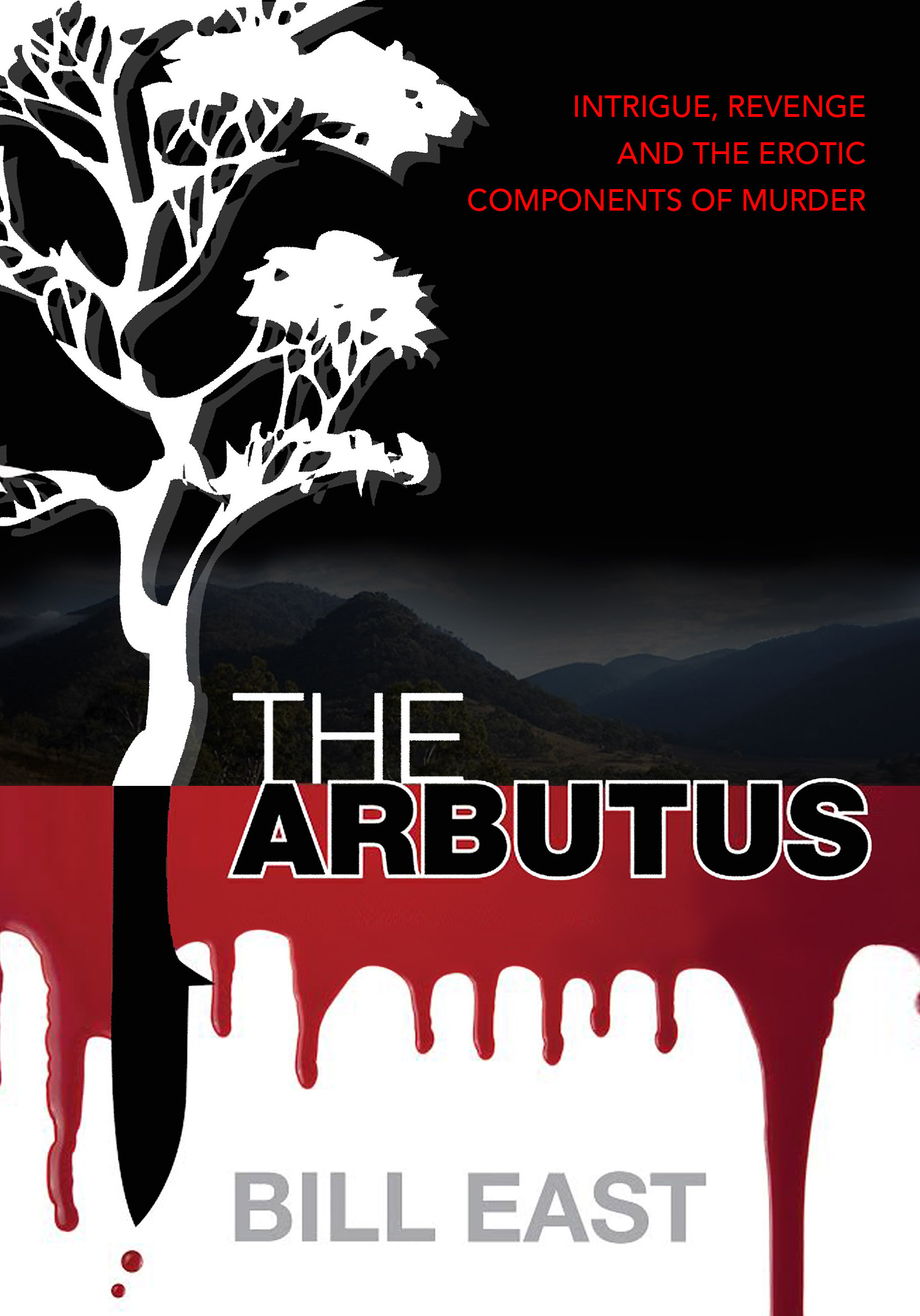
frontonlylo-res-arbutus-copy2-1Bill East’s The Arbutus is a dark and challenging novel that delivers a potent dose of madness, violence and erotic tension with the deliberation of a cannula. Maddie, a woman approaching middle age, returns from England to Peter, the Australian lover she fled many years before. Apparently unhinged and obsessive, Peter confesses to a series of murders at his wooded estate on the outskirts of Sydney. An intricate psychological game of revenge follows: The characters’ psyches are built layer by contorted layer; truths are offered and then undermined; the reader teeters on the edge of resolution, only to be pulled back into the game. Plausibility is often stretched to the limit (if the bizarre plot can be called plausible in any way): Is Maddie’s androgyny credible? Would Peter really have planned such a spooky endgame? On both counts, the author builds a convincing case for Maddie’s weird erotomania and Peter’s convoluted creepiness, and in the end, both their fates were easy to believe in. I rummaged in my reading history to find some novels that The Arbutus might echo. For the blending of the macabre and the world of nature (Peter has a thing about trees), I came up with Patrick Süsskind’s Perfume. For the exploration of twisted emotions, John Fowles’ The Collector and Sebastian Faulks’ Engleby came to mind. For gore, Jeffery Deaver’s The Bone Collector resonated. In the end, though, Bill East has created his own monsters. Crime thriller? Black comedy? Erotic mystery? Homage to trees? I didn’t care as I raced at top speed through The Arbutus.

You can find Bill East’s website here and buy The Arbutus here.

Smoking – the novelist’s best friend?

cleopatra
Cleopatra cigarettes: One of the stars of my novel Cairo Mon Amour

It’s been decades since I smoked, but I haven’t quite given up the habit. Having no desire to inhale burning vegetation these days, I still enjoy a vicarious smoke using the lungs of my fictional characters. In fact, smoking is a remarkably useful literary tool.

I identify four ways to exploit tobacco in fiction, but there are undoubtedly more.

But let me first offer a caveat: If you’ve never smoked, the remainder of this post might not hit that sweet spot: The hit you didn’t get from the first slim, black Balkan Sobranie outside a club in Soho; the hit you missed from the first gorgeous, toasted lungful of a Gitane outside Gare du Nord; the hit you could never experience from a mean-spirited little Players No. 6 after a meat pie and a pint in the Lawnmowers Arms somewhere west of Croydon.

Whoops, I slipped into nicotine reverie. Anyway, here are the four ways I use tobacco without actually smoking the stuff:

Historical setting: When I was a student at London University in the seventies, there were still ashtrays in tutorial rooms. Smoking wasn’t taboo. It wasn’t stigmatised. It was perfectly OK to inflict second-hand fumes on your tutor, or sit at the back of a plane filling the armrest ashtray with dog ends. But nowadays, only bad people smoke, and the best way to cast a negative shadow over a character is to have them light up. But good characters can reminisce about the Good Old Smoking Days. The shortest sex scene I ever wrote, set in 2011, goes, ‘Thea sat up, flushed and tousled, and pulled the covers around her. I lay back and mentally smoked a Gauloise’.

Social gradation: If you’re working in seventies England, as I am with my current work in progress, smoking is a wonderful index for where your characters fit into society: Working class characters smoke roll-ups and cheap fags (the Players No.6 is the epitome of poverty smoking, especially with a packet of ten rather than twenty). Better class smokers are more of your Benson and Hedges types, and homosexual men puff effetely on menthols. Elderly men in tweeds suck on pipes, and posh old geezers smoke cigars. Lesbians haven’t been invented yet.

Filling in a pensive pause: Want to fill a pause while your characters need to have a think? Let them have a smoke. You can tell that smokers are thinkers when you watch those wretched outcasts having a gasper outside the office block and pretending that they are pondering a takeover bid for CitiBank. The key to blowing a tobacco-induced thought bubble is to exploit the physical  and psychological details of smoking: Tapping the packet, finding the lighter, the first delicious puff, the sixth puff when you realise how much you hate being addicted, loathing the stinking ashtray. But what a boon for the writer, when a bit of internal monologue can be slipped into the moments of mental vacuum.

Male bonding: What did two blokes do in the Good Old Smoking Days when, left alone, they could find no words? They had a fag, and busied themselves with tapping the packet, finding the lighter, inhaling manfully, etc. Saves on dialogue!

Time for a Scotch, I think.

I write quirky novels about love, betrayal and redemption. Have a look here.