Great review of my latest novel!

Here’s a terrific review from an Australian reader:

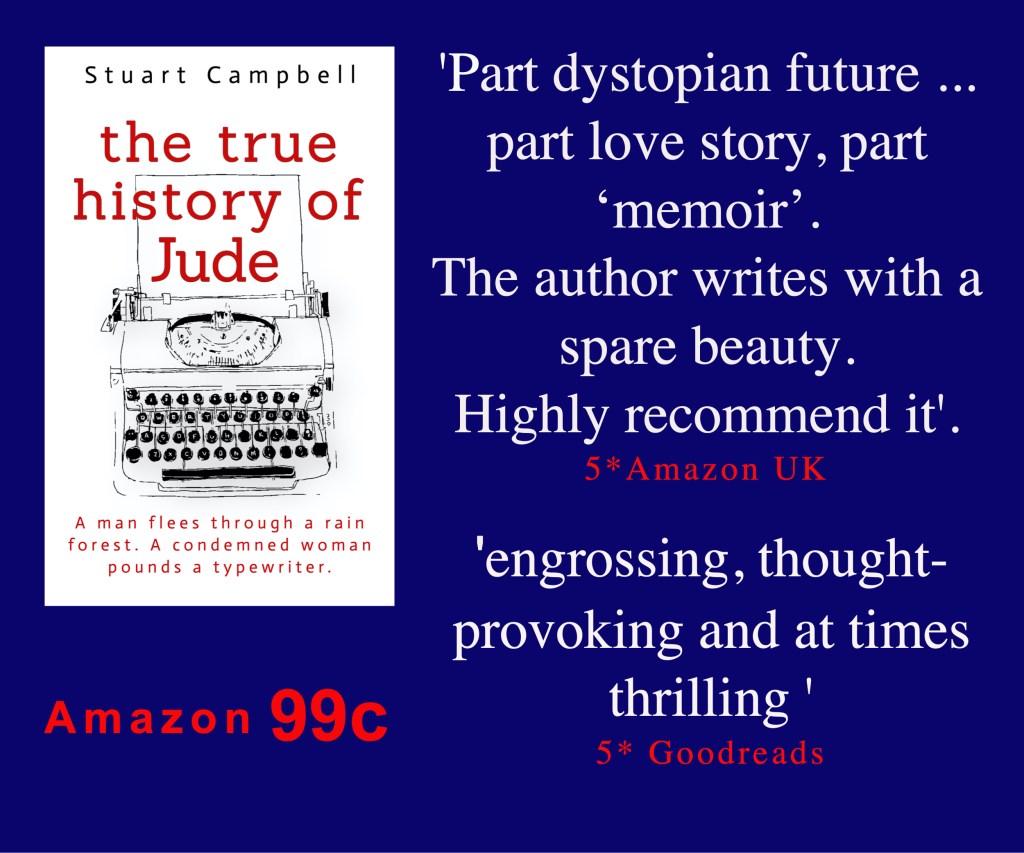
In The True History of Jude, Stuart Campbell dares you to look away from the world he presents on the page. But the thing is, you can’t. Told through an epistolary form, and through the eyes of young Jude and distinguished professor Sue (or is it?), the story traces their struggles and journeys–and ultimately their love–in a post-Australia world. The world-building is exceptional as are the characters who populate this story. The story brings front and centre the possible future of Australia, and the world, we currently glimpse in our peripheral vision. If you are after an intellectual dystopian love story, then I highly recommend The True History of Jude.

Click here for vendor links.

Young people don’t read novels by old blokes!

There’s nothing like selling your books at an arts market to learn about your readership demographic. I was quickly able to spot a potential buyer browsing at the stall. Amazingly they looked like me – over sixty, fashionably crumpled, and likely to visit an arts market! So this gave me some insights when I put some time this year into freshening up my backlist of five novels with new cover designs and updated manuscripts.

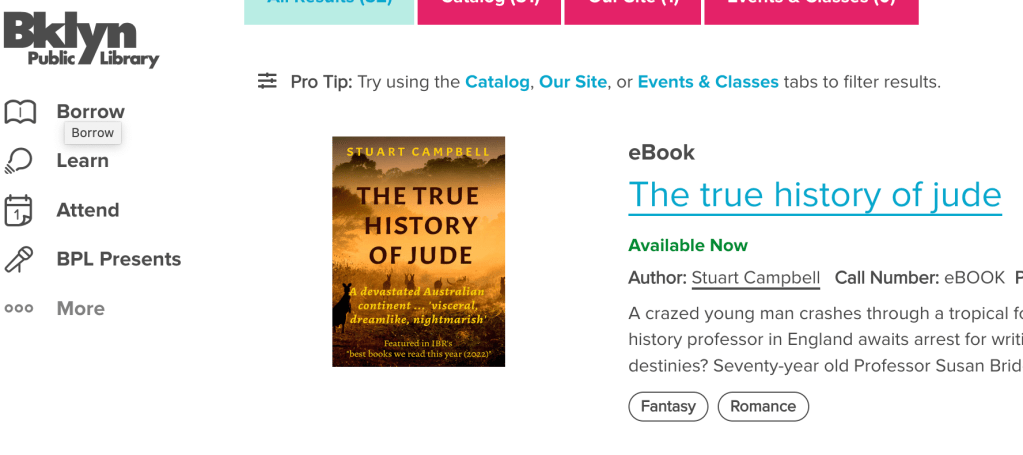
While Kindle, Apple and Kobo remain my main sales channels, I’ve produced new paperback editions that are available through an international distributor, making them readily available for libraries and booksellers to purchase. I was ridiculously excited the other day to see my latest book in the Brooklyn Public Library in the US.

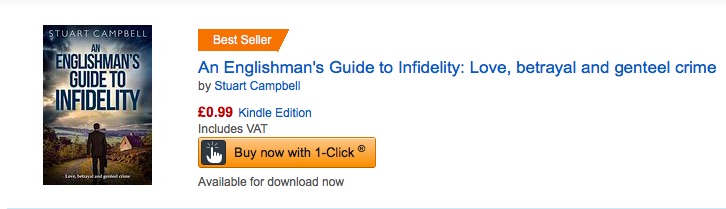
Sometimes I’m asked which of my novels is my favourite. Silly question – I love all my children. But if I’m pushed, my favourite is An Englishman’s Guide to Infidelity, which I first published in 2014. It’s my top seller with 2000+ Kindle downloads and sales, and it won a coveted Amazon Best Seller badge in 2016 – not bad for an independently published book. I should add that I have been exclusively self-publishing since parting (amicably) with my agent and publisher some years ago.

Here’s the blurb: Jack, the owner of a failing bookshop, is embezzling from a client. Thea is a philosophy lecturer with a taste for pinching cash. There’s something amiss with their marriage, but an occasional spot of larceny provides the frisson to keep it going, as well as the funds for the kids’ school fees. But things start to go badly wrong when an old lover turns up demanding a slice of the action. Could you live with a would-be murderer? This is the question for Thea and Jack in this fast-moving psychological drama with an undercurrent of black comedy.

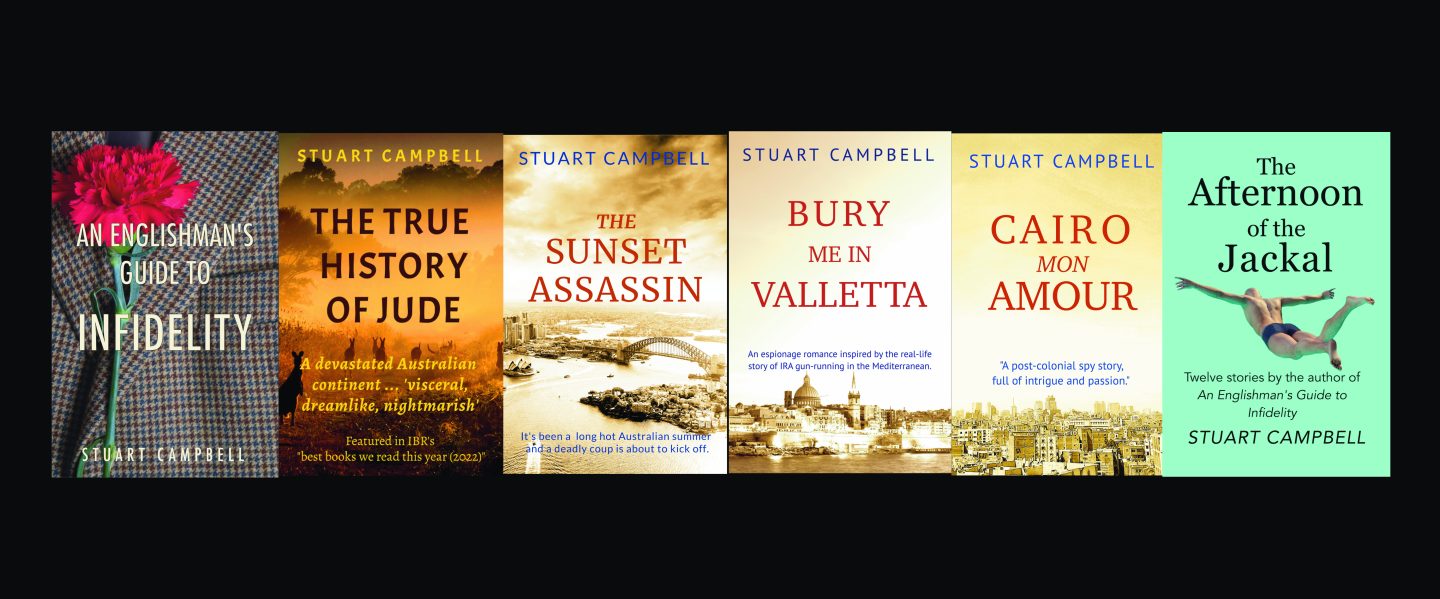
This book’s now on its third cover. For the 2014 version my designer compressed the main story elements into a romcom-style image with nail polish and fun fonts. The moody 2016 cover ditched the plot and tried to capture the essence of the male protagonist, as well as tying in with covers in the same style for two other novels. The 2023 cover makes no direct reference to plot or character, but unashamedly appeals to an older demographic, the key readership of this book. If I’ve learned one lesson in promoting An Englishman’s Guide to Infidelity, it’s that novels by old blokes aren’t read by young people.

Here are some lovely things people have said about this book on Amazon and Goodreads:

‘A fascinating tale I couldn’t put down. Told from three very unique points of view. Two deaths. Murders? Or accidents? It depends on who’s talking.’

‘I was engaged from start to finish, relishing the descent of ordinary people into the seamier side of life that slips beyond their control into unimagined complications and implications with surprising consequences.’

‘… realistically, funny portrait of a man struggling to do the right thing by his wife and family’

‘… a riveting psychological bender touched with wit and imperfectly charming characters.’

‘A thoroughly enjoyable read, a mystery that unfurls with just enough twists and turns to keep readers guessing right to the closing pages.’

‘… funny, irreverent, witty read. A brilliant story, fast paced and fun, told from three different points of view, with an element of mystery thrown in. Couldn’t put it down.’

‘… it has that intangible ingredient that forces the reader to read one more chapter in the hope that all will be revealed.’

And here’s me on a literary research trip back to the UK, the Raven Inn at Bath to be exact.

Find out more about my books here – especially if you’re an older reader!

Seven new stories – seeking feedback

After writing six novels, I need a break from emotionally draining two-year projects.

Over the last six months I’ve immersed myself in short stories – reading some of the best authors of the genre, and learning the craft of writing an entire work in 2000-3000 words.

I’m hopeless at remembering what I read (I’ve been promising for years to keep a list), but the standout short story authors have been Hilary Mantel, Peter Carey, Seamus Deane, Lucy Caldwell, and Wendy Erskine. The latter three are from Northern Ireland, and I chose them to help get my creative mind in good shape for a visit to Belfast in May 2023; one of my projects is to develop a piece of biographical short fiction based on a fragment my late father wrote on his early life in Belfast.

The Northern Beaches Writers Group, based at Manly here in Australia, have been a great support in critiquing one of my story drafts and exposing me to local short story writers.

And to show I’m really serious about this, I’ve entered stories in four competitions!

I have a collection of seven unpublished stories that I’d love to get more feedback on. The stories are mostly set in Australia and range from An Afternoon under the Paperbark, where a hidden observer witnesses a deadly family bust-up on the lawn, to Your Own Luck, a tale of desperate man who jumps off a cruise ship in search of a new life.

If you want to receive a copy, email me at stuartcampbellauthor@gmail.com .

HAPPY READING!

The True History of Jude is featured in IBR’s “The Best Books We Read This Year (2022)”.

I’m delighted that Independent Book Review has featured The True History of Jude in its “The Best Books We Read This Year”. You can find the full list here.

Many thanks to my readers for supporting me in 2022. After writing six novels, I’m turning to the short story format, and I’m lining up a number of competitions to enter in 2023.

To give you a taste of what I’ve been writing (working titles only):

An Afternoon Under the Paperbark: A family self-destructs in plain sight.

The Afternoon of the Jackal: A bizarre addition to a Christmas lunch in Sydney.

Your Own Luck: A man decides to stow away on a cruise ship.

Thanks, Dad: A university Vice Chancellor resurrects skeletons from his past.

Belfast: A story based on an autobiographical fragment by my late father.

Happy Christmas!

“Book Review: The True History of Jude” Reviewed by Erica Ball

The story of a rebellious woman and the power of our stories, even in a world where truth is not welcome 

The True History of Jude is an epistolary novel about a bleak dystopian future in which the geopolitical structure of the world has drastically changed. Due to massive environmental upheaval caused by climate change, many countries, including Australia, face grave uncertainty about the future of their cities and the people who live in them.  

When a pivotal moment strikes in the form of a tsunami, a complex political plan years in the making is triggered and the fates of millions are rewritten in an instant.  

One hundred years into this new world order we find Susan Bridehead, an eminent historian. We learn about her through letters to a friend in America she calls Alex. She has been tasked with writing the history of her country from its inception after the tsunami, but her history must be approved at the highest levels, and so it must match the official version of events. Basically, it must not tell the truth.  

At the age of seventy, Sue is experiencing worrying symptoms and is convinced her body is in decline. Perhaps this is why she dares to defy the law and begin to write what she calls a “true history,” namely the story of her prior life in the lawless lands back in Australia. Curiously she tells the story through the eyes of someone she knew there, Jude, rather than her own.  

Because of this, the reader is never really sure how much of Sue’s story is actually true. Everything we see is in either a letter to Alex or Sue’s version of events as she thinks they might have seemed through the eyes of Jude. Add to this the fact that memories are often unreliable in and of themselves, and the whole book is given an eerie dreamlike feeling. It really does make the mind go in circles.  

Fittingly, the elements of Jude and Sue’s backstory—the setting, people, and challenges to cover basic necessities—are visceral, but similarly dreamlike and even at times nightmarish. Their story takes place among the people left behind on the devastated Australian continent. They are complex and imperfect people trying to make any kind of life for themselves and make any kind of sense of this horrifyingly imperfect world.  

They must navigate a society in which the systems that are supposed to be in place need to be reinvented and completely rebuilt. After the collapse, everything needs to be figured out again: language, religion, economy, currency, power, goods, labor, basic know-how, and craftsmanship. And every one of these is open to being corrupted or perverted by the wrong person. Every community is left to its own devices and so evolves in its own way. 

It is striking how different people react to the same events in drastically different ways.  

Though very accessible to any genre reader, this book is highly recommended to those interested in near-future stories with chillingly possible trajectories. The political and social issues depicted are thought-provoking, and thus it would be excellent for book clubs that enjoy serious discussions. 

In many ways, it is a thought experiment with a terrifying premise: What would happen if the greatest powers in the world—those of government, military, and corporations were to join forces or be joined under a single will? As such, it is a look at how change can come gradually or in a single cataclysmic event. Of how freedoms can be slowly whittled away even if it’s obvious what is happening because no one has any idea what to do about it. Is there even anything to do about it, once such forces are at work?

Thank you for your interest in my latest novel, available here on Amazon (Kindle and paperback), Apple, Kobo, and other vendors – Stuart Campbell.

The Sunset Assassin gets a cover makeover

I’ve just updated the cover for The Sunset Assassin using an image licensed by Shutterstock. Instead of editing the image with a graphics program, I used Shutterstock’s built-in editor, which is terrific for simple jobs involving a single image.
I’ve used a consistent format for all of the Siranoush Trilogy novels: A bleached sepia image of the city where the novel is set (Cairo, Valletta and Sydney) with the title in a russet serif font, and a dark sans serif font for the author and the text at the foot of the cover.

Here’s the back cover blurb:

Sydney, New Year’s Day, 1978. While the beaches teem and the cold beers flow, a clandestine syndicate is planning to overthrow the Australian government. They’ve commissioned dodgy businessman Kerry Rich to detonate a bomb at the Opera House on Anzac Day. He’s passed the job on to Pierre Farag, a reluctant British sleeper agent dumped in Australia. But Pierre and his wife Zouzou want out — out of Sydney and out of doing other people’s dirty jobs. Meanwhile investigative journalist Liz Lanzoni has got a sniff of the bomb plot and sees the chance to break the story of the decade. As the day of the blast looms the operation unravels, and Pierre, Zouzou, Liz and Kerry find themselves on the run to a hideout in the northern tropics of Queensland. Soaked in the hedonism and corruption of late seventies Sydney, The Sunset Assassin traces the fine line between loyalty and betrayal.

Let me know what you think of the cover. And check out my books here.

5-star reviews for The True History of Jude

I usually write psychological thrillers and espionage stories, but I stuck my neck out with this book. I resisted advice to make it fit a genre. I wrestled with the text for six years.

Now the feedback is coming in, and I’m delighted with the positive things people are saying.

I think its the best book I’ve written.

Is it a dystopian thriller, a time-shift romance, or coming of age story? You be the judge.

See vendor links here.

My nightmare (satirical) projection for the future of the university

‘At my first lecture this year, I had to ask all the ladies wearing tall wimples to sit at the back,’ writes Professor Susan Bridehead in my genre-defying novel The True History of Jude.

The book combines a coming-of-age-tale, a time-shifting love story, and a reimagining of a Thomas Hardy novel—all embedded in a dystopian setting.

And as a fantasy, it gave me the power to project a set of contemporary themes to their potential extremes: I predicted a climate-ravaged and depopulated Australia leased to the world community for uranium mining, a corporatised global authoritarian system controlled by an Australian royal dynasty, and the destruction of artistic creativity under the crushing conformity of an information monopoly.

Could it happen?

When I was studying Russian in the USSR in 1974, could I have imagined the fall of the Soviet empire? When we basked in the Australian summer of 2019, could we have imagined a pandemic that would upend the world?

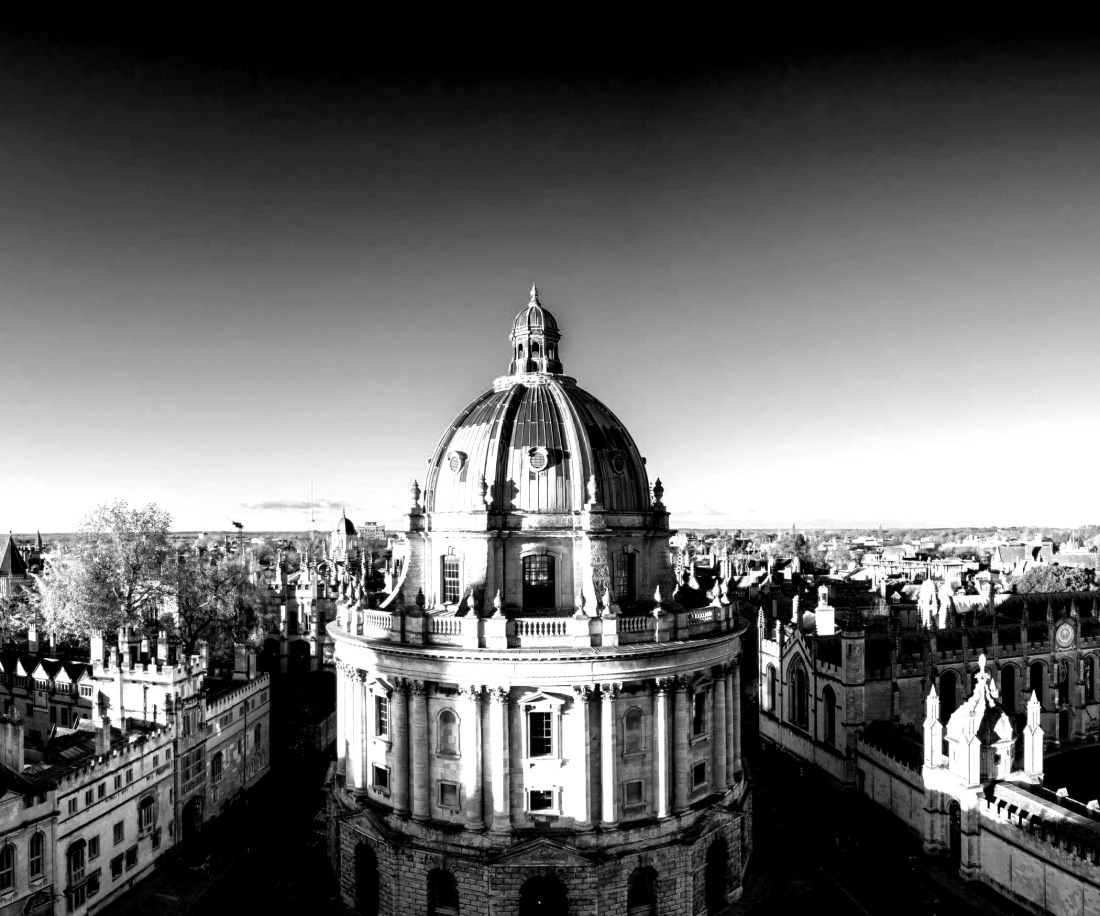
Back to the wimples: The Australian monarchy is the world’s first virtual state, having excised itself from its own territory*. The Palace operates from leased premises at Oxford University. Across the city is the exiled campus of my alma mater The University of Sydney. It’s from here that the elderly Susan writes fawning hagiographies of the Australian royals and teaches history to their offspring and aristocratic cronies whose royal stipends make it unnecessary for them to get jobs. The students return year after year to take the same courses, some even passing away from old age during lectures. Cosplay is a campus obsession: This year’s theme is Medieval, thus the tall wimples blocking the lecture hall sightlines.

It’s satire of course, but I’m certain that many academics will identify the threads I’ve pulled to weave scenarios like these: The banning of paper and handwriting so that all student work is created and archived online; the obligatory use of AI text generators to write assignments that result in randomly generated grades; works of fiction proscribed; professionals trained not at the university but in online polytechnics run by a consortium of three global consulting companies.

I’ve spent decades of my professional life helping create Australia’s higher education system. What I observe today is a quantum leap away from the undergraduate degree I took in the UK in the seventies—no internet, no credit point system, no fees, no student support service, no assignment mills, no student surveys, no casual lecturers. My future scenario for the university in The True History of Jude may seem outlandish, but the threads are clear to see today.

*The Australian Parliament excised the mainland from Australia’s migration zone in 2013.

Copyright 2022 Stuart Campbell

To check out The True History of Jude and my other books click here.

Image used under license from Shutterstock.com

Free Kindle download – last chance 27-29 September 2022

I’m offering a final free download of The True History of Jude on Kindle 27-29 September.

From 1 October, I’ll be widening my retail platforms to include Smashwords, Apple, Kobo and others. Jude will still be on Amazon in Kindle and paperback.

Here’s what people have been saying about my latest novel:

When I started reading “the true history of Jude”, I was completely taken aback. The back cover describes it as “a dystopian thriller” and that is exactly what it proved to be. To say that I enjoyed it, is an understatement. It is completely different from all your other writing.. But different in an engrossing way. The style of writing, the characters, the structure of the book are really terrific. Much of the book is in the style of letters (forbidden) between two principal characters and it is through the letters the story emerges. Although the book has no resemblance to “The Time Travellers Wife”, it left me with the same feeling I had on completion of that novel. The feeling can only be described as sitting back, putting the book down and going “Wow, that was an amazing story.” I admire the way you imagined the future and the repercussions of several events that precipitated that dystopia. I’ll leave it to other readers to discover what happened. Stuart, it’s a great book. I loved it.

Check my books out here!